
Washington Week with The Atlantic full episode, 10/16/26
10/16/2026 | 56m 46sVideo has Closed Captions
Full Washington Week with the Atlantic broadcast from October 16, 2026.
Full Washington Week with the Atlantic broadcast from October 16, 2026.
Problems playing video? | Closed Captioning Feedback
Problems playing video? | Closed Captioning Feedback
Major funding for “Washington Week with The Atlantic” is provided by Consumer Cellular, Otsuka, Kaiser Permanente, the Yuen Foundation, and the Corporation for Public Broadcasting.
Washington Week with The Atlantic full episode, 10/16/26
10/16/2026 | 56m 46sVideo has Closed Captions
Full Washington Week with the Atlantic broadcast from October 16, 2026.
Problems playing video? | Closed Captioning Feedback
Where to Watch Washington Week with The Atlantic
Washington Week with The Atlantic is available to stream on pbs.org and the PBS app.
Buy Now
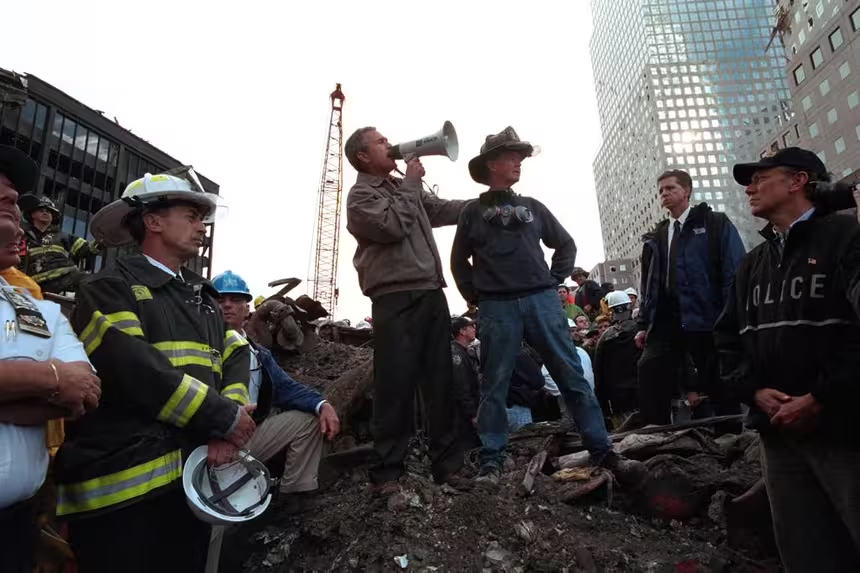
10 big stories Washington Week covered
Washington Week came on the air February 23, 1967. In the 50 years that followed, we covered a lot of history-making events. Read up on 10 of the biggest stories Washington Week covered in its first 50 years.Providing Support for PBS.org
Learn Moreabout PBS online sponsorshipTonight on a special edition of Washington Week with the Atlantic, the fight to control Congress, live from the battleground state of Texas.
Next, this is a special edition of Washington Week with the Atlantic, the fight to control Congress.
Corporate funding provided by Consumer Cellular.
Additional funding has been provided by friends of Washington Week with the Atlantic, including William C. Paley Foundation, George D. Hanby III in memory of Mary Jane Bunny Glick and of his brother Jay Hanby, Charles Hamoy through the Charles Hamoy Fund, Steve and Marilyn Kerman, Leonard and Norma Chlorine, Don and Janine Blom, Maria and Walter B. Witcher and the following individuals and by contributions to your PBS station from viewers like you.
Thank you.
And now from Austin, Texas, editor-inchief and moderator Jeffrey Goldberg.
Good evening and welcome to Washington Week.
We're coming to you tonight from Austin PBS in front of a live studio audience.
Early voting begins here in Texas on Monday, and the outcome of the race between State Representative James Tarico and Attorney General Ken Paxton could determine which party controls the Senate in the final two years of Donald Trump's presidency.
The biggest questions are on the table tonight.
Is there a blue wave coming?
What would the Democrats do if they managed to take control of one or both chambers of Congress?
And how will Donald Trump rule in the last two years of his presidency?
should he find himself living down the street from a Democratic controlled capital.
There's an even more immediate question before the country.
Will Trump or his supporters challenge the election results in conventional or unconventionally dangerous ways should they lose the House or the Senate?
And there's one more question.
I call it the the World War II question.
How will Donald Trump manage a destabilized world, one in which America's support for its allies can no longer be assumed?
We have a great panel to discuss all of this tonight.
Mark Leovich is a staff writer at The Atlantic and the author of, among other bestsellers, This Town.
He is a former reporter for the New York Times and the Washington Post and is known as the foremost anthropologist of Washington.
Ashley Parker covers the White House for the Atlantic and is a multiple Pulitzer Prize winner.
She previously served as White House bureau chief for the Washington Post.
Vivian Salama covers national security for the Atlantic and previously covered global affairs in the White House for the Wall Street Journal.
And Evan Smith is the managing director for events at the Atlantic and also hosts Overheard on PBS right here in this studio.
He is the founding editor of the Texas Tribune and he's something of a local legend.
Thank you all for And he's the next governor of Texas, right?
Yeah.
Yeah.
Yeah.
Um we haven't announced yet, but we're just I'm just assuming that The early polls are are good.
Evan, thank you for being here and hosting us in your in your home studio.
We're very glad to be um with uh such a great audience.
Um we have a lot to get to tonight.
Uh and before we talk about the midterms, um I you know, the world intrudes as it tends to do.
We just saw a dramatic Uturn, I guess it's another dramatic U-turn in President Trump's attitude toward Ukraine and and Russia.
Last week he decided to buy billions of dollars in diesel from Russia which makes Putin much richer at a time when he needs the money.
Um and President Trump has spent the week uh deriding uh President Zalinski of Ukraine.
He told uh an interviewer this week that he feels uh well this is Zilinsky talking about Trump that he feels betrayed by the powering down of Starlink.
that's the um uh communications that that that that uh we've been using.
Um and he feels betrayed by the diesel deal and he said quote, "It's a pity that we're losing a strong partner."
I was really struck by how final that sounds.
But Viviian, give us a a sense of what's happening, why it's happening, and what it means.
Oh, well, there's a difficult question.
Um but I will try.
So, um, and you have 12 seconds.
And I have exactly 12 seconds.
I, you know, President Trump has never shied away from the fact that he's been skeptical of Ukraine, its leadership, and this dates back to his first term.
Remember, in the first term, you had the so-called perfect call with Zalinski when he first took office that ultimately led to the first impeachment because he asked President Zalinsky to uh investigate his political rivals.
And so, you know, since then, President Trump has sort of had a grievance.
He also has an affinity for Vladimir Putin.
He likes the way that he runs his country.
It's sort of this all powerful way where he can kind of um you know put down journalists and political dissident and kind of rule with an iron fist and it has been very appealing to him.
He sees him as a strong man and that's something that appeals to him.
And so when Russia launched its war, first of all, it's a full-scale invasion of Ukraine in 2022.
President Trump a insisted that that would have never happened on his watch that Putin respects him too much to have done that.
But then secondly, he also decided that he would resolve this conflict overnight.
He hasn't managed to do that and he sort of tried partially because he had a lot of people around him pushing him in the direction of Ukraine.
Ukraine is an ally.
It's, you know, the doorstep of Europe.
You have to help.
And so he's entertained that idea for the first year of his presidency.
But over time, he um increasingly believed that the only guy he needed to talk to, the only guy who matters in this is Vladimir Putin, right?
Because he's more powerful.
He's the one who's going to change things.
And so, he's really kind of leaned in on that and as a result has come a price for Ukraine, both in terms of the deals he is making with Russia and the deals he is willing to kind of pull back on with Ukraine.
Yeah.
Ashley, you you have a PhD in Trump's behavioral patterns.
um UT Austin I think right.
Yeah.
Yeah.
Um and the question is is we we periodically go through these phases where he seems supportive of Zalinski, but from your perspective, does Trump ever change?
In other words, the the the the the impulses that he has seem to there's a a little bit of a sign curve, a roller coaster maybe, but he always comes back to the same ideas.
Yeah.
On his c I mean there's a sense that Donald Trump is not particularly ideological, which is both true and not true.
um which is to say that on his core set of beliefs, he's sort of frozen in amber in the 1980s and the views he held then being hardline and kind of nivist on immigration.
Um the views he had on trade, frankly, the views he had on Iran, um those are very unchangeable.
um you know in the margins he is often swayed by charismatic personalities by what he last saw on TV by the last person to call him on the phone or leave the oval office but on these big things he fundamentally doesn't change um which when it comes to geopolitics one of the things as Vivian just mentioned that he likes he likes strong men he likes strength and power when he was first elected to the presidency he thought that it was a bit more like a monarchy right he was kind of genuinely ly befuddled that Congress had to sign off on on laws and he couldn't just dictate these things.
Um and so I think Congress might be befuddled about that.
Yeah.
Everyone's deeply confused.
Yeah.
Um and and so at the end of the day, he sort of believes as as he said famously in that Oval Office blow up that Zilinsky doesn't have the card.
Zilinsky is operating from the weaker position and Trump who is desperate, desperate, desperate for a Nobel Peace Prize and wants this deal.
In his ideal view, he he would get the deal by Zalinski just capitulating with his quote unquote mediocre cards.
One question before I go to Mark on a on a question about history.
When you you talk about these patterns being set in the 1980s, I'm not asking this as a joke, but what was the key year?
Was it 79 the Iran hostage?
No.
Because it's really remarkable that there's that there's this level of multi-deade consistency in his views.
What he thought about Iran in 1979 is what he thinks today.
What he thought about trade in 1982 is what he thinks today.
Was there like a was there a moment when something coalesed in him where he developed his worldview?
I mean, I can't pinpoint it to a particular year or a particular month that that would make a great oral history, but I you could just say June 13th, 1981 and I'd believe you, you know, but but I I would say kind of the 80s as he's coming up as a you know, the the boy uh from the outer burrow made good.
I mean, even some of those other things are still there within him.
And these are not policy things, but there was this sense that he had finally gotten to Manhattan.
Um but he was not taken seriously by the he was sort of gouch and and a little crude and even that sense of outsiderness is something in the chip on his shoulder that you see I mean a that's how he relates to his base in certain ways but it's something that that is still with him.
I mean people joke or half say seriously that maybe one of the reasons he ran for the presidency was because he was so embarrassed by Barack Obama at the White House correspondence dinner.
who you know who knows if that's an origin story but it does get to those those pathologies that were formed as some of us were there and Trump did not look happy at that that moment actually the uh Mark let me ask you this about Trump and Trumpism um it's a a very deliberately oversimplified question but is there anyone in American politics like Trump in his ability to just sort plowed through uh things uh phenomenon that that would that would sink any other political leader.
Oh, not not even close.
No, I mean I think that we've seen this again and again.
I mean, you know, in many categories, one being things that other politicians would end their career.
Um, you know, we've seen from from the beginning.
I mean, that doesn't apply to Donald Trump.
And I I think that that's going to inform the the very messy I think succession to him in the Republican party because you know JD Vance whoever you know tries to be the air parent is going to find that those rules do not apply to him or her.
And I think so that well go back it's the almost the the the 10th anniversary of Trump's first term in office.
go back and and with everything that you know now, what are the qualities of Donald Trump that made him this unique uh gravitydefying candidate?
I mean, I think one of the superpowers is just the shamelessness, just his inability to be uh sort of confined by the rules of embarrassment, by the room, the rules of norms, by the rules of, you know, what will history think of me?
I mean I remember during the end of his first term uh there was all this kind of polyianish talk about well Mr.
President don't you worry about how you'll be remembered in history and he like and others around him like you know Rudy Giuliani and others would say no I'll be dead or you know I'll be remembered as a loser.
I mean it was very black and white but but it's also very much I mean you you do realize that the check and balance of the White House begins with the conscience and the character of the president him or herself.
Right.
Right.
Right.
Um, before we before we jump and we'll talk about the Trump legacy a little bit and before we jump to Texas and and national politics, I want to ask one more question about some news of this week.
Vivian, you've been covering uh the controversy over uh the execution of Nidal Hassan, the convicted terrorist who uh carried out the Fort Hood u massacre.
Pete Hexet, the secretary of defense, wanted to televise that execution.
That was too much for Donald Trump.
He just uh said no to that.
Can you tell us what happened inside the White House?
So Pete Hags, that sort of surprised everyone, including people at the White House when he came out and he had not cleared that with with President Trump.
Well, that the the people that we talked to, the sources we talked to say that they were blindsided by it.
And even if he did consult with President Trump, um he may have sort of processed the idea that there was going to be a firing squad um execution, but not that it was going to be televised with the president, that that didn't really kind of sink in.
And so when the president sort of realized it, partly because Pete Hagath announced it last week, um he was taken aback.
He was getting t he was inundated by calls including from Republicans, including even from people in his inner circle.
um Speaker Mike Johnson very um wary about the whole idea and this concept of you know a public execution of a parapolgic um an old man who was a parapolgic just did not sit well with the president and of course people even though the paraplegic was a mass murderer even though the parapolgic was a mass murderer and eventually when the president revealed that he would uh pull back on this live streaming he you know started with the idea that this man is a terrorist and deserves to eye in his view, but live streaming it will not happen.
This obviously raises questions about Pete Heg, Seth.
Uh it it it also raises questions about about his management of the Department of Defense.
It also raises questions about his future political judgment.
I mean, he is one of many people.
We obviously have Marco Rubio and JD Vance in the in the first two just conventional wisdom says that they're the two most likely nominees at the moment.
But Hegathth is has uh expressed a great deal of interest in electoral politics.
Does this hurt Heg Seth either in his current role or in his future?
I mean, there's been so many episodes in which Pete Hgsth has sort of um you know, kind of hit rock bottom and then somehow, you know, Yes, I'm aware of that.
I was involved in that.
There you go.
Um and somehow he he comes back from it in part because he almost knows how to speak President Trump's language.
He's very good at sort of putting himself out there on television and making these sort of campy videos with of show shows of military bravado and insulting the performance parts and insulting journalists and things like that.
And that resonates with the president even if literally everyone around the president kind of soured on him at one point or another.
Um, and that's been pretty consistent.
President Trump for some reason has just continuously believed that he is effective in part because he takes orders.
Right.
Right, Evan.
Evan, Jeff, um, on behalf of the 49 other states, could you explain Texas to us?
I cannot, um, I can Well, all right, then we're going to pivot to the earned income tax credit.
Mark, I I can tell you that it is the middle of October.
We're sitting here in an election year talking about whether Texas elections are competitive, and that is not something that we're used to in the state of Texas.
It has been more than 30 years since elections in Texas have been competitive.
The last time a Democrat was elected statewide in Texas.
The number one song in America was by Boys to Men.
That's how long ago it was.
November 1994.
That was the year that George Bush beat Anne Richards.
Other Democrats on the ballot won.
And since then, no Democrats have been elected.
We are looking at the possibility of a Democratic United States Senator from Texas and possibly other Democratic statewide officials.
And no one really can believe that we're here 3 weeks out, right?
I mean, there's good reason not to believe it, but let me let me give you a couple of names to to uh go against the the the feeling of novelty.
Betto oor Colin Alred, right?
Uh Tyler Rico is obviously raising tons of money, right?
Um and and and getting a lot of excitement around his name.
I mean, and it's all the more surprising because he scans, at least to me as an outsider, as someone sort of socioulturally closer to like the Brooklyn liberal model, uh, rather than some kind of But it tells you something about this election that James Telerico is running ahead of a generic Democrat and Ken Paxton is running behind a generic Republican.
Yeah.
Right.
That's that's one of the reasons that this race is so close, candidate quality.
And the only reason the only reason I bring up those two names is that there was a lot of excitement around them and and and for for whatever set of reasons, right?
And maybe it's structural, maybe there's just simply more Republicans than Democrats in in a dispositive way.
For some reason, Democrats can't get over that hump.
This is not like Kansas, which never I mean, now it's competitive, but never had, you know, never had these this that run of close calls for the Democrats, if you will.
So, so I'm not asking you to predict what's going to happen, but I'm asking you to predict what's going to happen.
What's going to happen?
Okay.
Well, let me let me first of all push back on you.
Colin Alred was never really competitive against Ted Cruz in that Senate race.
Betto is a better analogy.
It was a Trump midterm in 2018.
It's a Trump midterm now.
But there are a couple of things that are different this time versus last time.
The first is that the political environment has migrated down to the level of Texas voters in a way that it had not in 2018.
Turnout in 2018 in Texas was unusually high for a midterm, but people in Texas, both Democrats and Republicans, both urban voters and rural voters, are pissed off this year in a way that they were not in 2018.
That is a motivating factor in this election.
The second thing is that the issue set this time is working against Republicans in a way it did not in 2018. the economy, data centers, flock cameras, vouchers.
These are all issues that are cutting against Republicans in poll after poll.
The candidate quality thing I mentioned is a big deal.
But I would also say that the dynamics of the electorate are very important.
Latinos who voted Republican in the last election have swung all the way back according to every single poll.
The the Republican party, I'm told by people in both parties, is collapsing in the Rio Grand Valley.
a number of the seats they redist and that to remind our national audience that is a very very heavily Hispanic region majority Hispanic counties that are along the border and in South Texas where they re a lot of families that that have border police or or I I mean they're they they they lean it can lean conservative it can lean and we're probably susceptible to the idea that we're going to deport criminal migrants but they're not happy about deporting your gardener from the Home Depot checkout line right the the fact is that the the swing back of Latinos to the Democratic party is going to cost Republicans a number of those seats that they redrrew famously, right?
Can I just bring in Ashley for one second on this because I don't understand the the internal White House deliberations on these just on a pure political on a pure level of politics these deliberations u I would imagine that you know on one side you have Steven Miller who says deport as many people as you can and and and Hispanic support or non-support be damned and you have a lot of other people who are more politically sensitive to midterms among other things who are like maybe we should ease up a little bit because we did actually do surprisingly well with Hispanics.
What What What's the dynamic there?
Well, I mean, there is a misconception that the Hispanic vote is monolithic and turns on immigration.
Um, and and that's not the case.
Um, a lot of Hispanic voters uh who came here illegally or whose families came here illegally want other people to do the same, right?
So, so a lot of that appeal was uh economic votes.
Um, that's the first thing, which is also not going well now.
Um but but the second thing is that yes, Ste Steven Miller is incredibly hardline on immigration as discussed.
It's one of those few core political values that Donald Trump also shares with him.
Um but there is this irony where Republicans do benefit um and and Democrats to their peril on being tough on border security.
That is sort of a norm in the United States.
Um, but it gets to what Evan was saying, the sort of rounding up people who are just waiting in a Home Depot parking lot to try to go to work and work hard or someone's babysitter.
Um, and of course what we've seen in the states, not just in Texas, from ICE, um, the the murders.
Um, there was a real backlash in in the country.
It ends up diminishing what a lot of people see genuinely as a national security issue and it turns it into a culture wars issue that right now when people can't afford to their gas, they can't afford groceries that becomes very quickly diminished.
I think what you're what you're saying is that for a lot of people in the Trump universe, including maybe Trump himself, it is more of a culture war issue.
You wouldn't be targeting the people you're targeting if you were simply trying to enforce existing law on the border.
I think they do genuinely view it as a national security issue, but they have implemented it as part of their culture wars.
Right.
Right.
I mean, Mark, what's interesting here is that is that both parties have stumbled on immigration for opposite reasons.
The Democrats, the Biden administration did not take border security, border security seriously, much less what's going on inside the country.
And the Trump administration has moved way past the border, way north of the border, let's say, um to just sort of randomly or not randomly but very deliberately go into northern cities and start looking for illegal immigrants who are living responsible, quiet lives.
Yeah.
No, I mean the the irony of this is that Donald Trump did get elected largely on this.
I mean this was a huge issue for him and he also did a really I mean people perceived him as doing a really good job securing the border.
I mean, if he had just quit after however long it took to to feel like the border had been secured and not gone ahead with the with the next iteration of the ICE raids and the Home Depot, you know, just like the seizings and so forth, um he this would have he this would have been a great sort of thing for him to boast over, but he sort of let it run out of control, right?
Can I say something about the culture war just on this and to come back to the Telerico race?
Hundreds of millions of dollars have come into this state from out of state to put ads on during football games and everybody in Texas watches football that have been about trans kids.
If you look at the voters preferences on issues this cycle, issues related to trans Americans are at the very bottom.
This is an election about the economy.
I think what's we're gonna know this on November the 3, but I think what we will say is the Republicans lit hundreds of millions of dollars on fire running culture war ads in an election cycle that was still about the economy stupid diesel.
It's about the economy.
It's about the econom.
So, just to take it a step further, the reason that Kamla Harris she's for they them not you ad was so effective um during the campaign was actually in talking to both Democrat and Republican operatives, it was less about the actual trans issue and it was again in a moment of economic peril.
What it was signaling was she's she's not focused on what you care about.
She's not focused on prices and on your daily life life.
That's why it was so devastating.
But now it's the exact opposite.
Things Donald Trump is doing like talking non-stop about the ballroom, right?
He's asked a question about Iran and he holds up a huge poster board of the the Gilded Ballroom.
Um that sends the exact same signal to voters.
You're going to three supermarkets in order to use all your coupons and afford your groceries and this is what he cares about.
If I were if I were running for office right now, I would I would turn the ballroom into a data center and then point all the flock cameras at it.
Yeah, that's why I'd be very successful politician.
No, no, you know, it's interesting.
You mentioned the money that's coming into the state, which I guess is good for the people who live in the state.
Um, but or at least the TV buyers in in the state.
Uh our our friend Leanne Caldwell reports that uh the $500 million in combined spending so far and and the estimate is that the $368 million more than Republicans were planning on spending in this race.
That's a lot of Well, it's an enormous amount of money.
And again, it's possible that all this money never would have saved Ken Paxton.
We're going to know the outcome of this race soon enough.
But one scenario here is that money could have been better used to save John Hugh said in Ohio, to save Dan Sullivan in Alaska, to save any number of other candidates.
The Kansas race, which is suddenly competitive, that money might be more helpful in Kansas ultimately than in Texas.
Yeah.
Mark, I want to ask you about um the Democrats on this.
They Democrats have a pretty bad record of picking candidates.
Remember Graham Platner?
It seems like a million years ago, you know, people people loved Graham Plat.
No, but the Republicans have done, let's be be honest, they've done quite a job on themselves here in Texas in terms of picking uh a a a a fidly fidly unconventional candidate.
I would say they are fidly unconventional to be kind.
Yes.
Yes, I would say that that is I was just looking for vocabulary words.
You know, it was a great it was a great turn of phrase.
Oh, thank you very much.
But uh so so so talk about that and talk about the particular Trump dynamic that led to the Republicans picking possibly the worst candidate they could find to run against obviously this this young and exciting liberal Democrat.
Yeah.
I mean look I mean Donald Trump got directly involved in the Texas race.
Um he did not endorse John Cornin as many were hoping he would and who would have been a much stronger candidate and we might not even Cornin would have won probably.
I I would have absolutely been the favorite.
There's no question.
I mean there are other incumbents like John Houston in Ohio and Dan Sullivan in Alaska who are in big big dog fights.
But I think uh Cornin was definitely seen as a stronger general election candidate.
I I would give Democrats and Chuck Schumer in particular some credit for recruitment.
I think, you know, especially after they kind of got rescued from Platner by events, um they have a pretty good crop of Senate candidates.
Um Roy Cooper in in North Carolina, shared Brown in Ohio, Mary Pelto in Alaska, Terico here.
Um and a bunch of others.
So, I mean, they they are set up connected to their states in some organic.
Yeah.
And they're good candidates.
I mean, they've performed well.
They've overperformed in primaries and so forth with some exceptions.
But I do think also the overriding benefit they have is that Trump has just given them so much to work with.
Right.
Let's remember how we got here.
I mean, President Trump prioritized prioritized loyalty during the primaries over these qualifications.
And so so many of the people that he sort of sided with were loyal, but not necessarily people who could go on to win a general election.
They did well in the primaries, but here we are now, you know, Republicans are facing ma major potential losses because of this.
Vivian, let's also remember how we got here.
Donald Trump int launched a war against Iran.
Now, we've been in we've been in a cold war with Iran since 1979, obviously, but he he he chose the time and and the date um to to to upgrade that war, but then he didn't do the thing that you're supposed to do when you start a war, which is win.
Um and and so my question particularly in this state is that the the the fuel prices that and diesel prices that are a byproduct of not winning.
Uh how big of of of a deal is that in a state where I just I mean I know the state a little bit and everything is really far away.
Well, it's it's massive.
Look, I I fill up my car uh this week and I pay $4 and something a gallon.
The people who are long haul truckers going from one end of this very large state to another who are bringing us food, fiber, and other things that are material to our lives are paying north of $6 a gallon for diesel, which is the most it's ever been in the history of this country.
And that will take somebody who's MAGA oriented and make them unmagoriented.
Quickly, quickly.
Look, I I I do think that this is important, but let me tell you what the most important thing that we haven't talked about yet that's going to decide this race is.
What will John Cornin's voters do?
That is the one unanswered question that we have right now.
900,000 people voted for John Cornin in the first round against Ken Paxton.
500,000 voted for John Cornin in the runoff that he lost to Ken Paxton.
The difference between Betto or Ted Cruz in 2018 was 216,000 votes.
Are the Cornin people going to put two clothes pins on their nose in case one falls off and vote for Terarico?
Are they going to put merely one close pin on their nose and vote for Paxton?
Or are they going to skip that race?
Will there be a significant undervote?
That math is the ball game.
I'm telling you, on November 3rd, I'm just picturing how to put two clothes in on one.
Well, I think you could get on some weird local custom that I'm Well, you know, you raise a really interesting big question about Texas Republicanism.
I mean, the only living ex-Republican president this country has is a Texan, tried and true.
The foremost Republican strategist of the past 30 years, Carl Rove is here, just lives over there.
And and lives over there.
And we're going to bring him out right now.
Um and and both are outcasts.
Both are outcasts in not only in their party, but in their home party.
And and so the question for you, you've studied this more intensely than anyone.
How did this change happen?
And is there room for them and their brand of Republicanism and maybe John Cornin's brand of Republicanism in Texas's future to come back?
To come back.
Yeah.
Well, let me say I've lived long enough to see everything.
Suddenly George Bush is a liberal.
Yeah.
Right.
There was a time in Austin, Texas when George W. Bush, Carl Ro, these were the most conservative people you ever did meet.
And now George W. Bush could not get through a Republican primary in Texas.
Bush is a four-letter word in Texas.
Anybody associated with that administration, with that brand of politics is an outcast in the Republican party.
I I can't believe it.
But how deep is that?
Well, I think it's deep in the sense that a lot of people who were once that guy don't even run for office anymore because they know they're going to get killed in a primary.
Right now, it is the other end, the Trump end of the party that is dominant in politics in Texas.
Now, we're going to see whether this election is a rebuke of that end of the Republican party, but the Bush crowd for the moment is on the sidelines, right?
Is on the sidelines.
And and and there are really good politicians.
I'm going to cite one, the mayor of Fort Worth, Texas, Maddie Parker, who is one of the most, in my experience, interesting politicians in this country.
She is a 50% plus one Republican.
She is not an an ideologue.
She is not an activist Republican.
She's getting stuff done in her city.
The perception is she'd be a great governor.
She'd be a great United States senator from this state except for the fact that she couldn't get through a primary because she is much more aligned with that Bush wing of the party than the Trump wing.
Well, the the primary system is obviously a subject for a whole other other show.
You know, one of the questions just popped to mind as you were talking about Cornin voters is I want to know who Cornin himself is going to vote for.
Right.
I mean it doesn't I I mean you know you you look you wrote a a a book literally called thank you for your servitude.
It was about people who um it was anthropological actually it was an anthropological treatise.
Um I just find it I I find the questions that you were raising in that among the most interesting people who maybe you would phrase it this way.
People who knew better and who didn't agree with the turn that the Republican party was taking.
Yeah.
Turned anyway.
Cornin tried to be loyal.
Wasn't loyal enough.
I I I guess um voted with the president like 98%.
But the question it's not about it's not about just Cornin but the question for you is is there a a kind of especially let's assume just for argument sake that Congress goes Democratic and Trump is 80 plus years old in the last two years of a term.
Is there going to be a wholesale abandonment by people like Cornin who maybe were holding their nose the whole time?
you know, when does this um when does this level of complicity in things that they don't agree with?
When does it come to an end?
You you know, we we've thought in the past, certainly after January 6th, that that would that the fever's over.
I mean, people are, you know, people were speaking publicly about, you know, January 7th, which is over.
Yeah.
Yeah.
I know.
Lindsey Graham, I mean, the whole the whole crew, I mean, but look, it did snap back.
I mean, Donald Trump is term limited.
I mean, I I think look, in a category of they who knew better and who allowed it to happen anyway, John Cornin, for as nostalgic as certain people might be about him right now, was absolutely among them.
He and if he were endorsed by Donald Trump and got the Republican nomination, he would be talking very differently right now.
So, the idea that there are all these outspoken Republicans now who are uh who are finally sort of developing a backbone, I mean, the vast majority of them are people who are either out of office or just lost primaries like Tom Tillis and so forth.
So, I mean, that's that's worth talking about.
And and also just I mean, January 6, I think, is such a good striking example because there was a sense of this is over.
Um, and it I just think it's worth reminding people, not only did it snap back, but after January 6, it began to snap back after three weeks, right?
This wasn't a slow burn.
Within three weeks, Kevin McCarthy flew down to Mara Lago, appeared with Donald Trump, a photo was tweeted out, and Trump was back.
And so, I think what we will see if there is an abandonment at the end of the day, we have seen, and and this is not unique to the Republican party.
This is most politicians in general, but the Republican party is incredibly self-interested and self-motivated as politicians are both parties of getting reelected.
And so if there is any distancing, it will be because Trump for whatever reason no longer has that vicelike grip over his base.
But if it turns out in a Democratic controlled Congress is a lame duck president that he can still attack you and get voters to turn on you, you're not going to see these profiles encourage.
Right.
Right.
Um Vivian, I wanted to ask you something.
We we've talked about this a little bit.
Uh and and Mark mentioned the name Lindsey Graham.
Um, and when we were talking about Ukraine, you've made some interesting points about I mean a very specific point about Graeme, but a larger point about the difference between the second term and the first term.
In the first term, there were people uh around Donald Trump who were building and maintaining guard rails.
Um, one by one they've all disappeared.
Talk about that that that issue.
I think it's it's very fascinating.
So we've talked a lot about how this in this term the president really has surrounded himself with yes men and women people who will take orders agree I mentioned Pete Haggath earlier um that is what he has chosen as you know the path for his second administration in part because he felt like too many people undermined his presidency the first time around and he did not want that.
So this time around, you know, especially with Ukraine policy, for example, or even the Iran war, one of the things that we saw throughout was that for the most part, the president's whims were being carried out, but then he was being reigned in definitely in the first year.
And there really is only one reason for it, and it is Senator Lindsey Graham.
when he passed away in July, um I kind of rounded up all the old interviews I've done with him on either Iran or Ukraine and tried to piece together um just how influential he was on the president's thinking and his approach.
hugely influential in the president's decision to go to war with Israel um against Iran to attack Iran um in conjunction with Israel and also hugely influential in keeping the money and the aid flowing to Ukraine because he is an old school hawk when it comes to national security and he still believes that Moscow, Vladimir Putin should not be trusted and need to be uh need to be uh subdued.
And so that was, you know, he, the president still kind of even even though you could see it playing out in public that he was begrudgingly helping Ukraine out, he was still doing it.
It was partly because Lindsey Graham was so adamant and influential on his thinking.
So you literally think that as as Trump is sitting there stewing about Zalinsk's ingratitude or having just general warm thoughts about Vladimir Putin sitting there in the White House um that at some at at the the thing that was missing the dog that didn't bark was was Lindsey Graham calling him up and saying well of course you're not going to cut Starlink off to the Ukrainians and and then and then being influential on Trump's thinking and a couple of four-letter words and all of I mean, Lindsey Graham would have lost his mind on on on what we've seen just in the last week with regard to getting striking a diesel deal with Russia that will basically kind of fill their coffers again and allow them to strike and all of it.
This leads me to a a 2028 question in a kind of way.
We've talked about I mean the conventional wisdom is that JD Vance, Marco Rubio would be the two obvious contenders, leading contenders for the Republican nomination.
Not clear that Donald Trump believes anyone should follow him.
Um uh but JD Vance I guess is the technically anointed one.
Um, but in talking about the shift in Texas Republican politics away from what we now would call the muscular or over muscular interventionism of the Bush years, you know, um the Republican the Republican primary voter um especially after Iran, especially seeing where the prices are now, um it sounds like a little bit of an uphill battle for Marco Rubio to get uh to get the nomin ation.
I I mean I you get the feeling.
I mean, you hear Rubio and Vance and all these discussions, you get the feeling we're all going to look like rather obsolete in two years.
I mean, if you think about it feels like I I have a real feeling that someone who is not one of those two will will emerge.
I mean, if we were having this conversation, um I'm going to say someone else.
Yeah.
You know, last night, uh I thought I could trap him.
Evan mentioned Ted Cruz last night.
Ted Cruz.
No, actually Ashley mentioned Ted.
Anyway, uh that's a name of course 28.
But listen, if we were having this conversation in 2014, we'd have been talking about Jeb Bush and Chris Christie and and Rubio, the first iteration, and looking back, we would be sort of laughing at ourselves.
Right.
Right.
The other thing is that Vance like on paper is is very MAGA.
I mean, he's more MAGA than Donald Trump on paper.
Is that going to be a good thing?
But the party is Donald Trump.
Yeah.
Right now.
And the other thing and he's made sure of it.
And Ashley knows this better than anyone.
Um, the difference between JD Vance and Donald Trump is that, and people might not believe this who haven't been directly exposed to Donald Trump, but Donald Trump, um, has his real charms.
Uh, I mean, we've been directly in the Oval Office as he's trying to convince us that a chandelier would look great in hanging over the desk and that he won in 2020.
And that he won in 2020.
But I but but JD Vance um does not I'm going to try to find a way to say this.
Uh does not have a a personality that one associates with political popularity.
I'm hold Yeah.
Yeah.
J and Marco Rubio does to a much greater degree.
And Donald Trump like and and what what what people who don't vote for Donald Trump don't understand is that he's tremendously charming and charismatic when he wants to be.
Exactly.
I mean, uh, JD Vance is not the political athlete that even Marco Rubio is, and certainly not that Donald Trump is.
Um, and also, we've seen that Trumpism, the the behavior, everything about him is not transferable.
I would just point you to Marco Rubio in 2016 where in the last gasps of his campaign tried to do a poor man's Donald Trump and it didn't work for him.
Right.
Either you're born an insult comic or you're not.
You can't just Yeah.
Let's talk about what happens after uh after the midterms and what Trump's last two years in office might look like.
Evan, talk about that a little bit.
I mean, an ordinary figure in the last two years of eight years total, um you know, is a lame duck.
Uh he might not have Congress with him at all.
Uh and and those people sort of fade from view.
Donald Trump is not the sort of person who would allow himself to fade from view.
So what what I'm not asking for policy predictions, but what what could the relationship between a Democratic Congress and a lame duck Republican president who is Donald Trump look like?
Well, as a practical matter, if they win the House, Democrats win the House, or if they win both, then the Trump agenda could be slowed to the point of being dead in the water for the next two years.
President has shown a willingness, an enthusiasm for ignoring Congress the first two years.
He's been able to get stuff done without Congress being involved.
Congress has been unwilling to assert itself.
Surely he would find ways to do that.
But to me, the four most important words of the postmidterm period are going to be art of the deal.
This is a guy who temperamentally likes to cut deals.
remember that uh press conference with mom Donnie a couple of weeks ago where he was looking at mom Donnie like a a boy looks at his junior high school girlfriend right with those puppy dog eyes.
Um Trump understands that there are people he has to make peace with, do business with in the way that he going back to the New York Trump that that is the guy who we're going to see potentially for the next two years if Congress flips.
But I but I also think, you know, we were talking about how the guard rails from Trump's first term are gone to his second term.
I think to I mean, this may surprise people, but to the extent that there are still guard rails in the first two years of his second term, those will be gone potentially in the final two years.
And the thing Donald Trump fears more than anything is sort of obsolescence, irrelevance.
And so if he feels it's slipping away for whatever reason, because his party is having a primary that he's not a part of, because Congress is investigating him and he doesn't have control, what whatever it is, he will become ever more desperate to get the attention.
So you're saying he might go onto social media and tweet crazy things.
Well, well, sure.
C certainly that um he would never.
I mean, he would.
Theoretically?
Theoretically.
Yeah.
I mean, but you're what you're saying is an intensification of the practices that we've seen already.
In intensification of the practices, the people who don't like his behavior already loathe.
Yeah.
Right.
And there's also going to be a wave of sort of less qualified people coming into office as we see usually in the first after the first two years, you see turnover, right?
And the the fear is that also there are less qualified people that will step into the ranks and also be guiding and informing his decisions that way.
And that's also going to be problematic.
Vivian, I want to come to you to talk about what the the next two years might look like on a global from a global perspective, but let's just talk about I I don't want to scant the issue of what could happen next month during the election.
Obviously, elections are all local and distributed.
But we've gotten many signs that when Trump doesn't like the outcome of an election, he says so and also tries to manipulate uh the the systems to get the outcome he wants.
How worried should we be that let's just say there's two or three key Senate races that are very close that will decide control of the Senate.
Um, how worried should the country be uh of different kinds of shenanigans?
I mean, there's definitely there's definitely the potential for different kinds of shenanigans.
I mean, depending on what happens in the midterm elections, obviously that could hurt Congress's ability to do much.
Um, let's say in the case of Ukraine, for example, you know, if it is um if it is a if Democrats hold both chambers of Congress, for example, they could pass appropriations.
I mean, a lot of Republicans would agree to that, too.
They could pass appropriations only for Ukraine, for example, and find ways to get weapons and other things to Ukraine, but the White House has also become very skilled at circumventing sort of those norm those normal processes.
And so, that is definitely a possibility.
And especially with Steven Miller, who has basically mastered the art of circumventing the the roadblocks, um I think that that is definitely something that we're going to see a lot.
Evan, how worried are people in Texas about what I don't want to say it's inevitable that it will be a close election.
Um, but there's a really good chance that you'll have a very close race here.
Um, I'd say very worried.
Remember that the Republican candidate who may be on the losing end of a close election maybe is the attorney general who believes himself to have purview over election interference and shenanigans.
And you know, Texas has been a place where allegations have been made repeatedly disproven about non-citizens voting.
Tarant County, which is one of the largest counties in the country, that's where Fort Worth is, just cut the number of polling places in advance of election day summarily to reduce access to voting.
They say no, there's plenty of polling places, but the citizens of that community are not happy about this.
Well, what I mean, what are the chances that you wake up the morning after election day and we don't know who controls the Senate and we don't know the results here?
We don't know the results in Maine.
We don't know.
I mean, it's not insignificant.
I'll go back 26 years to when I was standing on Congress Avenue when George W. Bush and Al Gore were locked in an election that did not end on election night.
We have experience at this right here in Texas.
But look, I think it's entirely possible.
Mark, what are the chances that we actually are heading into a crisis and we're being all a little bit too bllythe about it, which is that the crisis would be if we don't even know by the time a new Congress is supposed to be seated, right, who's in charge.
Yeah.
I mean, that's the real threat here.
I mean, and there are states like Texas where I mean, by the way, it's likely we won't know who controls the Senate, even if there are no shenanigans or protests or anything because just the nature of, you know, Alaska time differences, slow counting, rank choice, rank choice.
I mean, there's going to be, you know, there that could take a while.
But I I would say there is part of me that thinks that, you know, it's it's important to be vigilant, but it probably at this point, you know, probably things will go fairly smoothly.
But at the same time, you know, January 6 kind of changed all the calculations there.
There's also I would add there's there's the actual crisis of you know the people around the president as we my colleague of the Atlantic reported trying to get him to declare martial law right like there's the crisis of real shenanigans and shenanigans is not a strong enough word but then there is the crisis of confidence and trust good word though yeah it's a nice word but and then there's the crisis of confidence and trust in institutions which have already been eroded when you have a president who doesn't accept the results of a free and fair election in 2020 and you know talking to Democrats they're terrified are ICE officials going to show up at the polls?
You know what?
We don't know what's going to happen.
But just point out even just the talk of ICE officials showing at the up at the polls coupled with the arrests um and some of the killings that is happening with ICE officials can have a chilling effect of a legal citizen who has brown skin saying, you know what, it it's not worth it for me, right?
I'm I'm not going to take time off of my job to show up and maybe get hassled by ICE and and get shot in a parking lot when I'm a citizen.
And Ashley just mentioned eroding agencies.
That's also true for the agencies right now that monitor and combat uh foreign interference in our elections where they have been really uh watered down to bare bones and that is something that officials are very concerned about as well.
The FBI is not that interested in what Russia does in America at least compared to the way it used to be interested in what Russia Well, they believe it's a hoax.
Actually, it's actually even worse than that where they believe it's a hoax and so they think that that is an under a narrative meant to undermine Donald Trump.
Right, Vivian?
I want to talk in the last few minutes that we have, I want to talk about the way the world could shake out.
Um, I alluded at the top of the show to the to the idea that um we're already in World War II.
We just don't recognize it as such.
And and the the reason I say that is you have a war in Ukraine.
Uh Russia has invaded Ukraine.
Russia's using North Korean troops and Iranian missiles to suppress a NATO backed Western country.
America has been supplying and been the main source of intelligence and weaponry at least until now more or less.
Um, but we're in this moment when our allies, America's allies don't necessarily believe that America will come to their rescue.
South Korea.
I'm thinking of Japan, Lithuania, the B the rest of the Baltic states, Poland.
Canada.
Well, our notorious enemy, Canada.
Um but but but Canada, the only threat to Canada is the United States.
The the the the threat to um Arab countries in the Gulf is Iran.
The threat to South Korea is North Korea, obviously, China, Taiwan.
So the question is if the president going back to this theme that the president's views are actually kind of stable in a way he is a quasi isolationist.
The next two years can be very very strange and very very frightening because America's adversaries might be able to guess that Donald Trump is not going to come to the rescue of our traditional friends.
Um there there is a increasing belief especially across Europe but elsewhere in the world as well um Japan you mentioned South Korea that the president will not come to their rescue as you say I mean a perfect exampy even when there's a treaty and a perfect example of it was about two months ago um the US was uh preparing to do their annual joint military exercises with South Korea and President Trump out of nowhere just uh put the kibash on it said we're not going to do them anymore because he didn't want to offend North Korean leader Kim Jong with whom he has a deep long-standing romance.
So, you know, he they they they completely pulled back on it.
They blow hot and cold, though.
Yeah, that is true.
This is true.
And so, but this was shocking to the South Koreans, but also to allies across the region who saw that as signaling to North Korea like it it's open it's open season at this point and this is something that is deeply concerning across the world.
I mark I mean, we always talk about the question of loyalty in this context of the Trump presidency.
Is there any loyalty at all to the principles that Democrats and Republicans have previously adhered to when it comes to the organization of the world, the postw World War II liberal international order?
Is there any sign there or did that die with Lindsey Graham?
Maybe.
Um, it's certainly dubious at this point.
I mean, certainly the NATO countries, you know, in Canada obviously and and Ukraine, I mean, they have learned, I think, this lesson not not just over the last year.
I mean certainly I mean probably towards the end of the first administration um and certainly now I mean I think they have in some ways learned how to stand on their own two feet in ways that I think has emboldened them in some degree and um you know maybe is healthy in the long run but certainly not for the purposes of the United States and their alliances.
Right Ashley maybe uh next to last question to you on this question.
Canada came up in a in a joking manner but it's not a joke.
Neither is Greenland.
um the things that he thinks about he always thinks about, right?
It it never I always think of it as kind of a a lazy Susan where the issue is just the brain is a lazy Susan and it just comes around.
Um so so talk about a president under duress under investigation by a a Congress.
We we've kind of hit this point, but I think it's worth underscoring.
Yeah.
Yeah, I mean again what what he is so focused on now um even under duress is is the ballroom is is physical tangible monuments to himself.
And I I say that to answer the Canada and Greenland question because he is a quasi isolationist except he he is very focused on physical tangible expansion particularly in the western hemisphere.
He sort of truly believes Canada should be a 51st state.
When Greenland pointed out you get all the advantages he's like but but it's not the same.
I want to own it.
Right.
And we may see that going forward.
Right.
Right.
Well, we're going to find out if Canada remains independent and we're going to find out who the next senator from Texas is.
I think we're going to find out soon.
We're going to have to leave it there.
I I want to thank our panelists for joining me.
And thank you at home for watching.
And a special thank you to Austin PBS for hosting us.
I'm Jeffrey Goldberg.
Good night from Austin, Texas.
Corporate funding for Washington Week with The Atlantic is provided by.
In 1995, two friends set out to make wireless coverage accessible to all.
With no long-term contracts, nationwide coverage, and 100% US-based customer support.
Consumer Cellular Freedom Calls.
Additional funding has been provided by friends of Washington Week with the Atlantic, including William C. Paley Foundation, George D. Hanby III in memory of Mary Jane Bunny Glick and of his brother Jay Hanby, the Euan Foundation, Sandra and Carl Delay Magnes, Rose Herschel and Andy Shreves, Robert and Susan Rosenbomb, Jay and Sharon Rockefeller, and the following individuals, and by contributions to your PBS station from viewers like you.
Thank you.
Hey.
Hey.
Hey.
You're watching PBS.
 New
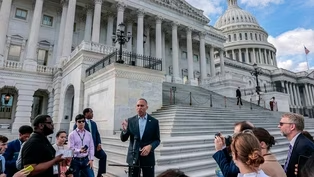
NewIs a blue wave coming, and how will Trump react?
Video has Closed Captions
Is a blue wave coming – and how will Trump react? (22m 46s)
 New
NewWho will emerge as the GOP's 2028 nominee?
Video has Closed Captions
Who will emerge as the GOP's 2028 nominee? (16m 18s)
Providing Support for PBS.org
Learn Moreabout PBS online sponsorship New Episode
- News and Public Affairs

Top journalists deliver compelling original analysis of the hour's headlines.
 New Episode
- News and Public Affairs

FRONTLINE is investigative journalism that questions, explains and changes our world.
 New Episode
 New Episode
 New Episode
 New Episode


 New Episode


 New Episode
Support for PBS provided by:
Major funding for “Washington Week with The Atlantic” is provided by Consumer Cellular, Otsuka, Kaiser Permanente, the Yuen Foundation, and the Corporation for Public Broadcasting.