
Exhibition explores link between Black women and Shakespeare
Clip: 10/16/2026 | 6m 17sVideo has Closed Captions
Exhibition explores connection between Black women and the works of Shakespeare
The Folger Shakespeare Library's newest exhibition maps an unlikely historical connection between Black women and the works of William Shakespeare. Nearly 100 objects document the stories of renowned scholars, popular actors and little-known historic figures. Geoff Bennett spoke with curator Patricia Akhimie. It's for our arts and culture series, CANVAS.
Problems playing video? | Closed Captioning Feedback
Problems playing video? | Closed Captioning Feedback
Major corporate funding for the PBS News Hour is provided by BDO, BNSF, Consumer Cellular, American Cruise Lines, and Raymond James. Funding for the PBS NewsHour Weekend is provided by...
Exhibition explores link between Black women and Shakespeare
Clip: 10/16/2026 | 6m 17sVideo has Closed Captions
The Folger Shakespeare Library's newest exhibition maps an unlikely historical connection between Black women and the works of William Shakespeare. Nearly 100 objects document the stories of renowned scholars, popular actors and little-known historic figures. Geoff Bennett spoke with curator Patricia Akhimie. It's for our arts and culture series, CANVAS.
Problems playing video? | Closed Captioning Feedback
Where to Watch PBS News Hour
PBS News Hour is available to stream on pbs.org and the PBS app.
Providing Support for PBS.org
Learn Moreabout PBS online sponsorshipGEOFF BENNETT: The Folger Shakespeare Library's newest exhibit maps an unlikely historical connection between Black women and the works of William Shakespeare over a period of more than 450 years.
Nearly 100 objects document the stories of renowned scholars, popular actors, and little-known historic figures.
I sat down with exhibit curator and the director of the Folger Institute, Patricia Akhimie, who spoke about the exhibit, which opens today.
It's part of our arts and culture series, Canvas.
Patricia Akhimie, welcome to the "News Hour."
PATRICIA AKHIMIE, Director, Folger Institute: Thank you.
GEOFF BENNETT: I have to confess this was not a connection I'd ever really considered, Black women and Shakespeare.
Shakespeare wrote so specifically about his time and place 400 years ago.
And you have traced this extraordinary line between his work and Black women across centuries.
How did those two become intertwined?
PATRICIA AKHIMIE: This is a story I have been really following in my own research for many years, but it's not a story that we have had the chance to kind of share with the general public.
It really begins in the time when Shakespeare is living and writing.
There's a sort of longstanding myth that Shakespeare's world was not a diverse world.
It's just not true that it wasn't.
And so one of the things we do in the exhibition is start by telling the stories of Black women who lived and worked in London at the same time that Shakespeare was living and writing there, and often in the same neighborhood, the same streets that he was walking, so to bring to life a world that is much more diverse and one that kind of celebrates the presence and the contributions of Black women.
But that's just the starting place.
Then we go on to look at all of the ways that Black women, as artists, as creators, as theater professionals themselves have used Shakespeare to tell their own stories.
And, really, that's what Shakespeare can do for us as contemporary audiences, is give us a starting place to make the work our own, make new work, and tell our own tales.
GEOFF BENNETT: We often talk about how performers interpret Shakespeare, but this exhibition makes a different argument, that Black women have actually shaped the way that Shakespeare is understood, taught, and performed?
How so?
PATRICIA AKHIMIE: Absolutely.
There are a number of artists.
It's hard to pick a favorite, but there are a number of artists who have pulled from Shakespeare to do some extraordinary things.
Probably my favorite is Toni Morrison, who is a beloved author that many of us know very well.
But we might not all know that Toni Morrison also was an avid Shakespearian, a careful reader of Shakespeare.
And towards the end of her life, she gave herself the project of rewriting and recreating one of Shakespeare's most well-known plays, "Othello," in her play, "Desdemona."
And, in "Desdemona," which is an incredible piece of work, the entire play is seen from the eyes of the female characters, Desdemona, but also the unnamed Black woman who appears in Desdemona's memories within "Othello" becomes a speaking character in Toni Morrison's revision.
But in our exhibition, what you will get to see is Toni Morrison's handwritten notes on a yellow legal pad as she's mapping out the structure of what will become "Desdemona" and sharing with us her ideas about what the interior of this character who Shakespeare only gives a few lines, what it's going to be.
GEOFF BENNETT: You have committed your entire professional career to this work.
Is there a story or a woman that fundamentally changed your understanding of Shakespeare and all of this history?
PATRICIA AKHIMIE: Again, it's hard to choose, but I think I'd like to tell the story of Frances DeBerry, who -- so there are lots of women in the exhibit who are famous, well-known, Rosa Parks, Maya Angelou.
Frances DeBerry was a woman who I did not know.
She was -- she was a contestant on a quiz show in the 1950s, "The $64,000 Question."
And she wasn't a Shakespeare professor.
She wasn't a theater professional.
She was just a person who loved to read, self-taught, but who considered herself an expert on Shakespeare.
And she chose Shakespeare as her category of expertise when she was a contestant on the show.
When asked what she would do with the winnings if she were to win "$64,000 Question," she said, well, I would publish my book.
And, actually, she did go on to do that.
She won $16,000 on the show, and she published her book, which was called "All the World's a Stage," and it was a monograph about Shakespeare's comedies.
And, in 1958, when that book was published, the Folger Shakespeare Library purchased a copy, and we have had it in our collection ever since.
That is an incredible story that I didn't know and that I'm so glad to know now.
GEOFF BENNETT: When someone encounters this exhibition, what do you want them to understand differently, either about Shakespeare or Black women or history or some connection thereof?
PATRICIA AKHIMIE: I think one of the most important things that I hope folks will take away is that we are the archivists of the future, that the objects that we will be able to use to tell important stories in the future, we're the ones who decide which of those will be preserved and how.
And so it's not just the Mona Lisa hanging in a museum.
It's, what is in your possession?
What's in your family's -- attic of your family home?
What are the objects that tell the important stories, especially about people who are marginalized in our society?
What are the objects that tell those stories?
And how can you make sure that we will have those available for future generations to see and understand?
GEOFF BENNETT: The exhibition is "To Hear Her Speak: Black Women in Shakespeare" at the Folger Shakespeare Library.
Patricia Akhimie, great to speak with you.
PATRICIA AKHIMIE: Thank you so much.
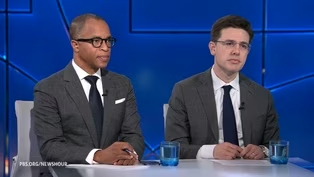 New
NewCapehart and Continetti on the press secretary's quick exit
Video has Closed Captions
Capehart and Continetti on the White House press secretary's quick exit (9m 18s)
 New
NewExamining Trump's claims at his midterm rallies
Video has Closed Captions
Examining the controversial claims Trump is making at his midterm rallies (6m 48s)
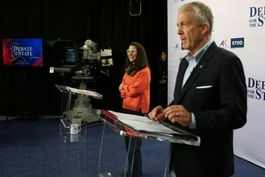 New
NewHow Alaska became a battleground in the fight for the Senate
Video has Closed Captions
How Alaska became a key battleground in the fight for the Senate (5m 1s)
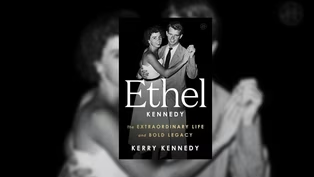 New
NewKerry Kennedy remembers mother's life, advocacy in new book
Video has Closed Captions
Kerry Kennedy remembers her mother's life and advocacy in new book (8m 49s)
 New
NewNews Wrap: Zacharia out as White House press secretary
Video has Closed Captions
News Wrap: Zacharia out as White House press secretary after less than a week on the job (4m 57s)
 New
NewOregon shooter attacked special ed classroom, police say
Video has Closed Captions
Oregon school shooter attacked special education classroom, police say (4m 32s)
 New
NewWhat makes the Oregon school shooting different
Video has Closed Captions
What makes the Oregon school shooting different – and what can be learned (4m 58s)
Providing Support for PBS.org
Learn Moreabout PBS online sponsorship New Episode
- News and Public Affairs

Today's top journalists discuss Washington's current political events and public affairs.
 New Episode
- News and Public Affairs

FRONTLINE is investigative journalism that questions, explains and changes our world.
 New Episode
 New Episode
 New Episode
 New Episode


 New Episode


 New Episode
Support for PBS provided by:
Major corporate funding for the PBS News Hour is provided by BDO, BNSF, Consumer Cellular, American Cruise Lines, and Raymond James. Funding for the PBS NewsHour Weekend is provided by...