
Readers Club | Ep 301: Charlotte McConaghy | Once There Were Wolves
Season 2026 Episode 3 | 58m 55sVideo has Closed Captions
PBS Books Readers Club hosts author Charlotte McConaghy to discuss her novel Once There Were Wolves.
PBS Books Readers Club is excited to kick off its third season with New York Times bestselling author Charlotte McConaghy to discuss her novel Once There Were Wolves and shed light on her brand-new highly acclaimed novel Wild Dark Shore.
Problems playing video? | Closed Captioning Feedback
Problems playing video? | Closed Captioning Feedback
Readers Club | Ep 301: Charlotte McConaghy | Once There Were Wolves
Season 2026 Episode 3 | 58m 55sVideo has Closed Captions
PBS Books Readers Club is excited to kick off its third season with New York Times bestselling author Charlotte McConaghy to discuss her novel Once There Were Wolves and shed light on her brand-new highly acclaimed novel Wild Dark Shore.
Problems playing video? | Closed Captioning Feedback
How to Watch PBS Books
PBS Books is available to stream on pbs.org and the free PBS App, available on iPhone, Apple TV, Android TV, Android smartphones, Amazon Fire TV, Amazon Fire Tablet, Roku, Samsung Smart TV, and Vizio.
Providing Support for PBS.org
Learn Moreabout PBS online sponsorshipMore from This Collection
The PBS Books Readers Club is a monthly digital-first series that brings its members into conversations behind the stories of your favorite books & shows. You can watch the online on the PBS App, with extended interviews available for PBS members on PBS Passport.
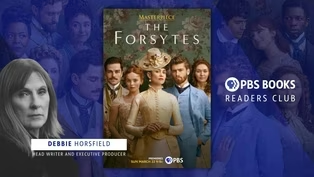
Readers Club- Debbie Horsfield | The Forsytes
Video has Closed Captions
The PBS Books Readers Club takes on John Galsworthy's classic novel series The Forsytes. (32m 36s)

Readers Club | 302 Book Picks for Black History Month with Lauren Smith and Princess Weekes
Video has Closed Captions
PBBS Books Readers Club recommend their favorite Black History Month reads. (16m 16s)
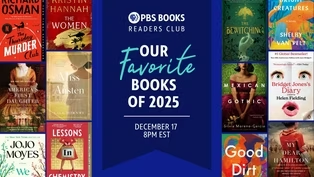
Readers Club | Ep. 212: Our Favorite Books of 2025
Video has Closed Captions
PBS Books Readers Club celebrates the wrap of its second season with a highlight of 2025 (47m 55s)
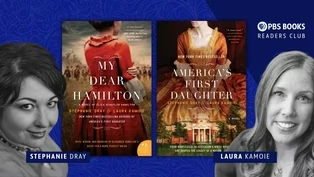
Readers Club | Ep. 211: America's First Daughter | Stephanie Dray & Laura Kamoie
Video has Closed Captions
PBS Books Readers Club welcomes co-authors Stephanie Dray and Laura Kamoie (1h 1m 45s)
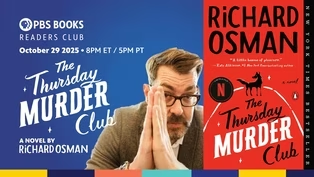
Wed Oct 29 2025 | Readers Club | Ep. 210: Richard Osman | Thursday Murder Club
Video has Closed Captions
PBS Books Readers Club welcomes celebrity writer Richard Osman to discuss his best-selling novel (52m 44s)
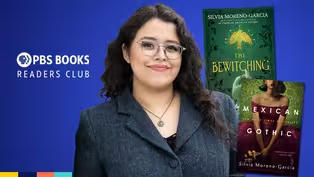
Readers Club | Ep. 209: Silvia Moreno-Garcia | The Bewitching and Mexican Gothic
Video has Closed Captions
PBS Books Readers Club welcomes award winning author Silvia Moreno-Garcia to discuss her new book. (52m 42s)
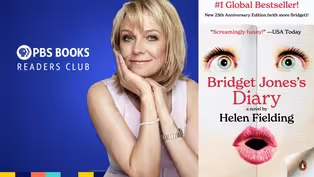
Readers Club | Ep. 208: Helen Fielding | Bridget Jones's Diary
Video has Closed Captions
PBS Books Readers Club welcomes beloved British author Helen Fielding to discuss her iconic novel (59m 30s)
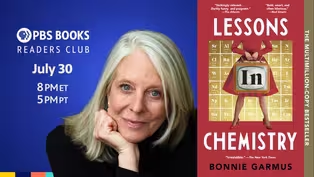
Readers Club | Ep. 207: Lessons in Chemistry | Bonnie Garmus
Video has Closed Captions
PBS Books Readers Club welcomes international best-selling author Bonnie Garmus to discuss her novel (49m 3s)
Readers Club | Ep. 206: Our Favorite Cozy Murder Mysteries
Video has Closed Captions
PBS Books Readers Club hosts a special event sharing Our Favorite Cozy Murder Mysteries (52m 32s)

Readers Club | Ep. 205: We All Live Here | Jojo Moyes
Video has Closed Captions
PBS Books Readers Club welcomes international & New York Times best-selling author Jojo Moyes (57m 37s)
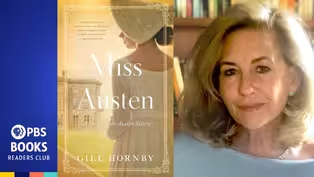
Readers Club | Ep. 204: Miss Austen | Gill Hornby
Video has Closed Captions
PBS Books Readers Club welcomes international best-selling author Gill Hornby to discuss her novel (51m 18s)
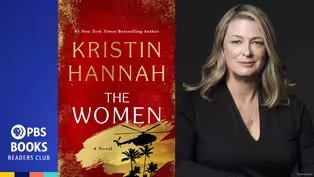
Readers Club | Ep. 203: The Women by Kristin Hannah
Video has Closed Captions
PBS Books Readers Club welcomes international best-selling author, Kristin Hannah to discuss novel. (53m 29s)
Providing Support for PBS.org
Learn Moreabout PBS online sponsorship(bright music) - Character is where you can really bring your own imagination and creativity to life.
That's where you become a sort of master of the story.
(bright music) - Well, hello, welcome to the PBS Books Readers Club.
- Today we welcome New York Times bestselling author, Charlotte McConaghy, to discuss her beautiful yet haunting novel, "Once There Were Wolves" and to learn more about her new instant bestseller, "Wild Dark Shore."
- "Once There Were Wolves" follows Inti Flynn as she arrives in the Scottish Highlands with a mission to reintroduce wolves to help save the environment.
Bruised by her own past, but still bold, Inti believes restoring the wolves is the key to healing the land and perhaps herself.
But when a man from the community goes missing, suspicion falls squarely on the packs.
To protect the animals, she's worked tirelessly to save, Inti makes a fateful choice that entangles her in a mystery far more human than anyone expects.
- This lyrical and deeply atmospheric novel blends environmental suspense with an intimate portrait of trauma, sisterhood, and resilience.
It's a poignant blend of emotional depth wrapped in a gripping narrative.
- Hi, I am Fred Nahhat and I'm here with Lauren Smith from PBS Books.
Joining us is our literary expert and award-winning writer, Princess Weekes, and our PBS Books National Director and Resident Librarian, Heather-Marie Montilla.
- And of course, we want to welcome you and all your fellow book clubbers.
We want to hear from you in the comments.
Let us know where you're joining us from, if you read "Once There Were Wolves" and what you thought about the book.
Also let us know if you would recommend her new novel, "Wild Dark Shore."
We hope to touch on that book today as well.
- Of course, we love reading and responding to your thoughts in the chat, and you can connect around books all month long by joining the PBS Books Readers Club Facebook group to share recommendations and discuss your favorite reads anytime.
- It really is the best book club ever.
And great stories are meant to be shared, so please click Share on Facebook or YouTube right now.
Your support means the world to us, and we know you'd never let your book buddies miss out on a great story.
- All right, so let's discuss Charlotte McConaghy's powerful novel "Once There Were Wolves."
What'd y'all think?
- Oh, I really loved it.
I think it's this really beautiful mixture of this fairytale kind of story in a very modern setting.
And I actually went to Scotland early this year and visited the Highlands, so I was kind of visualizing it as I was going through it.
And I think even the historical history of the wolves is such a fascinating thing, and I just thought it was just beautifully put together and creative and I was on the edge of my seat the entire time.
- Same.
- Me too, I loved it as well.
And it's not historical fiction, you guys know I love historical fiction, but I loved this book!
And there were so many twists and turns, one of them with Inti having mirror-touch synesthesia, and it was so interesting and a really unique character flavor.
But there were lots of aspects of things that were so unexpected throughout this novel, which, for me, really kept me engaged and reading and really reading and wanting to read more and never wanting to stop until I hit the end.
- Well, for me, you might expect variations on a theme, men behaving badly, but also women behaving badly, also everyone behaving badly in this one.
She had me at Apex Predator.
The description of that town hall meeting about how introducing the wolves back into the ecosystem would have reverberating effects across every aspect of nature was super, super interesting and had me right from that moment.
- And I think the bond that Inti has with the wolves and her passion for that, I think that's so interesting.
And I just thought it was really creative storytelling too.
It's not your traditional family drama.
There's so much creativity in here, the drama with the wolves, but also, like, Heather, you said, that mirror-touch syndrome that Inti has.
- Yeah.
- It was so fascinating.
I also couldn't put it down.
- Well, author Charlotte McConaghy is standing by to join us in just a moment to talk more about our captivating novel.
But first, we would love to know what you think.
Have you read "Once There Were Wolves?"
If not, does the premise intrigue you?
- Or maybe you recently finished her latest book, "Wild Dark Shore," and want to recommend it or pose a question for your fellow book clubbers.
We'd love to hear what you have to say in the chat.
- We also wanna make sure you're in the loop on all of our PBS Books Author Talks.
Here's how you do just that.
First sign up for our PBS Books e-newsletter at pbsbooks.org/subscribe for exclusive book recommendations, author interviews, and lots more.
It is the best way to get the latest updates straight to your inbox, - Then click over to YouTube and hit Subscribe.
The PBS Books YouTube channel features hundreds of author interviews, including two complete seasons of the PBS Books Readers Club with interviews like Geraldine Brooks, Percival Everett on his Pulitzer Prize winner "James," Kristin Hannah on "The Women," Richard Osman's "Thursday Murder Club," and so many more.
- And if you love PBS Books, consider supporting your local PBS station.
Now that we no longer receive federal funding, this program and your PBS station are counting on support from viewers just like you now more than ever.
So please, if you can, visit pbsbooks.org/donate to make a gift.
- It really is a critical time for PBS, and your gift can make a real difference right now, pbsbooks.org/donate will take you right to your local station's giving page.
There, among many thank you gift options, You can support PBS Books directly by one of our special gifts, like the PBS Books Readers Club book bag.
You can carry it as a handbag, wear it as a cross body, plus it's just super cute, I've been using mine for a long time, almost a year now, to carry around my laptop and books and it's still holding strong.
- We also have the official PBS Books Readers Club mug, just like we have here on set.
It says, "My Weekend is BOOKED!"
And isn't that the truth?
- [Lauren] And don't forget, PBS members get access to PBS Passport, the member exclusive section on the PBS app where you can stream full seasons of incredible PBS shows like this month's Watch Alike, "All Creatures Great and Small."
Readers who appreciate Inti's passion for animals in "Once There Were Wolves" will be heartened by this newest season filled with fresh veterinary cases, growing families, and a few new faces.
This season carries forward the show's enduring heart.
You can stream all five seasons right now on the PBS app as a member of your PBS station, plus catch new episodes in season six as they premiere with PBS Passport.
- And now let us turn the page to our book pick for this month, "Once There Were Wolves."
Let us now welcome in author Charlotte McConaghy.
Welcome to the PBS Books Readers Club.
- Thank you so much for having me.
This is really lovely honor.
- We are so thrilled to have you.
Thank you for joining us.
And we wanna talk about your latest book, "Wild Dark Shore," because it was at the top of everybody's reading list last year and going into this year.
But first we wanna start with "Once There Were Wolves," because it really touches on our theme on PBS this month on human-animal bonds.
So start with that book, tell us a little bit about it for viewers that haven't read it yet, and about your inspiration.
- Sure.
Yes.
So "Once There Were Wolves" is the story of two sisters, Inti and Aggie, and their mission to reintroduce wolves into the Scottish Highlands in order to rewild the forest there.
It's like a lot of places in the world, it's an ecosystem in crisis.
And the wonderful thing about wolves is that when you introduce an apex predator, their impact on the ecosystem is so profoundly positive that they can bring wildlife back to life.
So she's kind of on this really wonderful mission, but she's also a character who's bringing a lot of grief and trauma with her.
So she's running from things in her past and is struggling to kind of connect with people because of that.
The townsfolk are not keen to see her.
Most of them are farmers and they're really worried about their livestock and what the wolves will do to the livestock, and so they don't welcome her with open arms.
And then everything kind of changes when she discovers a body in the forest and it looks like it might have been a wolf.
And so she makes a really kind of bold, crazy decision to protect the wolves and then go on this mission to figure out who's done the murder.
So it's a sort of, it's a kind of a psychological mystery with a bit of romance, a bit of family drama, and lots of kind of connection to nature and wildness.
- Well, I said this earlier to this book club, it's an exact quote, "You had me at Apex Predator," the explanation of in the community meeting of how it impacts down the line, every last aspect of the ecosystem was fascinating.
Then in the acknowledgements, you mentioned it was inspired by a story at Yellowstone?
- Yeah.
- How does that connect and how did that inspiration arrive?
- Yeah, so originally this idea came to me when I read about this incredible forest in Utah, which is called Pando, the Trembling Giant.
And it's actually, it's thousands of Aspen trees.
But in fact it's not thousands, it's one.
It's one huge organism that's all connected and the trees are genetically identical.
And this incredible thing has been alive for an impossibly long time, some scientists think it might even be a million years old, but it's dying due to human impact.
And so one of the articles I read about this was that wolves would be actually a really elegant, simple solution to bring them back to that forest, where they had been in the past but had been hunted to extinction.
If we reintroduce them there, it would probably bring the Trembling Giant back to life.
But there was a lot of pushback in the area from locals.
So that sort of got me on this, I was very, very interested to find out more about this, about the wolves, about the sort of complex dynamic between both sides of this issue.
It took me, my research took me to reading about Yellowstone, which was this really wonderful- You guys are American, I'm sure you all know about Yellowstone, but it's this amazingly triumphant example of rewilding, where in the '90s they brought wolves back to the Yellowstone National Park.
And over a few decades, one of the good things that I was able to do from a few decades past this project was there was a lot of literature that I could then read.
There were a lot of first person accounts from the biologists that worked on that project.
And so it was just this treasure trove of information and insight and experience that I could not sort of believe I was stumbling across.
And just diving into that really brought to life this whole world, and I just decided to kind of use that project as a really good source material and to inspire my own.
- As my colleague, Fred, often says, location is also a character.
And so I was just wondering what made you decide to pick the Highlands in Scotland as a setting for this story?
I actually got to visit there earlier this year, and it's such a beautiful, unique place and they have their own unique history with wolves specifically.
So what kind of research went into writing this location and the wolf reintroduction project and making it a Scottish story?
- Yeah, well, I mean, that's a big part of it.
As you mentioned, they do have a really long, complex history with wolves.
A big part of their history is about the extermination of wolves and hunting them to extinction.
A lot of the monarchs were really anti wolves.
I think it speaks to a historical human attitude towards wildlife and nature and a need to sort of kill anything wild as a way of having more power than it.
So that was fascinating to me.
I have Scottish heritage myself, so I had been to Scotland a few times before to sort of roam around in search of my heritage and my roots, and really love the place there.
It's so beautiful.
It felt aesthetically right for a sort of eerie mystery set in the a snowy forest.
It's remote, it's wild.
It just sort of, it hit a lot of kind of really important points for me.
And I had originally thought about doing it in Utah, which was with Pando, the Trembling Giant.
But this was in COVID, we got hit by COVID really soon after I came up with this idea.
I had never been to Utah, I knew nothing about it, I knew I was not gonna be able to get there.
So Scotland made a lot more sense.
And they're also a place that is doing a lot of amazing rewilding work already, so it's forefront in their minds, this issue of how to kind of bring their landscape back to life.
So yeah, it just felt like it made sense.
- After all that research, you created this wonderful blend between fact and fiction.
Where did you feel it was essential to stick closely to your research?
And where did you feel you could fill it in with your own imagination?
And also how did you feel and when did you feel was it important to bring in class?
Because you also kind of weave this theme of class in.
- Okay, so for me, the research was all- I wanted to be rigorous with the research about the wolves and what it means to work with wildlife.
So I wanted to be as truthful as I could about the reality of a situation like this and a project like this.
Wolves themselves, I wanted to get them right.
I wanted to explore- I wanted to sort of convey a truth that doesn't often get conveyed, which is that wolves are in fact not aggressive, violent creatures.
They are incredibly gentle, family oriented, shy, frightened creatures, and you don't often see them depicted that way.
So it was important to me to sort of get that right, to be truthful about that and how they behave.
Wolves are not out there hunting people.
You never see them be aggressive towards people in fact.
It's very, very, very rare.
So yeah, that was really important to me.
I wanted to get a sense of how scientists who work with animals, what their life is like, what their sort of daily struggles and triumphs are like.
I wanted to get a sense of, I wanted to be truthful to the other side of this as well.
This sort of complexity of how it feels to be a farmer struggling with... It's a really difficult way of making a living often for these kind of smaller farmers.
They're not big, huge, horrible companies that just, I don't know, wipe out everything they can find and treat animals terribly.
This is quite a different thing to explore this sort of small, more organic farming method and the stress on them about the potential of bringing in a predator that could make their way of life harder.
So I wanted to bring that sort of struggle and argument and debate to life with nuance.
So that was where a lot of my research was based.
I also did a lot of research on the Scottish forests themselves.
I wanted to get those details right so that they were brought to life and you felt like you were transported there.
I think where I started to take liberties was with the characters.
The character is where you can really bring your own imagination and creativity to life.
That's where you become a sort of master of the story.
And I wanted to sort of allow Inti and Aggie, and Duncan, who's the policeman who's involved in trying to figure out this murder as well, I wanted them to have their own sort of depth, complexity that they could bring to these issues and kind of bring them to life.
And then of course, I loved playing around with slightly magical elements, slightly sort of fairytale vibes.
You get to the end of this novel, and it's this, I won't give away the ending, but there are big beautiful sort of slightly magical moments where you can either go all in and believe that this might be possible because of the miracle that is nature and the unpredictableness of animals, or you can feel like maybe that's where I've taken liberties.
But either way, that's a space that I really enjoy kind of exploring.
- Well, the research, incredible.
And of course the magical flourishes make it so compelling, but there's also a bit of your own personal history.
You acknowledged your father's sustainable farming practices.
Talk a little bit more about how that influenced your development of the vibe and the spirit of that farming community.
- Yeah, well, exactly.
So my dad has a small, beautiful little beef and lamb farm down on the ocean in this sort of southern part of New South Wales in Australia, and I had always grown up with him as a farmer.
And therefore, I think I had a slightly more balanced view into this.
I'm very, very pro animals, pro wolves.
I find it extremely distressing to see the way that they have been treated, slaughtered, villainized overall of human history.
It's really upsetting to me.
And so this was quite a complex, it was complex terrain for me to sort of grapple with, "Okay, how do I treat this..." I had a character who was angry.
She's a very, very angry character.
And she's angry because of the harm that she can see being done, not only to humans, but to the natural world, to wolves.
So she comes into this environment with... She's hostile, you know?
She does not really want to hear what the other side of this issue has to say.
She doesn't want to talk to the locals, she doesn't wanna hear their complaints, she's dismissive of them.
But I also needed to give her a sort of- It's an arc, she needed a transformation to be able to slowly sort of connect and learn that the only real way to do projects like this is by communicating and cooperating.
And so I think that my background, my family background allowed me to sort of see the other side of the argument and give it a little bit more complexity and nuance than maybe if I had just gone in with blinkers on and totally on Inti's side.
- Well, I really loved Inti as a character.
I found her voice to be so interesting.
She was angry, like you said, but also funny and sharp.
And it was just interesting to see how she viewed the world.
And she also has this rare neurological condition where if she sees somebody or something else being touched, she feels it physically in her own body, and it just added such depth to her character.
And I'm interested in how you stumbled upon that condition, why you chose to write that as part of her character, and how it led to her development.
- Yeah, so mirror-touch synesthesia is what it's called, and I think it's another element to the story that makes it feel slightly magical, even though it's real.
It's a completely real condition.
It's very rare, but a very small percent of the population does have this condition.
And I had heard about it on a podcast a long time ago, a science podcast, and just could not believe.
It's an astounding thing to sort of move through the world with.
And the way that you have to engage with other humans is really sort of strange.
And so I became very interested in it.
I have a mild case of synesthesia myself.
It's very different, it's not mirror-touch, it's just everything is my brain, my memory only works by connecting color and texture and shape.
So people have colors and textures, that's how I remember their names.
So I was always sort of already a little bit aware of this kind of neurodivergence and had it in my back pocket as something that I really wanted to kind of explore.
And then when I realized that this book was ultimately about empathy, the fundamental kind of importance of empathy and what happens to us when we have a lack of empathy, when we forget to train our empathy.
It is a skill, we can learn it, we can practice it.
When we forget to do that, what do we become?
So this is what this book is about.
It's about who the real monsters are.
Are they the wolves or are they the people?
And so this idea of a condition that is such a heightened state of empathy just felt like a really kind of interesting way in for this character to explore this theme.
She's so exposed by the extremity of this empathy that it almost becomes, it's a vulnerability for her, it's almost dangerous for her to be this empathetic.
And so she tries to close herself off to it.
And that's how the novel sort of explores those different states of being.
And how I think parts of us die when we stop empathizing with each other, but also with wild creatures and with the natural world and with our own wildness.
And so that's what I wanted to sort of show with Inti, that she needs to get to a place where she can open herself back up to the beauty of that empathy.
And yes, it's scary, yes, it's dangerous, but that's what love is.
- I love how you explore this idea of empathy.
And through that, Inti and her sister, Aggie, are presented and they have some really tough parents.
Their mom as a no-nonsense detective, their dad is very much a man who lives off the land, loves animals, but lives off the land and sadly struggles with his mental health as he ages.
How did you decide on these traits for their parents as you delved into empathy?
- Yeah, I wanted Intis parents to sort of provide her with two possible ways to view life and the world and the space that she takes up.
So as a child, I think it would've been quite frightening for parents, I think, to have a child who is so vulnerable to all the violence and harm that is happening around her.
To see somebody else inflicted with pain and then to feel that pain yourself is... It's a scary way to go through life.
And I think both of them try to protect her from that in different ways.
Her mother's way of protecting her is to arm her against connection, to start building her resilience, her tolerance, her walls against this thing, to block it out of her life, to block people out of her life.
Because her mother sees the worst in people.
She sees all the harm that they commit, and that's what she tries to impart to her daughter as a way of sort of protecting herself.
But on the other side of that is her father, who is, he's a naturalist, he lives in a BC forest.
He's deeply, deeply connected to the wild.
And he sort of presents her with a different way of looking at this thing that she has, which is that it's a gift.
It's a gift to be able to connect with other things, with people, with wild creatures.
And all she sort of needs to do is to be as kind and open to that gift as she can be, and it will be nourishing for her.
So she's got these two sort of polar opposite things going on in her mind, teachings that she's having to sort of sift through.
And I think the different parts of her life, the different things that she goes through, she and her sister, Aggie, go through a really terrible trauma.
And so that sort of pushes her in one direction.
But ultimately, I'm trying to push her back in the other direction with this story and her connection to the wolves, which is sort of a reminder that wildness is about balance and harmony.
- Absolutely, I love hearing you talk about empathy and emotions and how it all intersects with the characters in this story.
And I think there are some very dark scenes in this book, from murder to domestic violence.
How did you approach these moments in your process?
Was that hard for you to write?
And how did you get through it while also maintaining that empathetic core that you reiterate is so key to the characters that you're writing about?
- It was hard.
It was really, really, really hard.
This is very challenging subject matter.
The reason this book, I think... It was always going to be a book about wolves, but it also became a book about the way humans treat each other.
Specifically it's about male violence against women.
And it was because at the time that I was coming up with this idea, there was, I think, in Australia, it was one woman was getting murdered every week by her romantic partner.
And we don't have a big population.
So that is a lot, a lot.
That is an extremely high number, and that still happens every week.
And so I was really angry about that.
I think I was like Inti, I was angry.
And this book was a way of me trying to sort of, I guess get the anger out of myself and onto the page.
And it was a dark place to be.
But the thing about a story and writing is that it's a journey, it's a transformation.
It's movement from one thing to another.
So to start from a place of anger meant that I could write through it and into its opposite.
The whole point of this for me was about trying to make sense of what we do to each other and why we have this thing inside us that makes us cruel or violent.
And not just to each other, but also to animals.
What that is, where it comes from, to try to grapple with surviving that thing.
And I don't think this book is about forgiveness.
I think there's a lot of things that should not be forgiven, this is not what the book is about, but it is about finding a way to make peace with the things that we have been through, to survive, it's about healing, it's about finding healing in wild spaces and places and connections and just being brave enough to sort of, to take those connections on.
So in a way, it was a really nourishing, healing book for me to write as well.
- That's so interesting.
And I love the way that you approached the wolves as characters as well.
Some of them had their own unique personalities, but also just the way that people feel about wolves.
What do you think it is about them that fascinate us so much?
- Yeah, they are infinitely mysterious things.
So beautiful.
And also, I guess, frightening because they have this capacity to be dangerous and they are predators, and they're powerful predators within their ecosystems.
And so they sort of, I guess they've taken on this role in our history as the villains.
They're the villain of every story, of every fairytale, every childhood story.
And so we sort of, yeah, it's easy to put them into that role.
But one of the things that I really loved when I was doing all my research about the Yellowstone reintroduction project was the way that the biologists connected with the wolves on this really intimate personal level.
And the way they depicted each of the wolves as so unique, profoundly unique.
They had personalities, they had incredible stories of their own.
These wolves were going on these epic adventures and having these really amazingly rich family dynamics and stories.
And it was the reverence they had for these creatures and their personalities that made me realize I really needed to give all of the wolves in my story a unique personality.
I needed to bring them to life as characters in their own right.
So that was very, very important to me, that we sort of love them and connect with them as individuals.
- Well, and that is one of the wonderful things about reading, of course.
Learning new things, discovering new things about people and animals and the world.
And of course, maybe most importantly, you have made me a fan of wolves.
So thank you for that!
- Yay!
- Let us now pivot to "Wild Dark Shore."
Congratulations on the book.
It's really been very well received by readers.
Tell us a little bit about it.
I know it's also strikes some environmental themes.
Give us that punchy back-of-the-jacket overview.
- Okay, so it's the story of a father and his three children who are living on a very remote stormy island down near Antarctica, very out in the middle of nowhere, and they are packing up to evacuate because the island has become too dangerous to live there 'cause of the rising sea levels and the really sort of heightened weather.
But the night of a particularly bad storm, they discover a woman has washed ashore, and by some miracle she's still alive.
So they nurse her back to health.
But very quickly realize that she is holding some pretty big secrets about why she's there and what she's doing.
And she also discovers that they are not telling her the whole truth about what's gone on in the island, why there's no one else there, why all of the communications have been knocked out or sabotaged, and why she discovers a freshly dug grave.
So it's gothic romantic mystery and an eco thriller that's about, basically, it's sort of about how far we go from the people we love.
- So talk about your process a little bit in writing this, because you sort of switch the point of view from chapter to chapter and we hear from all these different characters.
Why did you decide to approach it that way, and how do you go about piecing all of those puzzle pieces together?
- That was a big challenge actually.
I wasn't sure initially how I was going to write this story, how I would tell it.
I struggled for quite a while.
I think I wrote the first 25,000 words four times and deleted them four times.
It's all part of the work that goes into figuring out how to tell a story.
There weren't wasted words in the end, they allowed me to sort of know what I needed to do to best tell this story and to understand my characters as well.
So I did a draft that was all from Rowan's first person point of view, but I needed to get inside the family's head as well.
That was so crucial for creating dramatic tension and dramatic irony.
With a mystery, it's really great to sort of be able to move and have characters who know different things and have your readers be sort of let in on secrets at the right time.
So I did a draft where it was all third person with all the characters, and then I was just really missing the intimacy of the first person.
But I didn't feel like I could do five different characters in first.
It would've been too hectic and confusing.
So I just experimented.
I tried, "All right, what if I do my main two, Rowan and Dominic in first and try the kids in third?"
And I just found that it allowed me a really nice rhythm and pacing, and sort of just a texture that was right for the book.
It suddenly came to life for me.
I was able to move sort of fluidly between the characters.
I could create tension.
But I was also feeling intimately connected to them.
So yeah, it was.
It was an experiment really.
- That's so interesting.
It's impressive.
I get confused, writing back and forth that way.
So I think that's so cool you could do that.
- Yeah, it was so rich.
And all those characters, Dom, Claire, Orly, all these characters seemed to be haunted throughout the novel by someone or something.
How did you land on the specific ghosts for each character, and did you know how they were gonna deal with their grief before you started writing or was that something that developed naturally along the story?
- Mm, good question.
So the ghosts were sort of doing two things.
I don't know if there are ghosts on this island or if this is this sort of slight madness of isolation that sort of takes over.
You get a sense when you go, there's an island called Macquarie Island, which is what I based Shearwater on, and I had this really, really strong sense when I went there that it was very haunted by its sort of bloody past.
It was a target for oil exploitation in the 1800s.
The sealers and the whalers went down there and just decimated the wild creatures, nearly wiped them out completely.
And you can feel that there, you can really feel it hanging in the air.
And so the trip was really important for me for understanding this novel and realizing that it's a gothic piece about a family that's haunted on an island that's haunted.
And then I had to sort of work out, "Okay, well, what does that mean for them?"
Of course, their late mother and wife is going to be a really important presence for them.
I think the island is sort of not letting them let go of her, not letting them move on or process their grief in a healthy way.
They're sort of clinging to this presence of her.
And I wanted to sort of play around with whether or not the presence was malevolent or not.
But as they sort of, as Rowan slowly finds out, she's actually a representation of, I think, the point of the hauntings on the island, which is that they're love.
I think the the way that these sort of ghosts in this story hang on is through love, loving connections.
And that's also true of the way that Orly connected with the voices on the wind, the ghosts of the creatures that have died there, he was very comfortable with these presences.
He is never fearful of them in that way that children are often really, I think, much more able to cope with that idea than maybe adults are.
So yeah, I think it was just a... I did discover it as I went along.
I played around, I wanted that eerie feeling to permeate this novel.
I wanted a sense of revelation, that I could sort of reveal that they were loving presences rather than scary ones.
But yeah, it was just quite an organic process for me, weaving them in and out of the book and figuring out how the characters will relate to them and free themselves of their grief.
- Besides love, another reoccurring theme in your novels has been attention to environmental issues.
What draws you to these themes and what have been some of the reactions you've received on these books and the way the environment is woven in?
- Yeah, I mean, I think I can see from the other side of these books that I certainly have a preoccupation with wilderness, both beyond us and within us and what it means, what it is, what our connection to it is.
I wanted to sort of write about characters who are deeply connected to the natural world, but I just found I couldn't do that without also writing about what's happening to the natural world.
Didn't feel right to me.
It's glaringly obvious now we can't go back.
We have gone way beyond the past, beyond the sort of... I don't know, it's just I see it everywhere now.
I find it really difficult to not focus on this, write about it.
It's something that I care deeply about, and I think we should always be writing about the things we care about.
And each of the three novels, I think, are a, they're a thematic trilogy in a way.
They all look at climate change, but through a slightly different emotional lens.
So "Migrations" was my book that was about sadness, species loss.
"Wolves," as I mentioned, is about anger, it's about rage.
"Wild Dark Shore" is about fear, specifically the fear of raising children in a time of ecological crisis, what that means, what our responsibilities are to our children, how do we talk to 'em about what's happening, how do we teach them to save a world that we have not yet been able to save?
How do we teach 'em about what love is in the face of loss?
Big questions that I ponder, I think about.
And I try to sort of grapple with those questions in my books.
And I have had an enormous sense that I am not the only one grappling with these issues.
There are many, many people out there who are sort of struggling with the same issues of, "Should we be having children now?
And if we do, how do we do that responsibly?"
And just all the complexities of parenthood and fear around what's happening to our planet.
And I don't know, I think if book can reach out and allow people to recognize their own fears and their anxieties, and to be seen, then it can sort of, there's a that that connection can be comforting and can just give people the sort of sense that they're not alone and the inspiration to maybe step up and do something about it, you know?
To think really, really carefully about how they wanna live on this planet, how they wanna live their life, the decisions they wanna make.
I really hope that writing about these topics just galvanizes people, gives them energy around what they wanna do, gives them a sense of purpose about how to move forward.
- Well, it is "Wild Dark Shore," I am the slowest reader in our pack, so I'm in a few chapters, but I look forward to spending, like millions of other readers, more time with this.
Let us turn now to talk a little bit more about you!
We're always fascinated by a writer's journey, and I'm sure there's been some ups and downs, but what's the best and maybe the worst part of being an author?
- It is a big lonely job in a way.
You spend a lot of time pondering life and existence and the world and other people, and you do it on your own.
And there's not really, you don't get a lot of chances to talk about this stuff.
You're grappling with things on your own.
And in one way, I think that's both things for me.
That's both a really difficult challenge, particularly if you're writing about stuff that's challenging and difficult, like climate change.
But it's also a really beautiful part of it.
I love the solitary nature of it.
I love being able to sort of sit quietly and think and walk and try to notice things and ponder.
I don't know what things mean, and that sort of element of it, I think, is twofold.
And then there's also the difficulty of making a living from it.
But it's deeply fulfilling for me.
There is nothing else that I would be able to.
I've never done any other jobs.
I've been writing since I was 14, so I don't have any other skills.
This is it for me.
I have to make it work.
- Understood.
Same.
(all chuckling) So yeah, it's high pressure in one way.
But yeah, I really love it and there's something that just feels so kind of just important about it for me.
It really makes me feel like myself in a weird way.
- You said that you started writing when you were 14, but when did you know that writing was it for you?
- Not too long after that, honestly.
It started because- I mean, I was a voracious reader of course, but I remember going to my mum and just saying, "I can't find my perfect book."
And she said, "Well, why don't you just write it?"
So I plunged into this big epic fantasy novel for kids and never again did any homework, basically.
She just kind of let me do that as my first priority.
And was just so supportive about it, you know?
Not every parent would do that, I don't think.
And she really sort of encouraged me to just go for it.
She could see that I had a fire burning in me about telling stories.
And so that encouragement was crucial.
I just didn't stop writing.
I spent every minute.
I would run home from school, I would sit down, I would write until my eyes were falling shut.
Every weekend.
And this happened, I finished school, I started university and dropped out after a month because I wasn't getting enough time to write.
So I just knew.
I knew it was my thing that I had to pursue.
- I love that.
And your mama knew it too.
- Yeah, she did.
- Mother knows.
- Mm-hmm.
- That's incredible.
Well, as you've been writing for a very long time, what is your ideal writing setup?
Are you a morning person, a night owl?
Do you write with music or in coffee shops or at home?
Where do you like to write and how?
- I always have to be totally alone.
I have to pretend like I'm the only person on the planet.
A cafe is way too distracting for me.
I love putting music on.
Music is really, really important for sort of dropping me down into the right emotional space.
It's just a shortcut to getting to much deeper, yeah.
I mean, I'm a mood writer.
So I don't set myself up with really strict word counts or times that I have to follow.
I write when it feels right, and music is really helpful for getting it to feel right.
I used to be a night owl, I would stay up all night writing and then just sleep all day.
But I have children now, so I cannot do that anymore.
I'm much more of a morning person now and just get too tired by the afternoon.
And I was really scared because I wrote "Wild Dark Shore" after I'd had my first child.
And I was extremely sleep deprived, very worried that the difference in focus and time would sort of result in a book that was just way worse.
But it's actually really encouraging to know that you can shift how you work and shift your process and still manage to get to somewhere that's sort of meaningful.
- Yeah, you're not the first author to have mentioned this.
Others have had children and had to switch from night owl to morning, and it's so interesting!
- Have you been reading any good books lately?
We'd love to know any recent favorites that really just jumped off the page for you.
- Yeah, so this year's been fantastic, I've loved so many of the books that came out this year.
I loved "Heartwood."
I actually went back and read "All the Colors of the Dark," which is not from this year but I really enjoy, that's Chris Whitaker.
I read "Dream State" by Eric Puchner.
"The River Has Roots," which was a gorgeous fantasy novel.
I loved that.
That's so beautiful.
It really reminded me of my sort of nostalgia, childhood.
I've been really getting into Claire Keegan this year.
The most recent one I read was "Foster," which is just gorgeous.
That was a really beautiful, beautiful little novel.
Yeah.
They're probably my favorites over the year.
- Well, you mentioned reading as a child.
Take us back there.
I am guessing you've read and loved books for as long as you can remember.
Prior to being 14 and taking up writing, were there some titles from those early years that specifically inspired you to read and ultimately write?
- Yeah, so I really loved big epic fantasy sagas, which is why I started writing them.
Yeah, I really longed for adventure and experience.
I wanted to have big life, which you sort of get in these big sprawling fantasy epics.
So when I was really young, I really loved the "Redwall" series, which is all about animals.
So maybe that's why I love animals so much as well.
I loved, there's an Australian fantasy writer called Isobelle Carmody, I was really into her.
An English fantasy writer Guy Gavriel Kay, who's been around for a long time, he's got lots of books out.
I loved his work when I was a teenager, or younger than a teenager.
I loved his stuff, it was just really rich and epic.
- Charlotte, if you could invite a character from any book that you've either read or written yourself, who would you invite to dinner?
- Oh.
Oh my gosh.
I would invite the main character from my favorite novel, which is "Hamnet" by Maggie O'Farrell.
- [Lauren] We were just talking about "Hamnet!"
(Lauren chuckles) - Loved it so much.
It's such a great book.
I would invite Agnes to dinner because she is such a great character.
She is so wild and passionate and capable and just wonderful.
I would love to have dinner with her.
- Do you have a favorite library now or perhaps when you were a child?
- Well, this won't mean much to you guys 'cause I'm in Australia and you probably aren't too connected to Australian libraries.
But my local is great.
I grew up in Armidale, so the Armidale Library was wonderful.
And just my school libraries also were so great.
I remember my school library in primary school used to specifically get books in for me because I had read everything and she couldn't keep up with me.
So she was great.
- What is the best advice you've ever received, either about writing or just about life?
- I mean, I can speak to the advice about writing because it's something that I follow very closely for all my books, and it's really simple.
It's just write what you most want to read at the time you're writing.
So it's really easy to get lost in sort of thoughts about audience, thoughts about readers, thoughts about what's going on in the publishing industry, the market, the world, the zeitgeist.
But if you always come back to, close out that noise and just write the thing that you want to read, that you love, put all the things in that you love every time.
And then I think it will be sort of, it'll be truthful and that's the most important thing.
- That's beautiful.
- I'm gonna write that down.
(all chuckling) - What do you hope readers will take away from your books?
- Hopefully I'm not gonna repeat myself too much.
I sort of mentioned this before, but I really hope that it brings readers a sense of connection with nature, with wildness, with creatures, with wild spaces, and each other, with the people they love.
I hope it makes them feel deeply.
I would like for the books to move them and I would really like the books to inspire them to think about how they can help in slowing down the effects of climate change, how they can think about their own choices.
And just to feel energized.
Hope's really important, but hope has to lead us to action otherwise it's useless.
So I'm hoping that these books bring a sense of action and purpose.
- I love that.
Finally, Charlotte, is there anything that you'd like to say to your readers?
- Oh, man, just a huge, huge thank you for the way that these books have been sort of picked up and talked about and shared.
I am incredibly humbled and just so, so grateful for anyone who has read any of them, even if they don't like them.
It's a wonderful thing to read books and to be sort of always searching for new things to learn about, to understand, new perspectives to discover.
So thank you.
A big thank you.
- Well, I would say that you moved us, you connected us, and you certainly inspired us through both of the books, "Once There Were Wolves" and "Wild Dark Shore."
Author Charlotte McConaghy, thank you so much for joining us today.
We are grateful.
- Oh no, a real pleasure to talk with you.
Thank you so much for having me.
- Well, as always, talking with the authors makes me appreciate the books even more.
What surprised you at home most about Charlotte and her writing process?
Did this spark any inspiration in you?
Please let us know in the comments.
We wanna know what you thought.
What did all of you think?
Heather, let's start with you.
- It was amazing to me the immense amount of research she did.
And really also her goals, right?
Her goal about breeding connection and inspiring people to take action, right?
And all of that stemmed from research and research and more research.
I loved the conversation.
It made me love her books more.
It was really wonderful.
- I second all of that.
I feel like the best part of doing this show, besides being with all of you, is genuinely getting to hear the process of these really clever, interesting people.
And her passion for the environment, especially in these days, it just came across so fully.
And I love wolves!
And I love everything she had to say about it, and I just could have kept listening to her all night long.
A really clever, thoughtful person.
I'm gonna pick up anything she puts down on the page.
- Same!
I really liked her too.
And I thought the way that she approached "Wild Dark Shore" and writing it from different voices multiple times, that shows such a confidence, I think, in knowing that in the end this book is gonna work out and spending all that time to go through that process.
I think as a writer, she really seems to trust herself, which I respect and envy just a little bit.
- Yeah, I got a lot from it.
And too Heather's point about research, she also included her lived experience, which maybe not a genre, but for every author, every book is some part of historical fiction 'cause they're bringing themselves to it, which I thought was interesting.
She definitely connected us all for sure.
And then some of her personal advice, I guess.
Variation from what we've heard before of, "Write what you know," she said, "Write what you love.
Write what you want to read."
And I really appreciated that about her.
- Yeah, write what you care about was something else she said.
I thought that was so cool.
Well, thank you, book friends, for joining us for such a meaningful discussion.
If you love these stories about animals and the people who care for them, like we read about in "Once There Were Wolves," don't miss our PBS Watch Alike, "All Creatures Great and Small."
This one, it's a little bit more feel good than "Once There Were Wolves."
So you'll enjoy watching the celebration of community, compassion, and the bonds that help people and their animals move forward together.
You can catch up on past seasons and stay up to date with season six as a member of your PBS station on the PBS app and on pbs.org.
- And of course, we wanna invite you to join the PBS Books Readers Club Facebook group, subscribe to our YouTube channel and to our e-newsletter at PBS books.org/subscribe to stay in the loop on future Author Talks and discover our latest book recommendations.
- And know that you really do play a major role in making PBS Books happen.
This and all your favorite PBS programs rely on donations and the support of viewers just like you and me.
- So join your book friends in supporting these events.
Just click the link in the description or comments or visit PBS books.org/donate.
- You'll be taken to your local PBS station's donation page where you can find PBS Books swag as our thanks for your gift.
I know I'm obsessed with the PBS Books Readers Club book bag.
It's my go-to for library hauls and so much more.
You can also snag the official PBS Books mug.
It says "My Weekend is BOOKED!"
Plus, as a member of your PBS station, you could stream hundreds of inspiring PBS shows, concerts, documentaries, and of course full seasons of Masterpiece dramas like "All Creatures Great and Small," all with PBS Passport.
So follow us on Facebook and then go sign up for the PBS Books e-newsletter at pbsbooks.org/subscribe to make sure you don't miss our next Book Pick announcement along with other great book recommendations.
- And subscribe to our YouTube channel for more amazing reads and hundreds of author interviews.
- We'll see you next time.
Thank you for being a part of the PBS Books Readers Club.
(bright music)











Support for PBS provided by: