
True Detective Helps in the Black Dahlia Case
Preview: Season 8 Episode 3 | 1m 29sVideo has Closed Captions
True Detective Magazine was used as a tool to help hunt down the Black Dahlia murderer.
Historian William Deverell explains True Detective Magazine’s popularity in the 50s and 60s as a reflection of the turmoil that LA was experiencing at the time. Explosive metropolitan growth and the implicit and explicit promises of fame lead to a lot of “shadow” in the city. Hordes of creatives in Los Angeles with their pens at the ready found inspiration in the true crime genre.
Problems playing video? | Closed Captioning Feedback
Problems playing video? | Closed Captioning Feedback
Lost LA is a local public television program presented by PBS SoCal
True Detective Helps in the Black Dahlia Case
Preview: Season 8 Episode 3 | 1m 29sVideo has Closed Captions
Historian William Deverell explains True Detective Magazine’s popularity in the 50s and 60s as a reflection of the turmoil that LA was experiencing at the time. Explosive metropolitan growth and the implicit and explicit promises of fame lead to a lot of “shadow” in the city. Hordes of creatives in Los Angeles with their pens at the ready found inspiration in the true crime genre.
Problems playing video? | Closed Captioning Feedback
How to Watch Lost LA
Lost LA is available to stream on pbs.org and the free PBS App, available on iPhone, Apple TV, Android TV, Android smartphones, Amazon Fire TV, Amazon Fire Tablet, Roku, Samsung Smart TV, and Vizio.
Providing Support for PBS.org
Learn Moreabout PBS online sponsorshipI was reading about the Black Dahlia murder.
They actually used this magazine True Detective magazine.
They planted a story in here, knowing that it would get the attention of a suspect.
It actually worked.
The suspect read about it, contacted this police psychologist.
The True Detective was, in some ways, a law enforcement tool.
In some ways, and it just shows you the hunger that people have, buying these magazines by the tens of thousands each edition.
You do get the sense if you read a lot of these-- and they date from the mid-'50s through the mid-'60s or thereabouts-- the turmoil in L.A.
It's growing so fast, and there are people from all over the world trying to make a go of it.
There's a lot of stress and tension in the culture, and in the worst aspects of human behavior, that erupts with this kind of stuff.
What can we learn about Los Angeles by studying true crime?
People have been finding all kinds of ways to do dastardly things to one another across time and across space and geography.
But in L.A., you've got a lot of ingredients that lead to this kind of record.
You have explosive metropolitan growth.
You have the implicit or sometimes explicit promise of fame and glamour and fortune.
You certainly-- culturally and physically-- you have a lot of sunshine, but that creates a lot of shadow.
And so, you have the light and dark of human experience.
And then you have plenty of people trying to make a living out here as creatives with pens in their hands and typewriters at the ready.
So, it's a kind of alchemy that can produce this result.
Video has Closed Captions
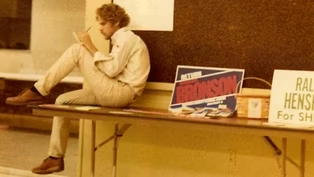
Clip: S8 Ep3 | 5m 8s | Michael Connelly credits his LA crime reporting experience as the foundation of his fiction writing. (5m 8s)
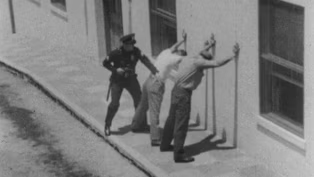
Preview: S8 Ep3 | 30s | Discover how the True Crime genre was shaped by its deep historic legacy in Los Angeles. (30s)
Providing Support for PBS.org
Learn Moreabout PBS online sponsorship














Support for PBS provided by:
Lost LA is a local public television program presented by PBS SoCal