Trouble at Sea
Trouble at Sea
Special | 13m 48sVideo has Closed Captions
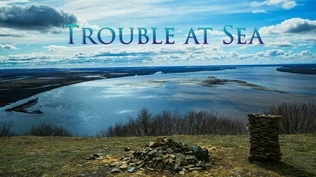
A short documentary of the salmon hatcheries of Alaska.
Wild salmon runs along the Yukon River are collapsing, leaving communities like Saint Mary’s struggling to adapt. Trouble at Sea dives into how these losses are reshaping life in Alaska—and why hatcheries aren’t the simple solution they appear to be.
Problems playing video? | Closed Captioning Feedback
Problems playing video? | Closed Captioning Feedback
Trouble at Sea is a local public television program presented by AK
Trouble at Sea
Trouble at Sea
Special | 13m 48sVideo has Closed Captions
Wild salmon runs along the Yukon River are collapsing, leaving communities like Saint Mary’s struggling to adapt. Trouble at Sea dives into how these losses are reshaping life in Alaska—and why hatcheries aren’t the simple solution they appear to be.
Problems playing video? | Closed Captioning Feedback
How to Watch Trouble at Sea
Trouble at Sea is available to stream on pbs.org and the free PBS App, available on iPhone, Apple TV, Android TV, Android smartphones, Amazon Fire TV, Amazon Fire Tablet, Roku, Samsung Smart TV, and Vizio.
Related to This Special
So this is the drying rack, where usually when the fish come in, the guys that bring the fish fishing and we hang them on these poles right here and, let them air dry.
And sometimes it takes about seven, seven to 14 days depending on, the weather, pretty much, before we move them in the smokehouse.
So you like, got good airflow.
See the strings, breezing there so moving there.
So you got some good airflow in here to get the salmon dry to move to the smokehouse.
Declines have been going on since 2020.
Was the last time we harvested some salmon.
Just a little bit.
Every single community is like this.
We got no salmon.
The empty fish racks, bare Just wasting away.
with no salmon.
Along the Yukon River in Alaska and Canada.
Communities like the Yupik village of Saint Mary's have been devastated by plummeting runs of wild salmon in this remote village.
Salmon are an economic and cultural mainstay people have depended on for generations.
But wild salmon here and in other parts of their range are struggling.
And people like Serena Fitka think they know.
One reason why I believe the hatcheries are playing an impact on our salmon returns.
They're in competition with the food, that the fish are eating and just over populating our oceans.
And it's common sense, you know, in my opinion, Alaska leads the world in salmon hatchery production.
Unlike fish farms that raise and feed salmon in pens, hatcheries, incubate fertilized eggs and then set free young fish to complete the growing cycle at sea, hatcheries work by by bringing fish in basically out of the stream and into an area where to a setting where, we can have greater survival.
The largest die off of of salmon occurs between the time when the eggs are laid, the time that they emerge from the gravel.
Salmon's natural homing instinct guides these fish to return to water bodies near the hatcheries when they're mature, making them readily available for harvest from freezing, from drought, from predation, from mudslides, from all the things that cause them to, die in nature before they ever get a chance to get to the ocean.
The hatchery controls all those variables.
And so instead of getting 10% making it to the ocean, you're going to get 90%.
Make it to the ocean.
Once they hit the ocean, all things are the same.
Alaska's modern hatchery program began in the 1970s as a way to provide fish for commercial salmon harvests.
Since then, hatchery production has skyrocketed, and these fish have become ingrained in the lives and livelihoods of many Alaskans.
Today, Alaska's hatcheries generate nearly $600 million in economic output each year.
Earnings.
No one is eager to give up, but this technological marvel comes at a cost.
Hatchery salmon, weakened wild fish genetics through interbreeding, and evidence suggests that they compete with wild salmon for food.
About 30% of the salmon harvested in the state is from the hatchery program, so you can put a dollar amount on that every year.
At the inception of this program, it was recognized that the sheer scale of those programs, which average somewhere in the realm of one and a half to 2 billion hatchery salmon are released, I think for pink salmon in Prince William Sound.
It's somewhere on the order of 700 million.
The sheer scale of those programs means that there is a potential for genetic impacts to, both diversity and fitness.
So we've studied what the impacts of hatcheries are on wild fish.
For several decades now, and everything from genetic problems to, competitive problems.
The genetic problems, arise when the fish that should spawn in the hatchery mix and interbreed with fish in the wild part of the ecosystem.
And then those so-called hatchery genes can make it into the genes of the of the offspring of that interbreeding.
And in many cases, it's, it's, results in much lower fitness of the those hybrid fish hatchery origin fish.
Had about half the reproductive success of natural origin fish these this lower reproductive success.
We don't know what it's associated with.
But if if it's persistent across generations, indications are that it may have a genetic basis to it.
And if it has a genetic basis to it, that means we are introducing this kind of hatchery.
Based genetic background into the system that could have downstream effects on the overall productivity of the natural systems themselves.
The primary product of Alaska's hatchery industry is pink salmon.
These fish are already the most abundant type of salmon in the North Pacific.
Research shows that when pink salmon are especially numerous, other salmon don't grow as much, suggesting there's simply not enough food to go around.
So what we see is when we look at annual growth of salmon sockeye salmon scales, we see that in odd years when pink salmon are highly abundant, the growth of those sockeye salmon is greatly reduced in even numbered years, when there are relatively few pink salmon, sockeye salmon growth is relatively high.
And we see this pattern, now in many of the salmon species as well as other animals in the in the North Pacific Ocean, evidence is mounting that pink salmon are reshaping the ocean food chain, impacting everything from plankton to whales.
Sometimes there's an appeal to, a, what's called a trophic cascade.
It just means that the pinks are affecting the ecosystem in a way that a lot of other species feel it, and it's generally through food.
So roughly one out of every four salmon, adult salmon returning from the North Pacific Ocean or hatchery origin.
The question is, how much of that pink salmon affect if it's in effect, if it's there, how much of that is due to hatcheries?
We can infer, given that there's, you know, a high percentage, of hatchery origin salmon, that some of that impact is being caused by those hatchery origin pink salmon.
And in other cases, Chum salmon.
If we're going to talk about competition, we're talking about multiple different organisms in the ocean, technically kind of grazing on the same pasture.
So the question is, if you stopped hatcheries now, would you would you have a a benefit to competition?
I don't know, I'm not saying we wouldn't.
We know they eat a lot of the same food.
We know that they have slightly different migration patterns, but we also know they spend a lot of time in the same ecosystems, in the same water strata.
So there's many good reasons to believe, based on theory and observations alone, that pink and chum salmon do compete with wild sockeye salmon.
You have to wonder why hatcheries continue to produce massive numbers of hatchery pink salmon and, something like 1.5 billion hatchery pink salmon breeding released primarily by Alaska and Russia to some extent each year.
This is the lowest value species of salmon.
And I think, you know, hatchery managers simply don't recognize, the effects that pink salmon have on all these other species of salmon, especially the much more valuable, Chinook salmon, sockeye salmon, coho salmon.
Alaska does have some of the best wild salmon production on the planet and habitat.
And we'd like to keep it that way.
However, the number of people in the world keeps growing, and so they have to be fed.
And that's what it comes down to, feeding the world.
Most of this food goes outside of Alaska.
It's our biggest export.
Seafood is.
And the problem is that people are looking at this as a simple, fix.
Release more fish into the ocean and get more fish back.
But it's not that simple.
There's there is a, limitation to the capacity of the ocean to support all of these fish.
I think the most important thing we should do is be dead honest about what the risks of our our actions are.
In the case of hatcheries, I think we have under estimated and we have under communicated what the risks of ramping up hatchery production are.
I don't think we can say yet that we know what the hatchery impact is on the wild stocks yet I really don't the work is ongoing.
We're we're getting more information all the time.
But I don't think we can give a definitive answer yet.
Anytime humans do something, there's an impact, right?
There's there's nothing that has no impact.
So I'm not going to sit here and say there's no impact from it.
I just struggle to find what the big negative impact is.
For me, right.
There's a lot of factors, a lot of variables that are, I think, causing the declines.
Warming of some water is not only in the river, but also in the ocean as well, pumping a bunch of fish due to the ocean that's not naturally being done.
It's all human, humane.
Human action is you can't be the only one sacrifice.
You just have to adapt to those changes.
And if that means that start fishing, reduce the output of three fish.
That's what needs to be done.
So we're pretty sure we're just having some.
Really, really fishing for the last time, we got to fish for Kings was in 2020.
I believe that was the last time we were able to gather or harvest whatever kings we could.
Anyway, that summer, my king salmon backbones dried really good.
To this day, my husband and I, we've been making those bones last.
We still have a few more pieces, and we cut off little pieces because we crave them so much.
And we eat them only.
Only when we have that really bad, crazy.
So we take our back bones and we cut off little pieces and eat one side.
We still eat all the meat we could and give and let our dog have the bone.
Now we don't even share with our dog.
All right, we need our voices heard.
And we need, need advocates.
Truly.
You know, even just to say that I got new fish Anchorage.
That's all you need to say.
Video has Closed Captions
Preview: Special | 30s | A short documentary of the salmon hatcheries of Alaska. (30s)
Providing Support for PBS.org
Learn Moreabout PBS online sponsorship
- Science and Nature

Explore scientific discoveries on television's most acclaimed science documentary series.

- Science and Nature

Capturing the splendor of the natural world, from the African plains to the Antarctic ice.











Support for PBS provided by:
Trouble at Sea is a local public television program presented by AK