
The Race From LA to Phoenix
Clip: Season 8 Episode 1 | 3m 56sVideo has Closed Captions
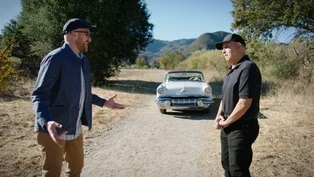
Morgan Yates traces the origins of the Auto Club of Southern California back to motor racing.
The Auto Club of Southern California’s archives charts Los Angeles’ love affair with the automobile. Morgan Yates talks about AAA’s origins as a promoter of motor racing. The club notably organized the Cactus Derby, a race covering 500 miles of desert between LA and Phoenix. Spurring advocacy for “good roads” in the US, they called for paved roads outside the city limits and into rural areas.
Problems playing video? | Closed Captioning Feedback
Problems playing video? | Closed Captioning Feedback
Lost LA is a local public television program presented by PBS SoCal
The Race From LA to Phoenix
Clip: Season 8 Episode 1 | 3m 56sVideo has Closed Captions
The Auto Club of Southern California’s archives charts Los Angeles’ love affair with the automobile. Morgan Yates talks about AAA’s origins as a promoter of motor racing. The club notably organized the Cactus Derby, a race covering 500 miles of desert between LA and Phoenix. Spurring advocacy for “good roads” in the US, they called for paved roads outside the city limits and into rural areas.
Problems playing video? | Closed Captioning Feedback
How to Watch Lost LA
Lost LA is available to stream on pbs.org and the free PBS App, available on iPhone, Apple TV, Android TV, Android smartphones, Amazon Fire TV, Amazon Fire Tablet, Roku, Samsung Smart TV, and Vizio.
Providing Support for PBS.org
Learn Moreabout PBS online sponsorshipMasters: If you want to understand LA's love affair with the automobile, there's no better place to start than the archives of the Automobile Club of Southern California.
From traffic laws to license plates to city planning, the Auto Club's records chart the city's evolution on 4 wheels.
And tucked among the maps and manuals is a surprise.
The story of how motor racing helped drive it all forward.
So I think most of us think of the Auto Club as the group that rides to our rescue when we have a flat tire or a dead battery.
But what most people don't know is that it has its origins in motor racing.
Man: Way back at the very beginning, 1901 or so, the club was at that time really a social organization, and we were interested in good roads.
We were interested in also racing, this idea of promoting the automobile in all of its guises, including as a form of entertainment.
Sitting in the stands watching these newfangled machines go faster and faster.
Masters: And one of the first auto races in Southern California was at the Coliseum, or where the Coliseum is now was then Agricultural Park.
Yates: Yes.
What we're looking at here is an original program for the 1903 Auto Meet that was sponsored by the Automobile Club of Southern California.
So this is 121 years old, and it's as fragile as-- as anything that age.
Masters: Right.
Yates: Whoever had this at the meet had their pencil as well.
It's like keeping score at a baseball game.
They were writing down the results of some of the races.
So they have the times and the distances.
This first one is for-- they talk about the type of vehicle.
Masters: Gasoline machines only.
Yates: Right.
And I think it's a 5-mile race.
And here was the winning time: 5 minutes and 45 seconds.
And if it wasn't a gasoline machine, it would have been most likely a steamer, like the white steamer or the Stanley steamer.
So this was back before the internal combustion engine had kind of won the day as a mode of powering automobiles.
So there were steamers, there were electric cars.
Masters: Right.
Yates: And then the-- the gasoline engine.
Masters: So, 1903, there's the first organizer, the first Auto Club-sanctioned race.
It was a track race, but the Auto Club was also organizing road racing, too, a few years later.
Yates: Yes.
And so if you think about Formula One, the Grand Prix is where they will take over these road routes.
So they're driving on-- on surface streets.
Well, that has a long history as well.
The LA-to-Phoenix road race, of course, is hundreds of miles.
Masters: This is, what, this is 1911.
Back then, this is an adventure.
And I mean, we're talking about harsh, unforgiving desert.
Yates: But also, you know, the roads were often in abysmal condition.
Masters: Yeah.
Yates: The last year of the race in 1914 was notable because it was raining for most of the time.
So they were going through muck, and they picked a different route.
Masters: That's a very different--we're going through the Mojave here instead of the Colorado Desert.
Yates: Right, and you can see that the cartographers marked the previous years on there, so you can kind of get a sense of how it was a little bit different.
They had to ferry across the Colorado River.
Masters: Wow.
Yates: There were 20 entrants on this one.
In 1914, only 8 of them made it.
So even though these were race cars, they were still quite fragile.
Masters: And I imagine that soon after this, or maybe during this time, while the Auto Club was organizing and sanctioning these races, it was also advocating for, hey, let's extend the paved roads out-- outside of the city areas.
Yates: About 20 years before that, in 1880, road advocates were the bicyclists.
They came on the scene.
The League of American Wheelmen came on and they had the motto "Good Roads."
They wanted smooth roads to ride on.
So here you have, 20 or so years later, the automobile comes on the scene and it picks up that mantle of the Good Roads movement.
It was the Auto Club of Southern California's motto.
The Fast and the Forgotten (Preview)
Preview: S8 Ep1 | 30s | Auto racing's LA roots, from dry lake beds to movie ranches, left tread marks across the region. (30s)

Video has Closed Captions
Clip: S8 Ep1 | 4m 31s | Harold Osmer retraces the origins of speedway racing in Los Angeles. (4m 31s)
Providing Support for PBS.org
Learn Moreabout PBS online sponsorship











Support for PBS provided by:
Lost LA is a local public television program presented by PBS SoCal