
The Greatest Adventure | Parenthood
Season 44 Episode 10 | 54m 33sVideo has Audio Description
Parenthood is the ultimate journey, full of danger.
Parenthood is the ultimate journey, full of danger. Lionesses teach their cubs how to survive by showing them how to tackle giant buffalo. Burrowing owls provide an underground nest for their chicks and mimic a rattlesnake’s sound to protect them.
See all videos with Audio DescriptionADProblems playing video? | Closed Captioning Feedback
Problems playing video? | Closed Captioning Feedback
Major support for NATURE is provided by The Arnhold Family in memory of Henry and Clarisse Arnhold, Sue and Edgar Wachenheim III, The Fairweather Foundation, Charles Rosenblum, Kathy Chiao and...
The Greatest Adventure | Parenthood
Season 44 Episode 10 | 54m 33sVideo has Audio Description
Parenthood is the ultimate journey, full of danger. Lionesses teach their cubs how to survive by showing them how to tackle giant buffalo. Burrowing owls provide an underground nest for their chicks and mimic a rattlesnake’s sound to protect them.
See all videos with Audio DescriptionADProblems playing video? | Closed Captioning Feedback
How to Watch Nature
Nature is available to stream on pbs.org and the free PBS App, available on iPhone, Apple TV, Android TV, Android smartphones, Amazon Fire TV, Amazon Fire Tablet, Roku, Samsung Smart TV, and Vizio.
Buy Now
Explore More Ways to Watch
Bring the beauty and wonders of wildlife and natural history into your home with classic NATURE episodes.Providing Support for PBS.org
Learn Moreabout PBS online sponsorshipPart of These Collections
What's Streaming on NATURE?
Here are the episodes of NATURE currently available to stream online.
View Collection
Parenthood
David Attenborough narrates the adventures of animal parents around the world.
View CollectionProviding Support for PBS.org
Learn Moreabout PBS online sponsorship♪♪ ♪♪ ♪♪ ♪♪ [ Animals trilling, squawking ] ATTENBOROUGH: A female western lowland gorilla.
And her newborn.
Just moments old.
♪♪ For his mother, the arrival of her young baby is the start of a new chapter in her adult life.
♪♪ Parenthood.
♪♪ ♪♪ Her journey will be challenging.
Full of excitement... uncertainty... and complete commitment.
♪♪ There will be mistakes.
There always are.
♪♪ But success for her, and, indeed, for all parents, has perhaps the greatest of consequences.
♪♪ It ensures the future of life on our planet.
♪♪ ♪♪ ATTENBOROUGH: Parenthood is a journey like no other.
♪♪ The responsibility of providing constant food and safety for offspring can be extremely challenging.
♪♪ For most, it all begins with a good home.
♪♪ A mother lion in the grasslands of the Kalahari in Botswana.
♪♪ Her 20-strong pride is ruled by her and her sisters... ...who each has her own cubs.
One mighty family who help each other through thick and thin.
♪♪ For months, their home is scorched by 45-degree heat.
[ Thunder rumbles ] [ Thunder crashes ] But once a year, their territory is brought to life by distant rains.
♪♪ ♪♪ Up until now, these cubs have had very little experience of water.
So their mother will have to guide them to get them through the trauma.
♪♪ [ Cub yowls ] ♪♪ ♪♪ Getting used to swamp living is a vital part of their cubs' upbringing.
Because these precious waters attract animals from miles around.
[ Cape buffalo lowing ] Cape buffalo.
The smell of fresh water lures them from the surrounding savanna, and they come in extraordinary numbers.
♪♪ A herd 3 miles long and full of 1-ton animals.
♪♪ ♪♪ They, too, cannot survive without the water at the center of the lion's territory.
♪♪ She must show her cubs that patience is their greatest ally.
♪♪ Once in the swamp, the buffalo spread out into smaller groups.
Lionesses will take the lead in any hunt.
But a mother here has the added pressure of having to teach her growing cubs how to tackle giants.
♪♪ ♪♪ One swipe of its horns could kill any one of them.
The cubs must watch and learn.
[ Cape buffalo grumble, snort ] ♪♪ ♪♪ ♪♪ ♪♪ ♪♪ The younger lions are allowed to be the first to feast.
Hunting giants, however, is not without its risks.
One of the pride's mothers is missing.
[ Lion mewls ] Contact calls go unanswered.
[ Lioness mewls ] [ Mewling continues ] ♪♪ ♪♪ In attempting to provide food for her young, she has been gored by a buffalo.
There is nothing the pride can do to help.
♪♪ With her cubs too young to hunt for themselves, her death leaves their future uncertain.
[ Cub mewls ] ♪♪ ♪♪ But they don't have to face it alone.
♪♪ ♪♪ The matriarchs will take on responsibility for them.
♪♪ ♪♪ In lion society, females often share the load of parenting.
Related adults will continue to care for the orphans alongside their own offspring.
It'll be another year before they're fully independent.
In that time, they must be taught how to survive here.
♪♪ And luckily for them, the leader of this pride is an excellent teacher.
♪♪ ♪♪ ♪♪ Parental investment is a risky strategy for many animals.
Particularly in the largest of all habitats, the ocean.
♪♪ The sheer diversity of life makes some parts of the ocean a highly competitive environment.
So the animals who choose to raise their offspring here need to have an edge.
♪♪ Here in Indonesia, protected by the reef, lives one of the ocean's most ingenious parents.
A female boxer crab.
Attached to her underside is her brood of over a thousand eggs.
Her challenge is to keep them safe until they hatch.
Whilst keeping herself well fed.
So, like any good parent, she's come prepared with a solution.
♪♪ On her claws are live anemones that she's collected from the reef around her.
The anemones filter food from the surrounding water, which the crab mother steals for herself.
It's an ingenious way to keep energized while looking after young.
♪♪ But it's not without risk.
To capture the food she needs, she must take her anemones out in the open.
♪♪ A cuttlefish.
A cunning predator that pounces on the unprepared.
♪♪ ♪♪ Exposed and alone... ♪♪ ...she is a sitting crab.
♪♪ But she isn't defenseless.
Her anemones have venomous stings that can deter most predators.
A very effective weapon for a mother in need of protection.
♪♪ In fact, her anemones are such good tools that they are highly prized amongst the crab community.
♪♪ ♪♪ And this mother has a jealous rival.
♪♪ Empty clawed, her opponent will do anything to secure her own anemone.
♪♪ ♪♪ She isn't going to surrender them without a fight.
♪♪ ♪♪ Overpowered, the mother loses one of her anemones.
The battle leaves her exhausted and vulnerable.
She needs to lie low and buy herself some time.
Because this super mum has yet another trick.
Slowly and meticulously, she dissects her remaining anemone, creating a clone.
♪♪ Her remarkable problem-solving allows her to keep herself and her young alive for a few more days.
Until, eventually, she's ready to let them go.
♪♪ ♪♪ Climbing to the top of her coral home, she begins to release her tiny offspring into the current... ...a few at a time... ...until all her crablets are independent.
Thanks to her care and attention, she has given them an excellent start in life.
♪♪ Raising offspring alone is extremely challenging.
So, many parents resort to teamwork.
♪♪ A female burrowing owl is looking for a partner amongst the wildlands of Arizona.
And this young male seems eager to please.
♪♪ To win her over, he must first find a decent burrow, and that is proving tricky.
Burrowing owls use holes abandoned by other animals.
But the ones he's found are either still in use... [ Screeching ] ...or already have well-established families.
♪♪ Her patience is running thin.
♪♪ [ Chittering ] When finally he's found one, she flies in for a closer inspection.
♪♪ ♪♪ The hallway clearly requires a little housekeeping.
Though small inside, it's deep enough underground to keep her chicks cool in the midday heat.
Returning to await her verdict... ♪♪ ...he receives a less-than-enthusiastic yes.
♪♪ Over the coming weeks, she will lay one egg a day and then incubate them all until they hatch.
His responsibility now is to provide her with a constant supply of food.
♪♪ Until, eventually, their teamwork pays off.
♪♪ [ Chick squeaks ] ♪♪ At first, the father's food supplies are enough to keep their chicks growing.
But soon, both parents will have to work to put enough food on the table.
♪♪ ♪♪ ♪♪ ♪♪ All this constant activity inevitably attracts attention.
♪♪ ♪♪ A roadrunner.
[ Roadrunner coos ] Fast and wily, this opportunist could kill an entire brood of young chicks.
♪♪ Their burrow has been chosen to keep them hidden from predators.
But at the first sign of danger, the chicks create a deterrent.
[ Chicks screeching ] Their call mimics the sound of an angry rattlesnake.
[ Screeching continues ] But rattlesnakes are one of the roadrunner's favorite prey.
Returning with takeaway, the father is alerted to the danger.
♪♪ [ Birds squawking ] Disaster averted.
[ Chittering ] But now both parents are caught between keeping a watchful eye on their chicks and providing enough food for them to grow large enough to defend themselves.
♪♪ They work around the clock.
♪♪ And their chicks' expectations are seemingly never-ending.
The parents' lives soon reach a turning point.
The growing chicks begin spending more and more time exploring their surroundings.
And there are less demands on the parents, as a few of the chicks become capable of finding their own snacks.
♪♪ [ Chick squawking ] For the parents, that is a welcome relief.
[ Squawking continues ] ♪♪ Parenthood is even harder when the environment is working against you.
And for those parents who need reliable fresh water to raise their young, the conditions are rarely perfect.
♪♪ The Ruaha River in Tanzania.
For most of the year, it provides a lifeline to those that live here.
But during the dry season, this refuge almost disappears... [ Elephants grumbling ] ...leaving this mother hippo and her calf with a dilemma.
[ Hippos grunting ] He was born just two months ago at a time when water was plentiful.
But now there are only a few pools left where the water is still deep enough to shield him from the harsh sun.
The other hippos in the area have had the same idea, so her newfound nursery has become...a little crappy.
♪♪ ♪♪ ♪♪ For now, though, hygiene is the least of the mother's worries.
These enormous fountains of fertilizer require over 100 pounds of vegetation every day.
And now, in the dry season, that is a problem.
Good grazing is nearly 1 1/2 miles from the safety of the river.
But it's too hot to make the journey in daytime.
♪♪ She must wait until nightfall.
♪♪ In the cool of the night, the surrounding bush comes alive.
But with darkness comes the unknown.
♪♪ Like it or not, the hippos must leave the safety of their pool and head into the night in search of food.
♪♪ The mother must not leave her calf alone, so the pair begin the slow and uncertain walk to find distant grazing.
♪♪ ♪♪ ♪♪ ♪♪ There is some safety in numbers close to the water, but this far into the dry season, the best food is further away.
♪♪ Their size offers them some protection.
♪♪ A hippo mother is a formidable bodyguard.
Her mouth is filled with 20-centimeter ivory tusks that serve only for defense.
But a young hippo is vulnerable.
So the calf must never stray too far from his mother.
[ Animal yowls ] ♪♪ ♪♪ ♪♪ ♪♪ There is an unnerving quietness to the bush around her.
But now they are too far from the water to seek refuge there, and their stalkers know this.
♪♪ A nearby male also senses danger, and he joins the mother.
Even in small groups, hippos can defend themselves against a single lion.
But not against a pride.
♪♪ The mother knows if they all hold their ground, they might have a chance.
[ Hippos grunt ] ♪♪ The less experienced male panics... [ Hippo bellows ] ...and they lose their advantage.
[ Hippos grunting ] ♪♪ ♪♪ [ Animals screeching ] The body of a young male hippo will keep a pride fed for a week.
♪♪ The mother and her calf returned to the protection of their pool.
They have had a lucky escape.
♪♪ But the mother hippo's remaining refuge will soon dry out.
And she and her calf will have to travel further and further into the unknown.
They'll need to do this every night.
♪♪ All parents need dedication in the face of adversity.
♪♪ The quest for food can be a seemingly never-ending commitment for many parents.
And here in Namibia, one takes that commitment to extremes.
This female African social spider laid her eggs just days ago.
And now her brood of 30 spiderlings are dependent on her for food.
♪♪ So, in their early life, she regurgitates a milky liquid which the spiderlings drink directly from her mouth.
♪♪ They will grow to 10 times this size in the coming weeks.
To fuel such growth, she will need to leave her nursery to hunt.
♪♪ ♪♪ Luckily, this mother has family she can rely on.
50 fully grown adult sisters who share her nest.
And who hunt in perfect unison.
♪♪ ♪♪ By stopping simultaneously, they can listen with their feet to detect the whereabouts of their prey in their vast nest.
♪♪ ♪♪ ♪♪ Within weeks, her spiderlings are ready to start hunting for themselves.
And as they grow, her offspring and all their cousins become insatiable.
♪♪ They're born with the ability to hunt together as a pack, just like their mothers.
Only now, there are over a thousand of them.
♪♪ ♪♪ ♪♪ Her role is almost over, which is just as well.
Since laying her eggs, the mother's condition has been deteriorating, and her movements have become labored.
The demands of parenthood are finally taking their toll.
But she has one more gift for her offspring.
The only thing she has left.
♪♪ Her struggling appears to mimic the vibrations of a distressed prey insect.
And her hungry spiderlings descend en masse to their mother's dinner table one last time.
Only this time, she is the main course.
♪♪ ♪♪ ♪♪ Hers is the ultimate sacrifice, born out of a need to ensure the survival of the next generation.
♪♪ But the spiderlings are not yet finished.
♪♪ They turn on their surviving relatives, eating every adult in the colony one by one.
♪♪ Until the next generation... is all that is left.
Parental sacrifice on this scale is rare in the natural world.
Though there comes a time in a parent's journey when all that effort seems worth it.
♪♪ ♪♪ A female western lowland gorilla in Gabon.
She will help her young for almost four years to learn the complexities of living in their jungle home.
But as he becomes more independent, she must let go and allow him to acquire the rules of a gorilla's social life.
♪♪ ♪♪ His newfound independence triggers a crucial moment in his mother's journey.
It gives her the chance to think about her next stage of parenthood.
The father of her young one is reaching the end of his prime.
At 34, he's old for a silverback.
And unbeknownst to him, he is under constant assessment.
Female lowland gorillas will leave their troop if they think there might be better options.
And that decision all boils down to one thing.
Has he still got it?
[ Gorilla grunting ] Hmm.
Not bad.
Her offspring will inherit his excellent physique, giving them a good head start in life.
♪♪ [ Body thuds ] ♪♪ Braun isn't the only thing she considers.
Though males play little part in raising their offspring, females nonetheless prefer males with a degree of tolerance.
And the old silverback has always been good with kids.
♪♪ On top of his physique and character, she's also constantly assessing what his territory has to offer.
♪♪ Wherever it comes from... ...good and plentiful food is crucial for any mother trying to raise her young.
♪♪ And variety helps parents teach their young about what to eat and where to find it.
In the food department, he scores highly.
♪♪ ♪♪ He even has a swamp, which might not sound like much, but the grasses here provide much needed protein to a lowland gorilla's diet.
She also is looking for protection when life gets risky.
[ Elephant trumpets in distance ] [ Elephant rumbles ] The forest elephant is not immediate competition but a threat to young gorillas nonetheless.
[ Elephant rumbles ] ♪♪ [ Gorilla chuffing ] Willingness to stand up to those bigger than him is certainly attractive in a partner.
♪♪ ♪♪ If she chose to leave, however, there would be significant risks.
♪♪ Any new male with whom she associates could kill infants that aren't his own, so she'll have to leave her child behind.
And it would take months to establish herself within a new troop.
Here, at least, she already has a partner.
Just a slightly mature one.
♪♪ For now, it seems he has passed her test.
♪♪ But there's still time to change her mind.
[ Gorilla farting ] ♪♪ Parental strategies have evolved over millennia.
But now, over 80% of the Earth's landmass is affected by human activity, and animal parents are having to adapt to this new world.
♪♪ ♪♪ An endangered Iberian lynx, known as Audrina.
♪♪ ♪♪ This abandoned barn is the best place left for Audrina to raise her five kittens.
♪♪ It's an excellent refuge for her growing family -- cool, sheltered, and full of activities for soft play.
[ Lynx hisses ] In fact, this place is so good that Audrina is not alone.
Both her mother and her daughter have chosen to raise their kittens here.
Three generations raising their young together.
A rare phenomenon and a sign of hope.
But the recovery of lynx here has only been possible by what has happened outside the barn.
♪♪ Less than a decade ago, the farmers here chose to change their practice to suit the native wild animals.
They stopped hunting and began creating habitat amongst their crops.
And quicker than anyone had imagined, the native animals moved back in.
First, prey, then predators.
Soon, the farm became a safe refuge for parents like Audrina to introduce their kittens to a world that had been redesigned with them in mind.
One where kittens have room to explore... ...play... [ Lynx hisses ] ...and hunt.
♪♪ And they thrived.
We are beginning to understand that it's possible to use our world for our needs whilst also providing for wild animals.
♪♪ And we are discovering that, by doing so, it's possible to help other species.
♪♪ ♪♪ Iberian lynx have begun a remarkable recovery, but their fate still remains in the balance.
The future is uncertain for all parents across our world.
But what is clear is that, for all of us to survive, we will need to help each other.
♪♪ ATTENBOROUGH: The "Parenthood" team relied on experts all over the world.
MAN: This shoot would have obviously been impossible for us without the help of all the amazing guides and trackers we had.
DR.
ROBBINS: For this project to succeed, we need to work together with the Babongo.
ATTENBOROUGH: It is Babongo trackers' carefully crafted relationship with the gorillas that is key.
[ Speaking French ] The "Parenthood" crew traveled to South Africa's Malgas Island to film the remarkable parenting story of the endangered Cape gannet.
DR.
STRYDOM: You can clearly see what it used to be like.
This was all nest right up until the house, and now the colony starts way back there.
The single largest threat to the Cape gannet is the decline of food resources.
There's not enough fish.
And what some seals have now learned is that the gannets carry fish in their stomach.
In a day, just one day, we can have a hundred or more predated out at sea.
ATTENBOROUGH: As the climate heats, rainfall is becoming less reliable everywhere.
There is often too much or too little and at the wrong time, a significant challenge for the "Parenthood" crews while filming the series.
East Africa was in the grip of a historic drought, and the consequences for both wildlife and people became clear.
SAMUELS: We've just been filming a group of elephants, and they just ran into a big heed of cattle.
WOMAN: How do you deal with 10,000 cattle as an elephant?
It's a whole level of parenting skills that they're not equipped to deal with.
ATTENBOROUGH: The lack of fresh water and grass has put both people and elephants under immense pressure.
We have the power to help nature recover, and sometimes it's the simplest changes that can have the most profound impacts.
In the vast grasslands of Patagonia, the "Parenthood" team are here to record the story of adult guanacos and their calves.
Soon, the issues facing guanaco parents became clear.
It's estimated that fences are responsible for the deaths of at least 30,000 guanaco in Patagonia every year.
DAVIES: If they just made them a tiny bit lower, be such a simple solution, and it would make the world of difference, I think.
HEINONEN: If there is no guanacos, the ecosystem will collapse.
I have a complete hope and I'm very optimistic of the capacity of nature to recover.
ATTENBOROUGH: While the climate changes and resources dwindle, every community can find ways to support the natural world.
It's up to us to ensure that they and generations to come will have a planet worth inheriting.
♪♪ ♪♪ ♪♪ ♪♪ ANNOUNCER: To learn more about what you've seen on this "Nature" program, visit pbs.org.
♪♪
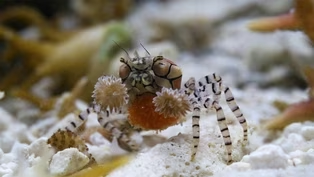
How This Crab Mom Fights With Living Weapons
Video has Closed Captions
Clip: S44 Ep10 | 2m 59s | A boxer crab mother relies on living anemones for defense. (2m 59s)
Parenthood Diaries: Behind the Scenes
Video has Closed Captions
Clip: S44 Ep10 | 3m 36s | Go behind the scenes of our miniseries "Parenthood." (3m 36s)
Preview of Parenthood "The Greatest Adventure"
Video has Closed Captions
Preview: S44 Ep10 | 30s | Parenthood is the ultimate journey, full of danger. (30s)
Spider Mother Devoured by Children
Video has Closed Captions
Clip: S44 Ep10 | 3m 17s | This spider mother provides one last meal for her brood: herself. (3m 17s)
Providing Support for PBS.org
Learn Moreabout PBS online sponsorship
- Science and Nature

Explore scientific discoveries on television's most acclaimed science documentary series.














Support for PBS provided by:
Major support for NATURE is provided by The Arnhold Family in memory of Henry and Clarisse Arnhold, Sue and Edgar Wachenheim III, The Fairweather Foundation, Charles Rosenblum, Kathy Chiao and...