
The Fast and the Forgotten
Season 8 Episode 1 | 27m 10sVideo has Closed Captions
Auto racing's LA roots, from dry lake beds to movie ranches, left tread marks across the region.
Explore Southern California’s century-long love affair with car racing. Once a major form of entertainment, racing drew crowds and shaped the region’s car culture. Nathan visits the Auto Club of Southern California’s archives, watches land speed racers in the high desert, tours the Petersen Museum’s vault and uncovers the hidden racing history of the Santa Monica Mountains.
Problems playing video? | Closed Captioning Feedback
Problems playing video? | Closed Captioning Feedback
Lost LA is a local public television program presented by PBS SoCal
The Fast and the Forgotten
Season 8 Episode 1 | 27m 10sVideo has Closed Captions
Explore Southern California’s century-long love affair with car racing. Once a major form of entertainment, racing drew crowds and shaped the region’s car culture. Nathan visits the Auto Club of Southern California’s archives, watches land speed racers in the high desert, tours the Petersen Museum’s vault and uncovers the hidden racing history of the Santa Monica Mountains.
Problems playing video? | Closed Captioning Feedback
How to Watch Lost LA
Lost LA is available to stream on pbs.org and the free PBS App, available on iPhone, Apple TV, Android TV, Android smartphones, Amazon Fire TV, Amazon Fire Tablet, Roku, Samsung Smart TV, and Vizio.
Providing Support for PBS.org
Learn Moreabout PBS online sponsorshipNathan Masters: A strange machine puttered through the streets of Los Angeles one early morning in 1897.
Moving under its own power, LA's first horseless carriage crept along at only 6 miles per hour.
But Angelenos quickly shifted into high gear.
Southern California embraced the automobile faster than almost anywhere else and became a proving ground for American motor racing.
From wooden speedways to desert lake beds, racing didn't just entertain.
It shaped the region's identity and paved the way for the city we know today.
Announcer: This program was made possible in part by a grant from Anne Ray Foundation, a Margaret A. Cargill philanthropy.
Masters: If you want to understand LA's love affair with the automobile, there's no better place to start than the archives of the Automobile Club of Southern California.
From traffic laws to license plates to city planning, the Auto Club's records chart the city's evolution on 4 wheels.
And tucked among the maps and manuals is a surprise.
The story of how motor racing helped drive it all forward.
So I think most of us think of the Auto Club as the group that rides to our rescue when we have a flat tire or a dead battery.
But what most people don't know is that it has its origins in motor racing.
Man: Way back at the very beginning, 1901 or so, the club was at that time really a social organization, and we were interested in good roads.
We were interested in also racing, this idea of promoting the automobile in all of its guises, including as a form of entertainment.
Sitting in the stands watching these newfangled machines go faster and faster.
Masters: And one of the first auto races in Southern California was at the Coliseum, or where the Coliseum is now was then Agricultural Park.
Yates: Yes.
What we're looking at here is an original program for the 1903 Auto Meet that was sponsored by the Automobile Club of Southern California.
So this is 121 years old, and it's as fragile as-- as anything that age.
Masters: Right.
Yates: Whoever had this at the meet had their pencil as well.
It's like keeping score at a baseball game.
They were writing down the results of some of the races.
So they have the times and the distances.
This first one is for-- they talk about the type of vehicle.
Masters: Gasoline machines only.
Yates: Right.
And I think it's a 5-mile race.
And here was the winning time: 5 minutes and 45 seconds.
And if it wasn't a gasoline machine, it would have been most likely a steamer, like the white steamer or the Stanley steamer.
So this was back before the internal combustion engine had kind of won the day as a mode of powering automobiles.
So there were steamers, there were electric cars.
Masters: Right.
Yates: And then the-- the gasoline engine.
Masters: So, 1903, there's the first organizer, the first Auto Club-sanctioned race.
It was a track race, but the Auto Club was also organizing road racing, too, a few years later.
Yates: Yes.
And so if you think about Formula One, the Grand Prix is where they will take over these road routes.
So they're driving on-- on surface streets.
Well, that has a long history as well.
The LA-to-Phoenix road race, of course, is hundreds of miles.
Masters: This is, what, this is 1911.
Back then, this is an adventure.
And I mean, we're talking about harsh, unforgiving desert.
Yates: But also, you know, the roads were often in abysmal condition.
Masters: Yeah.
Yates: The last year of the race in 1914 was notable because it was raining for most of the time.
So they were going through muck, and they picked a different route.
Masters: That's a very different--we're going through the Mojave here instead of the Colorado Desert.
Yates: Right, and you can see that the cartographers marked the previous years on there, so you can kind of get a sense of how it was a little bit different.
They had to ferry across the Colorado River.
Masters: Wow.
Yates: There were 20 entrants on this one.
In 1914, only 8 of them made it.
So even though these were race cars, they were still quite fragile.
Masters: And I imagine that soon after this, or maybe during this time, while the Auto Club was organizing and sanctioning these races, it was also advocating for, hey, let's extend the paved roads out-- outside of the city areas.
Yates: About 20 years before that, in 1880, road advocates were the bicyclists.
They came on the scene.
The League of American Wheelmen came on and they had the motto "Good Roads."
They wanted smooth roads to ride on.
So here you have, 20 or so years later, the automobile comes on the scene and it picks up that mantle of the Good Roads movement.
It was the Auto Club of Southern California's motto.
Masters: Even as the dream of smooth, reliable highways was becoming a reality, something else was accelerating.
LA's need for speed.
By the 1910s, speedways were popping up across the region, turning bean fields and dusty streets into proving grounds for man and machine.
And it all started on an old horse track just beyond the city limits, in a rowdy fairground known then as Agricultural Park, home today to the LA Memorial Coliseum.
Most people might associate this place with USC football.
Rams and the Raiders.
Maybe the Dodgers.
And of course, two going on 3 Olympic Games.
But what a lot of people don't know is that this, when it was--back when it was Agricultural Park, this was the site of the first official motor race in Southern California.
Man: Yes.
That was 1903, which was part of the Fiesta Week celebrations, which today would be the county fair, because the Coliseum didn't show up for another 20 years.
But there was a one-mile thoroughbred horse racing track that was located here, and they had gambling and the whole bit until the city decided to shut that down, and that's part of why that track went away, and the place became useful for other things.
Masters: It was set up just beyond the city limits so people could get away with things like gambling.
There was a saloon under the stands.
Osmer: Yeah.
More auto racing has taken place in Southern California than any other place in the world.
174 different official auto racetracks.
And that's not Uncle Bob's back 40 or Jefferson Avenue or places like that.
No, these were officially sanctioned events, and that's not including motorcycles and go karts and everything else.
It was just part of the culture.
So it was just part of what people did.
Masters: And we're talking about places that you just would not associate with auto racing today.
Santa Monica, Beverly Hills.
Osmer: Right.
Masters: Those were the sites of famous racetracks.
Osmer: Auto racing is one of the main reasons that Santa Monica was able to retain its autonomy from Los Angeles.
They held the Santa Monica Road Races from 1909 through 1919.
It was an annual event.
They raced from Ocean to Wilshire up to the Old Soldier's Home, which is the Veterans Center at San Vicente, and came back down.
It was an 8 1/2-mile course.
And what happened was Los Angeles was annexing all of the little communities in the area to become what it is.
So the auto racing guy said, "Hey, we'll build your roads for you.
We'll make the roads a little wider.
We'll grade them, make them smooth.
You let us race on them and then after we're done racing, we'll smooth them out again and we'll do that."
And so there was a trade-off.
Santa Monica developed after other parts of the--of the city, and the auto racing brought them all that attention.
And they were the biggest races in the country at the time.
Man: ...Vanderbilt Cup race in Santa Monica, California, and there they go.
A new world speed record is being set by one of the greatest drivers in the country.
It's going to be Dario Resta, who wins with an average speed of 86.98 miles per hour.
Masters: Now, what you're saying about how the auto racing in Santa Monica was used as a promotional tool is fascinating because there was a symbiotic relationship between the developers and the promoters, and then the auto racing.
Osmer: Absolutely, yeah.
And so when the Rodeo Land and Water Company was dividing up their properties, they built the racetrack in Beverly Hills.
Of course, it was called Los Angeles Speedway because in 1920, when the place was built, nobody knew where or what a Beverly Hills was.
And the track operated from 1920 to '24, and it was a wooden speedway, a big oval made completely out of wood.
It was two by fours on edge.
Masters: They ran on wood.
On two by fours.
Osmer: The other problem you run into is you can't just take a circle, slice it in half, and add straightaways because the transition is too abrupt.
So they developed what's called the Searles spiral easement, which was borrowed from railroad technology.
It's to where it's a gradual change of radius and angle and these kind of things that come into play that allows for a smooth transition.
So the cars could effectively stay wide open and transition from the flat to the straightaway or to the curves, and then back down again and keep racing.
Masters: And this is a principle that's used in racetrack construction everywhere, but it was pioneered in Beverly Hills.
Osmer: Beverly Hills was the first one where they implemented the Searles spiral easement.
Masters: Despite how prevalent auto racing was in Southern California, so much of the evidence of it has just been obliterated.
Osmer: Yes.
[Both laugh] Osmer: It breaks my heart.
Masters: It's one of the great ironies of LA's racing history.
The same culture that helped build the city was slowly pushed out by its growth.
As land values soared, speedways disappeared.
Paved over, built up, nearly forgotten.
But the hunger for speed didn't subside.
As new speedways sprouted in more remote areas, a parallel culture took root on city streets.
There, young hot rodders turned quiet boulevards into makeshift drag strips until the police put the brakes on.
So the racers went searching for space and found it on the sun-baked flats of the high desert.
There, with nothing but sky above and dust below, hot rodding shifted gears and throttled forward.
[Engines revving] Man: This is an early Ford roadster.
Masters: This is what you would have seen out in the streets of LA in the thirties.
Man: This is-- this is how it all started.
Masters: This is--you want to connect with the sport's roots, you race something like this.
Man: Right.
So this is a 1926, '27 Ford roadster body that they've lengthened the front end of it to make it more streamlined, aerodynamic.
[Engine roaring] Masters: That is a thing of beauty.
Wow.
Lattin: So this is--would be one of the faster streamliners.
Probably the fastest car out here.
It'll probably get top time in the meet.
[Engine humming] Masters: I met up with Bill Lattin, vice president of the Southern California Timing Association, to see how the tradition still thrives and thrills at El Mirage Dry Lake.
Lattin: 1937, 1938, a bunch of hot rodders from Southern California were racing around the streets, and the--the cops were busting them and stuff, and so they had the wherewithal to come out to find this lake bed, which was a vast flat area.
These mountains are full of alkali, like, coming from Mount Baldy and stuff.
If you look at a satellite photo of it, it has this swath of gray matter in a satellite photo.
It all comes to here, and Mother Nature rains on it, fills it up during the wintertime.
It mends the lakebed of any damages.
It just comes and it settles here.
And so all these cracks get, like, filled in.
And it just becomes, like, almost like asphalt or concrete.
Masters: So your family has a long history in this sport.
Lattin: My dad first started racing, I believe it was in the late sixties.
I was very young.
Um, '71, 1971, I remember going to Bonneville with him and he raced a '53 Studebaker.
We went up there and stayed a few days.
He set a record and we came back.
I went every year after that.
So I learned how to do this since I could walk.
Masters: So you're normally out here competing, too.
You're not just directing the event.
Lattin: Yeah.
I got about 6 or 7 cars I've built that I've raced out here.
Masters: Wow.
So late thirties, your organization was founded.
You came out here.
It's a safer place to do land-speed racing.
Soon after that, I imagine World War II.
Lattin: Yep.
Masters: Caused a huge interruption.
Lattin: Yep.
It took all the men and women that could fight and they all went abroad to fight the war.
So racing pretty much stopped.
There was, uh, one in particular.
Karl Orr, his wife Veda stayed back.
Kind of kept it going.
They come out and--and just put on an event once in a while out here.
Masters: So Veda Orr kept the sport alive, in large part.
She distributed this newsletter.
It was circulated among servicemembers.
Lattin: Yeah, actually, my dad acquired all of her stuff and we got her husband's engines and got one of his cars, and all of her letters we produced into a book.
When they came back from the war, the innovations changed the whole world.
They could weld better.
There was better equipment.
Everything just made this boom.
Masters: So the innovations that made the US military a deadlier fighting force also made your sport faster.
Lattin: Yep.
Everybody got way smarter.
Masters: Robert Petersen was among the World War II veterans who turbocharged hot rod culture.
After serving as a reconnaissance photographer in the Army, he came home with sharp camera skills and big ideas in his headlights.
His first client as a publicist, the Southern California Timing Association, eager to tune up hot rodding's image by focusing on innovation, not danger.
In January 1948, Petersen and his partner Robert Lindsay produced a program for the world's first-ever hot rod exposition in Los Angeles.
That program became volume one, issue one of "Hot Rod" Magazine, the spark plug that ignited Petersen's publishing empire.
I headed to the Petersen Museum on Wilshire to see that inaugural issue for myself.
On my way to the archive, archivists Lauren Fisher and Nathaniel Salvini took me on a quick tour of the museum's vault, a treasure trove of more than 250 rare vehicles.
Our first stop, a Ford Model T that topped out at just 18 miles an hour, a reminder of how far auto racing has traveled.
Salvini: They built 15 million of these things, and it really democratized racing as well.
There was a huge aftermarket ecosystem, basically.
Masters: That aftermarket ecosystem was what set LA apart, letting racers push their cars far beyond what auto manufacturers intended.
Fisher: This is a wonderful example of a modified 1932 Ford.
Masters: Ford Roadster.
Salvini: Yes, and this one was built by Ray Brown, and he ran this on the dry lake beds.
Masters: And all people needed was a garage or backyard to rev up their dreams.
Fisher: We're actually coming to one of my favorite vehicles in the entire collection.
This is our Max Balchowsky Old Yeller Mark III.
It's a 1959.
And the reason I love this is that he built these in his backyard, practically.
They were called junkyard dogs.
He would get junkyard parts and put them and modify them, create engines that were faster.
His wife Ina was pretty much equal part in helping engineer and tune and take care of all of his race cars.
She grew up in her dad's mechanic shop.
Masters: As Nathaniel returned to his processing work, Lauren and I changed lanes and cruised into the Petersen's archives.
Fisher: We're down here in the archives of the museum.
Masters: It's always a treat to see these materials that are not always available to the public.
So we have here, it says volume one, number one, and it sold for 25 cents.
The date is cut off.
January 1940... Fisher: 1948.
Masters: '48.
OK.
Fisher: ...Hot Rod.
Yeah.
Masters: It seems like he found a magazine for almost every type of automobile interest because there's, like, 4x4, off-road, there's motorcyclists, there's-- whatever niche automotive interest you have, he found a publication for it.
Fisher: Yeah, and he was always interested in either starting a new title or acquiring a new title.
Masters: So we have a bunch of advertisements here.
Electronic Balancing Company, based in Long Beach.
Navarro Racing Equipment.
Glendale.
George Riley and Company.
They sold racing carburetors.
4-Wheel Drive in Los Angeles.
This is a little out of place.
Puritan Homemade Candies.
Fisher: Ha ha!
Hey, he sold advertising where he could.
Masters: Right.
Fisher: But you will notice that there's a lot of Los Angeles or Southern California-based advertisers.
But also, if you're going to be a hot rodder, you're going to use local companies.
Masters: Yes.
Fisher: It's not like today where it shows up in two days at your doorstep.
These were things that needed to be customized and manufactured, and you--you wanted a local company you could go to and talk to.
There was a huge aftermarket community for these rodders.
Masters: This really does underscore, though, the LA origins of this motorsport.
Fisher: Yeah.
Make no mistake about it.
Hot rodding is a Los Angeles sport.
Masters: So this is what made it into the magazine, but you have these prints here.
Fisher: Not everything was always published.
He was known for hiring a lot of these staff photographers, and they would go out to events and meets and races, and that was another thing that legitimized a lot of early hot rodding and racing, is that you had people showing up from a publication to take photos of it.
Masters: Yeah.
Fisher: I mean, that's a big deal.
It's publicity.
And this is actually a picture related to Karl and Veda Orr, who were hot rodders and-- Masters: Leaders in the community, right?
Fisher: Yes, absolutely.
And so there's gems like this that kind of talk about the diversity of hot rodding as well.
One of my favorite female racers is Paula Murphy.
They didn't tell her she couldn't do it until she started to try to do it.
Um, even taking away her racing license at one point.
Um, and--yeah, and the NHRA actually apologized to her.
Paula Murphy's a huge inspiration to a lot of female racers at the time, and it was very sweet when I met her.
She came to the museum.
She said, "I didn't know what I was doing at the time was such a big deal."
Masters: There used to be speedways all over LA, and most of them have just been completely erased from the landscape.
But if you have a discerning eye, you can locate some remnants.
Fisher: Exactly.
And that's exactly the type of stuff that we preserve in the archive, are a lot of, um, race programs and speedway advertisements, things like that.
Um, one in particular we have here from 1957 is from Speedway at Paramount Ranch.
Masters: Paramount Ranch, which was originally connected to the Paramount Film Studio.
Fisher: I believe so, yes.
Yeah.
Masters: Like almost the "Mad Men" era here.
Fisher: A little bit, yeah.
You're starting to get more graphic design in a lot of the advertising in these, um, and these are just race programs.
These were things that were, you know, kind of given out at races and whatnot.
People were getting very interested in racing.
Masters: Unlike so many other racetracks in Southern California, Paramount Ranch hasn't vanished in the rearview mirror.
It's still here, tucked into a bucolic canyon above Agoura Hills.
In fact, it's part of a unit of the National Park Service, the Santa Monica Mountains National Recreation Area.
I met up at Paramount Ranch with photographer Allen Kuhn, who captured dramatic images of the races held here in the 1950s.
So, Allen, there were once so many racetracks across Southern California, including right here in the Santa Monica Mountains.
Kuhn: Correct.
Masters: Unfortunately, there's just such little evidence of it that survived outside of photo archives like yours.
Kuhn: When we came here, we only did it for two years because it was a very dangerous course.
Masters: Right.
Kuhn: But when I first saw it, I thought, oh, boy, trees.
We got trees all over the place.
It was like being in Europe.
Experimenting with it.
There were so many different angles you could get.
That's one thing I did do was I got a lot of pictures with not such large cars, but a lot of background to it.
Masters: And that's how the National Park Service sort of got back in touch with this part of its history.
Through your photos.
Kuhn: This is one of my favorite places to shoot from, because you got the action of the turn here and you could get close.
Masters: There is no barrier separating these people from the--from the cars.
Kuhn: Basically, no.
It wouldn't have done any good anyway, because it had been the hay bale and a 2,000-pound car going, what, 80, 90 miles an hour.
I don't know how many hay bales you'd need.
Masters: Ha ha!
More than they would have put up, probably.
Kuhn: Yeah.
For sure.
Yeah.
OK, now you're coming up to the piece de resistance, and this is definitely my signature shot, as they say.
Masters: I can see why.
It says just everything about auto racing, right?
You have, like, a sense of danger.
Of course, the motion, the speed.
The look on his face is--his chin and-- Kuhn: This you have the sense of speed without-- without having motion.
Masters: Tom Young, a retired park ranger, helped uncover the nearly forgotten racing history of Paramount Ranch.
Now, years later, he brought down his vintage Pontiac to take me for a spin around the old track.
Young: We could hear that engine roar.
It wants to really take off.
Masters: Now--because now we're on the racetrack, of course.
Young: You betcha.
This is turn one.
That's right.
Masters: So how many national parks have a racetrack inside them?
Young: I've done a little bit of research on that and what I have found is none.
Masters: None.
So this is the only one.
Young: When we purchased this property in 1980, it was a working film ranch, but it was also a ranch.
There was cattle here online and so on and so forth.
So we knew that there was filming here.
But as we progressively moved into managing it, it became evident that this isn't a normal ranch that has a high banked turn and a bridge and all these other things, but it really wasn't until years later that we actually started to find out how significant it was when we started to encounter some of the racers who actually raced here, and they started telling their stories and it opened up our eyes.
Masters: So even if this racetrack only operated for a year and a half, there was a lot of history and a lot of action packed into those 18 months.
Young: During that time period, we had 5 sports car races here and two stock car races all crammed in that time period.
American manufacturers were going crazy with building new V8 engines.
Fuel injection for '57 Corvettes, Pontiacs.
Superchargers by Ford.
Couple that speed technology without a lot of suspension changes or braking technology.
So there may have been some forethought in knowing that cars were going faster, and that would have been also an influencing factor as to why they would stop racing here.
Masters: Over the course of a single weekend in 1957, 3 major crashes, including two that were fatal, stained the track's reputation.
Paramount Ranch never hosted a competitive race again.
Instead, the track shifted to a filming location for classics like "The Love Bug," "Munster, Go Home!
", and "The Devil's Hairpin."
Young: We're standing at a location where we can probably find the last standing racetrack guardrail, but I'm going to give you something.
It's a photograph.
And that photograph was taken from the 1957 "Devil's Hairpin."
We are literally standing where that... Masters: Oh, you can see, the ridgeline here matches.
Right there.
So this is-- right here.
The racetrack right here.
Young: We're standing on the racetrack, which means it's going to be this way.
Masters: Right.
Now, there are no rattlesnakes in here, right?
Young: There's no guarantees.
Masters: All right.
Let's go this way.
Young: I'm gonna go this way here.
Then I want you to walk back towards me.
That way there we got a good grid.
Masters: Well, we do see this tree.
I don't know if this is one of these trees that's still growing here.
Young: It could be.
Masters: It could be.
Young: And--oh.
Masters: Ohh!
[Laughs] I was expecting it to be higher, but of course, you're right.
It's been buried by all the sediment.
Young: It's hiding in plain sight.
Masters: Wow.
Young: So now we're standing at the edge of that guardrail in that photograph.
Masters: Oh, amazing.
Young: Hidden in plain sight.
And I've worked here for years.
I didn't know about it.
Masters: Tom and I continued to walk as much of the track as possible, hunting for more clues along the way.
So here's another big curve here.
This is the hairpin curve.
Young: That is the Devil's Hairpin curve.
Masters: The Devil's Hairpin.
OK.
And how did it get this devilish name?
Young: In the movie, this is the turn that created the drama where there was a possible life-and-death decision to be made.
You could build up a lot of speed coming into this, so much so that if you didn't plant your vehicle in the right place at the right time, you could literally slide off the road.
Masters: It sort of blows the mind because we're here on a quiet day in the Santa Monica Mountains, you know, surrounded by these native oaks.
Maybe we have some parrots up in the tree here.
But it's just this serene environment.
And yet in the 1950s, you would have cars screaming around these curves.
You'd have spectators everywhere.
I'm sure the parking lot was packed.
Young: It absolutely was.
Matter of fact, I just so conveniently have Art Evans' book called "Paramount Remembered."
Masters: Oh, wow.
Young: And the front cover shows almost exactly where we're standing.
Masters: This is where we are.
We're, like, right in the middle of this.
Young: That's exactly right.
We're right--we're right in the middle between these two cars.
Masters: So I realize that there are a lot of different values that you have to balance, and some of them are in conflict when you're the National Park Service.
But there's a lot of history here that is worth preserving, too, and I mean, the National Park Service is doing a great job of preserving the film history, right, and of course, the racetrack is part of the film history, but the auto racing is also a big part of the history of this tract of land.
Young: The nature of the National Park Service is what I had experienced in my career, is that we're very nature-loving and we--we love to teach others about that, educate them and protect our wildlife.
But when we focus on those things, we have a tendency to forget about those other cultural values that exist around us.
Maybe there's a story to be told.
Maybe we should try and protect some of this asphalt so we can tell this story for generations to come.
Because after all, that's what the Park Service is for.
We're here to preserve and protect and to do that in an indefinite way.
Masters: And car culture isn't just part of the American narrative, but it's car racing, especially as we've learned, is something special to the story of Southern California.
It's appropriate to preserve this for future generations to learn about that history.
Young: Well, I would hope so.
Masters: Is there more to see?
Young: There is more to see.
Masters: Let's go take a look.
Young: All right.
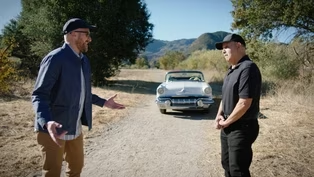
The Fast and the Forgotten (Preview)
Preview: S8 Ep1 | 30s | Auto racing's LA roots, from dry lake beds to movie ranches, left tread marks across the region. (30s)

Video has Closed Captions
Clip: S8 Ep1 | 4m 31s | Harold Osmer retraces the origins of speedway racing in Los Angeles. (4m 31s)
Video has Closed Captions
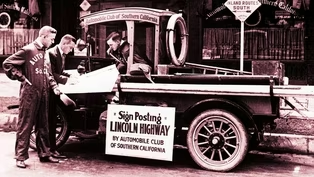
Clip: S8 Ep1 | 3m 56s | Morgan Yates traces the origins of the Auto Club of Southern California back to motor racing. (3m 56s)
Providing Support for PBS.org
Learn Moreabout PBS online sponsorship











Support for PBS provided by:
Lost LA is a local public television program presented by PBS SoCal