
Tamara Keith and Amy Walter on Democrats not playing it safe
Clip: 8/3/2026 | 9m 35sVideo has Closed Captions
Tamara Keith and Amy Walter on Democratic primary voters not playing it safe
NPR’s Tamara Keith and Amy Walter of the Cook Political Report with Amy Walter join Amna Nawaz to discuss the latest political news, including the Michigan Senate primary and the message Democrats are taking into the midterms, prosecutors dropping Reflecting Pool vandalism charges and President Trump's response.
Problems playing video? | Closed Captioning Feedback
Problems playing video? | Closed Captioning Feedback
Major corporate funding for the PBS News Hour is provided by BDO, BNSF, Consumer Cellular, American Cruise Lines, and Raymond James. Funding for the PBS NewsHour Weekend is provided by...
Tamara Keith and Amy Walter on Democrats not playing it safe
Clip: 8/3/2026 | 9m 35sVideo has Closed Captions
NPR’s Tamara Keith and Amy Walter of the Cook Political Report with Amy Walter join Amna Nawaz to discuss the latest political news, including the Michigan Senate primary and the message Democrats are taking into the midterms, prosecutors dropping Reflecting Pool vandalism charges and President Trump's response.
Problems playing video? | Closed Captioning Feedback
Where to Watch PBS News Hour
PBS News Hour is available to stream on pbs.org and the PBS app.
Providing Support for PBS.org
Learn Moreabout PBS online sponsorshipAMNA NAWAZ: Well, for more now on tomorrow's midterm primary races, we turn to our Politics Monday duo.
That is Amy Walter of The Cook Political Report With Amy Walter and Tamara Keith of NPR.
It's great to see you both.
AMY WALTER, The Cook Political Report: Hello.
TAMARA KEITH, National Public Radio: Good to be here.
AMNA NAWAZ: Let's pick up where Lisa left off, in Michigan.
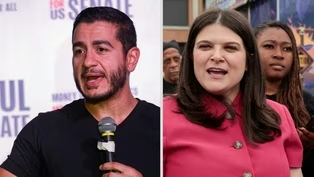
The defining issues in that Senate primary, you have got the moderate Congresswoman Haley Stevens and the progressive Abdul El-Sayed running to take on the presumptive Republican nominee, Mike Rogers.
Amy, for Democratic primary voters here, seems to be at issue of which direction they want to see the party go or which candidate they think can actually win in November.
Is that fair?
AMY WALTER: Right.
I do think that's fair.
And I think Haley Stevens was a great example of the kind of candidate that could win in the first Trump midterm election.
She was part of the establishment at a time when people in thought the establishment and institutions were going to be the answer to Trumpism.
She came from working in the Obama White House.
She was somebody who was going to stand up, all those things that Democrats believed Trump was knocking over.
In the eight years since then, what many Democratic voters have seen is that standing up for the -- what they thought were universal values of democracy, of institutions and of norms is no longer as powerful, and that those institutions and norms didn't protect the country from a second Trump election.
And so where you see Democrats now is very similar to where Republicans were at this point in, say, 2014 or even in 2010, when they believed that the Republican leadership was not properly reacting to the election of President Obama, and they needed a new direction to go.
So she will run and she's continuing to run on, I'm the electable candidate.
But I think, for many voters in Michigan, what they're saying is we don't need to play it safe anymore because playing it safe is really what got us Donald Trump back.
AMNA NAWAZ: And, Tam, we have already seen the Republican, Mike Rogers here, release an attack ad before he even knows who he's running against, against Abdul El-Sayed.
He's sort of depicting him as a Trojan horse who will bring communism to Michigan.
We should point out that El-Sayed doesn't identify as a Democratic Socialist, but he has several backing him.
What do you make of that line of attack?
TAMARA KEITH: I think we're going to see a lot of it.
That is a line of attack that we're going to see all over the country, whether the Democratic candidates are actually aligned with Democratic socialists or not, because that is one of the ways that Republicans have keyed in on to say, oh, those other guys, they are way too extreme for you.
And they're after this sort of narrow piece of the pie of voters who are actually persuadable.
And so what you have to do to convince a persuadable voter is to disqualify the other party.
And so absolutely this race is going to be -- if El-Sayed moves on to the general election, it is going to be like a pretty perfect test of can a populist progressive outsider win in a swing state?
And Mike Rogers is -- some people I have been talking to in the state have described him as sort of a plain vanilla Republican.
He's not -- he's not a flamethrower, he's obviously endorsed by President Trump, he's campaigned with President Trump, but he's sort of a mainline Republican.
And so you're going to see what happens when Democrats, if El-Sayed is the nominee, nominate someone who is considered a little bit more of a risk, who has taken some positions on social issues, not what he's campaigning on, but has taken some positions that could be portrayed as extreme.
And progressives are watching this and saying, hey, this is our chance.
If he can win in the general election, then we can convince well-meaning electability voters that, come 2028, they should vote with their hearts and not with their heads.
And let's also be clear that President Trump is so much more unpopular in Michigan today than he was in 2024.
TAMARA KEITH: Yes.
AMNA NAWAZ: That's a good point.
AMY WALTER: So the actual electorate looks a lot different today than it did in '24 than it will in 2028.
AMNA NAWAZ: And there's an issue Lisa pointed out in her reporting as well that is coming up in this election that hasn't as strongly in previous.
That's the funding from AIPAC in particular.
We see it as a factor in this primary.
We also seeing it in Missouri, where there also -- there's a primary there for the First Congressional District.
And that race is a rematch between the progressive Cori Bush and the moderate Wesley Bell.
Two years ago, Bush lost to Bell, blamed her loss on AIPAC's spending there.
But Lisa's reporting shows this is something voters are paying attention to you.
Why is this happening now?
AMY WALTER: Yes.
I think what they're paying attention to, it's less the issue of Israel, though the issue of Israel looks very different today to Democratic voters than it did a few years ago because of the war in Gaza.
So I think already you have seen the shift in opinions of Israel among Democrats going down significantly, and then the issue of corruption now being front and center and of money in politics being part of that corruption message.
When you hear the term AIPAC now in the way -- especially in Michigan, the way that El-Sayed talks about it is the corrupting power of money, right?
These are donors who are spending millions and millions of dollars to bring someone to Washington.
I'm not going to take that money, much more so than this is a debate between the two of them over Israel.
TAMARA KEITH: Yes, and this is something that we have seen in other primaries all over the country.
We saw it in Illinois.
We saw it in New Jersey.
And AIPAC money has become sort of a -- just like a phrase that represents money in politics, outside influence.
And we have to say that this comes at a time when the war in Iran is unpopular, and many of these candidates are on the Democratic side linking it to an economic message.
They are saying the money should be spent in America on health care and food and housing and not on a foreign war that we don't agree with or supporting Israel, which we don't agree with.
It is very much linked to that economic message in a way that may make it more resonant than just talking about foreign policy, which typically does not move elections in America.
AMNA NAWAZ: Meanwhile, I want to ask you about something we have seen from the president in the last few days.
He went on another sort of spree posting on TRUTH Social on Saturday, about 40 or so posts within an hour or so, ranging from A.I.-generated images of himself, hinting at a U.S.
takeover of Greenland or making Venezuela the 51st state, also a rebuke of his U.S.
attorney Jeanine Pirro, who's longtime been an ally of his.
That, as you both know, followed Pirro and the DOJ dropping charges on Friday against a man they accused of vandalism at the Lincoln Memorial Reflecting Pool, saying the damage in their filing was because of hasty installation and renovation, not because of vandalism.
We should note prosecutors just today have released -- or really actually pulled back more cases related to vandalism there, so they're dropping those charges.
President Trump continues to insist it was vandalism, even today in the Oval Office.
Here's what he had to say.
DONALD TRUMP, President of the United States: And I was disappointed with Jeanine Pirro, really disappointed with Jeanine Pirro.
She folded like an umbrella.
AMNA NAWAZ: Tam, explain to us why the president is doubling down on this and also reports that he could drop Jeanine Pirro now?
TAMARA KEITH: Because the president doubles down on everything.
The Reflecting Pool was an embarrassment for him.
It was supposed to be this glorious American flag blue, repairing something that Obama couldn't repair, and it became a metaphor, a really unfortunate metaphor for the president with green algae and paint peeling.
And he rapidly started blaming vandalism.
And it wasn't just once.
He blamed vandalism at least 20 times, by my count.
And the length of the gash that he said that the vandals put in the sealant got longer and longer and longer.
It was like 250 feet.
Then it was 300 yards.
It got longer and longer.
The reality is, he does not ever apologize.
He never looks back.
He always doubles down, even if, in court filings, the truth matters, which is a different than the court of public opinion, where he -- which is his realm.
AMY WALTER: Right.
And that's what -- the really important point, which is you can say whatever you want on TRUTH Social, you can make claims that are outrageous in the public square.
When you come in front of a federal judge, you cannot make those same comments, not only because you will lose your case, but you could also be held in contempt if you're actually lying, knowingly lying to a judge.
So the stakes are much higher for somebody who's actually arguing that case than for Donald Trump, who can actually just needle the person who's supposed to be arguing the case.
AMNA NAWAZ: Standards for evidence are higher as well.
AMY WALTER: Yes, those things.
AMY WALTER: I didn't go to law school, but I have heard such things.
AMNA NAWAZ: Nor did I. AMNA NAWAZ: Amy Walter, Tamara Keith, great to start the week off with you both.
Thank you so much.
AMY WALTER: Thank you.
TAMARA KEITH: You're welcome.
 New
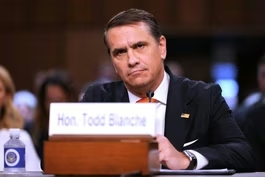
NewBlanche wins support from GOP holdouts after scrapping fund
Video has Closed Captions
Blanche wins support from GOP holdouts after vowing to scrap 'anti-weaponization fund' (4m 58s)
 New
NewCyberattacks on water systems reported in 7 states
Video has Closed Captions
What we know about the cyberattacks on water systems in 7 states (6m 32s)
 New
NewMichigan Senate primary divides Dems over direction of party
Video has Closed Captions
Contentious Michigan Senate primary divides Democrats over direction of party (7m 50s)
 New
NewNews Wrap: Michigan reports deaths related to cyclosporiasis
Video has Closed Captions
News Wrap: Michigan reports 2 deaths related to cyclosporiasis outbreak (6m 38s)
 New
NewSen. Moreno calls on ex-son-in-law Rep. Miller to resign
Video has Closed Captions
Sen. Moreno calls on ex-son-in-law Rep. Miller to resign amid domestic abuse allegations (4m 50s)
 New
NewTrump says new talks are Iran's 'last chance' to make deal
Video has Closed Captions
Trump says new talks are Iran's 'last chance' to make deal 'before decapitation' (8m 41s)
 New
NewWildfires destroy hundreds of buildings in Washington state
Video has Closed Captions
Wildfires destroy hundreds of buildings, displace tens of thousands in Washington state (3m 8s)
Providing Support for PBS.org
Learn Moreabout PBS online sponsorship New Episode
- News and Public Affairs

Today's top journalists discuss Washington's current political events and public affairs.

- News and Public Affairs

FRONTLINE is investigative journalism that questions, explains and changes our world.

 New Episode
 New Episode
 New Episode
 New Episode
 New Episode
 New Episode
 New Episode
 New Season
Support for PBS provided by:
Major corporate funding for the PBS News Hour is provided by BDO, BNSF, Consumer Cellular, American Cruise Lines, and Raymond James. Funding for the PBS NewsHour Weekend is provided by...