
Octavia Butler
Clip: Season 8 Episode 2 | 5m 51sVideo has Closed Captions
Ayana Jamieson describes Butler's legacy as an author who wrote “different ways of being human."
Ayana Jamieson has read every piece of Octavia Butler’s work that she has been able to get her hands on. Of course, she has read Butler’s published and unpublished novels, but Jamieson has also sifted through her archives of interviews, video recordings, personal papers, grocery lists, and more, all of which point to a profound influence that Southern California has had on her writing.
Problems playing video? | Closed Captioning Feedback
Problems playing video? | Closed Captioning Feedback
Lost LA is a local public television program presented by PBS SoCal
Octavia Butler
Clip: Season 8 Episode 2 | 5m 51sVideo has Closed Captions
Ayana Jamieson has read every piece of Octavia Butler’s work that she has been able to get her hands on. Of course, she has read Butler’s published and unpublished novels, but Jamieson has also sifted through her archives of interviews, video recordings, personal papers, grocery lists, and more, all of which point to a profound influence that Southern California has had on her writing.
Problems playing video? | Closed Captioning Feedback
How to Watch Lost LA
Lost LA is available to stream on pbs.org and the free PBS App, available on iPhone, Apple TV, Android TV, Android smartphones, Amazon Fire TV, Amazon Fire Tablet, Roku, Samsung Smart TV, and Vizio.
Providing Support for PBS.org
Learn Moreabout PBS online sponsorshipMasters: As the years passed, science fiction moved from niche to mainstream, but it never lost its edge.
One Southern Californian who pushed the boundaries of the genre was Pasadena's own Octavia Butler.
Her work, deeply rooted in her experience and her community, tackled issues of gender, race, and class while keeping one foot firmly in the world of sci-fi.
I met up with Butler expert Ayana Jamieson at one of the author's favorite spots-- Vroman's, a Pasadena institution and one of Southern California's oldest bookstores.
So L.A., or Greater Los Angeles, has these really strong associations with science fiction.
Where does Octavia Butler fit in?
Jamieson: I think she was very well-versed in knowing ways that people have been left out or deficiencies in the narratives that were told already.
She loved the genre because, she said, it had no closed doors, but also she didn't like the way that people were portrayed, in particular women and marginalized people, so in that way, she really sets herself apart.
She says she's writing different ways of being human, as opposed to universalizing everything.
Masters: So you've probably read more words written by Octavia Butler than anybody.
We're talking about published works, of course, but her archives, her personal papers, anything you could get your hands on, right?
Jamieson: And interviews and other video recordings.
I mean, someone else can say that they have, but in her archives, there are, you know, many, many, many letters, grocery lists, drafts of things that are not published, and I've really gotten into a lot of those, and I think they tell us a lot more about her association with L.A.
and Pasadena and California and how geography is really embedded, kind of, in our sense of self, and that sense of place never leaves her work.
Masters: Yeah.
If you read a book like, right over here, "Parable of the Sower," I mean, Southern California is all over this book.
Robledo is a suburb of Los Angeles, and they actually walk the highways.
Masters: [Indistinct] Jamieson: Yes.
We see the San Gabriel Mountains.
We see the grapevine and fires, and we see suburbs and sprawl and pollution, but it's very specifically Californian, and then in "Mind of My Mind," the book that comes in this series chronologically, she has her main characters living in the Wrigley Rose Parade house, so these are things that are in the archive where you might not see that name show up in the published work, but you'll see her notes in a photocopy saying, "This is Larkin House."
That kind of audacity when she was writing these stories in her teens,--like 12, 13, 14, 15--then publishing them as the first set of books that she published, she's really grounding herself in this reality and changing that psychological landscape for herself and also for us when we read it.
Masters: Now, when you say she's grounding herself in this reality or the reality she was living in at the time, she was also critiquing that reality, right?
Jamieson: Oh, absolutely.
Her mother was part of the First Great Migration.
Her family came from Louisiana and a sugar plantation, and her mother was a maid who had had 3 years of education, so think about being a 3-year-old or a 4-year-old who has to sit down and be quiet and is seeing her mother go in and out of back doors, so I think she really saw those power dynamics from an early age and started to unpack what that meant.
If you grew up in this area, it's not like you have to go to some other community to see that inequality.
You literally could go south, or you can go west, or you can go east, and you can see that right there.
Masters: And Pasadena was, in many ways, de facto segregated.
I mean, I think I recall that she referred to where she grew up as Jim Crow California.
Jamieson: Oh, absolutely.
It's well-known by people who live in the city that there are, like, bus routes and streets that you cannot go on.
Like Foothill Boulevard--which used to be Route 66, right-- there were places that you could not go without, like, a written pass above this line, so above this line was a sundown area, right?
She would say her mother would get, like, pulled over, or police would come and ask her what she was doing when she was changing a tire and things like that.
Masters: So a big part of the L.A.
sci-fi tradition is this community that was built up around it--I mean, the Los Angeles Science Fantasy Society.
Did Butler have a similar community that she plugged into?
Jamieson: Well, she would attend Loscon, and she did get invited to be guest of honor, but I think things mostly took off after 1970, so once she went to the Clarion Science Fiction and Fantasy Writers' Workshop, she went to her first con when she was there, but she was, like, the only Black person.
She came back here, and the community that she had was sort of, like, people's grandma inviting her for a book club, right... Masters: Uh-huh.
Jamieson: So she would go to people's houses and go to their homes and, like, discuss her books and sign her books, so there was, like, this underground community that was above and beyond what was happening in the larger sci-fi fandom community.
Masters: Butler has been inducted into this pantheon of sci-fi greats.
What does that mean to a young reader today?
Jamieson: It means that they're already present.
They're not having to, like, scrounge and look for representation and figure out where they can see themselves, and they don't have to just be forced to identify with a dominant character, right?
There are so many different types of people and different types of bodies and different types of family situations and different types of genders in Butler's work that she really appeals to a wide audience in ways that other writers in the so-called canon really have not, so I think she made space not only for people in science fiction, but also many other genres.
Video has Closed Captions
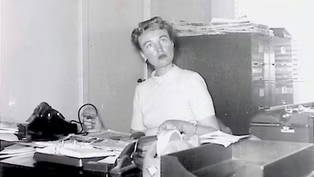
Clip: S8 Ep2 | 5m 26s | Alexis Bard Johnson and Joseph Hawkins explain how Sci-Fi fandoms welcomed queer people. (5m 26s)
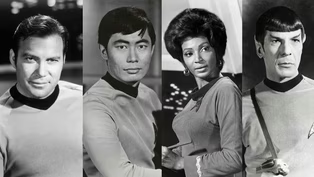
Preview: S8 Ep2 | 30s | Uncover the origins of the sci-fi genre and its unique connection to historic Los Angeles. (30s)
Providing Support for PBS.org
Learn Moreabout PBS online sponsorship












Support for PBS provided by:
Lost LA is a local public television program presented by PBS SoCal