
Lost Speedways
Clip: Season 8 Episode 1 | 4m 31sVideo has Closed Captions
Harold Osmer retraces the origins of speedway racing in Los Angeles.
As smooth, reliable highways became a reality in Los Angeles; speedways began popping up throughout the region. Satisfying LA’s need for speed, the first speedway arose at Agricultural Park, home today to the LA Memorial Coliseum. Harold Osmer reveals that historically, with 174 officially sanctioned auto racing tracks, more racing has taken place in Los Angeles than any other place in the world.
Problems playing video? | Closed Captioning Feedback
Problems playing video? | Closed Captioning Feedback
Lost LA is a local public television program presented by PBS SoCal
Lost Speedways
Clip: Season 8 Episode 1 | 4m 31sVideo has Closed Captions
As smooth, reliable highways became a reality in Los Angeles; speedways began popping up throughout the region. Satisfying LA’s need for speed, the first speedway arose at Agricultural Park, home today to the LA Memorial Coliseum. Harold Osmer reveals that historically, with 174 officially sanctioned auto racing tracks, more racing has taken place in Los Angeles than any other place in the world.
Problems playing video? | Closed Captioning Feedback
How to Watch Lost LA
Lost LA is available to stream on pbs.org and the free PBS App, available on iPhone, Apple TV, Android TV, Android smartphones, Amazon Fire TV, Amazon Fire Tablet, Roku, Samsung Smart TV, and Vizio.
Providing Support for PBS.org
Learn Moreabout PBS online sponsorshipMasters: Even as the dream of smooth, reliable highways was becoming a reality, something else was accelerating.
LA's need for speed.
By the 1910s, speedways were popping up across the region, turning bean fields and dusty streets into proving grounds for man and machine.
And it all started on an old horse track just beyond the city limits, in a rowdy fairground known then as Agricultural Park, home today to the LA Memorial Coliseum.
Most people might associate this place with USC football.
Rams and the Raiders.
Maybe the Dodgers.
And of course, two going on 3 Olympic Games.
But what a lot of people don't know is that this, when it was--back when it was Agricultural Park, this was the site of the first official motor race in Southern California.
Man: Yes.
That was 1903, which was part of the Fiesta Week celebrations, which today would be the county fair, because the Coliseum didn't show up for another 20 years.
But there was a one-mile thoroughbred horse racing track that was located here, and they had gambling and the whole bit until the city decided to shut that down, and that's part of why that track went away, and the place became useful for other things.
Masters: It was set up just beyond the city limits so people could get away with things like gambling.
There was a saloon under the stands.
Osmer: Yeah.
More auto racing has taken place in Southern California than any other place in the world.
174 different official auto racetracks.
And that's not Uncle Bob's back 40 or Jefferson Avenue or places like that.
No, these were officially sanctioned events, and that's not including motorcycles and go karts and everything else.
It was just part of the culture.
So it was just part of what people did.
Masters: And we're talking about places that you just would not associate with auto racing today.
Santa Monica, Beverly Hills.
Osmer: Right.
Masters: Those were the sites of famous racetracks.
Osmer: Auto racing is one of the main reasons that Santa Monica was able to retain its autonomy from Los Angeles.
They held the Santa Monica Road Races from 1909 through 1919.
It was an annual event.
They raced from Ocean to Wilshire up to the Old Soldier's Home, which is the Veterans Center at San Vicente, and came back down.
It was an 8 1/2-mile course.
And what happened was Los Angeles was annexing all of the little communities in the area to become what it is.
So the auto racing guy said, "Hey, we'll build your roads for you.
We'll make the roads a little wider.
We'll grade them, make them smooth.
You let us race on them and then after we're done racing, we'll smooth them out again and we'll do that."
And so there was a trade-off.
Santa Monica developed after other parts of the--of the city, and the auto racing brought them all that attention.
And they were the biggest races in the country at the time.
Man: ...Vanderbilt Cup race in Santa Monica, California, and there they go.
A new world speed record is being set by one of the greatest drivers in the country.
It's going to be Dario Resta, who wins with an average speed of 86.98 miles per hour.
Masters: Now, what you're saying about how the auto racing in Santa Monica was used as a promotional tool is fascinating because there was a symbiotic relationship between the developers and the promoters, and then the auto racing.
Osmer: Absolutely, yeah.
And so when the Rodeo Land and Water Company was dividing up their properties, they built the racetrack in Beverly Hills.
Of course, it was called Los Angeles Speedway because in 1920, when the place was built, nobody knew where or what a Beverly Hills was.
And the track operated from 1920 to '24, and it was a wooden speedway, a big oval made completely out of wood.
It was two by fours on edge.
Masters: They ran on wood.
On two by fours.
Osmer: The other problem you run into is you can't just take a circle, slice it in half, and add straightaways because the transition is too abrupt.
So they developed what's called the Searles spiral easement, which was borrowed from railroad technology.
It's to where it's a gradual change of radius and angle and these kind of things that come into play that allows for a smooth transition.
So the cars could effectively stay wide open and transition from the flat to the straightaway or to the curves, and then back down again and keep racing.
Masters: And this is a principle that's used in racetrack construction everywhere, but it was pioneered in Beverly Hills.
Osmer: Beverly Hills was the first one where they implemented the Searles spiral easement.
Masters: Despite how prevalent auto racing was in Southern California, so much of the evidence of it has just been obliterated.
Osmer: Yes.
[Both laugh] Osmer: It breaks my heart.
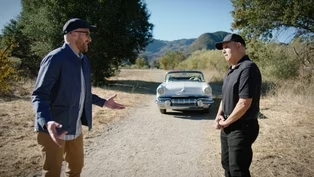
The Fast and the Forgotten (Preview)
Preview: S8 Ep1 | 30s | Auto racing's LA roots, from dry lake beds to movie ranches, left tread marks across the region. (30s)
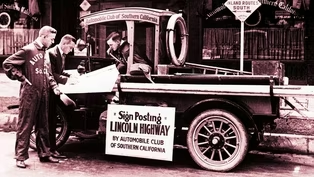
Video has Closed Captions
Clip: S8 Ep1 | 3m 56s | Morgan Yates traces the origins of the Auto Club of Southern California back to motor racing. (3m 56s)
Providing Support for PBS.org
Learn Moreabout PBS online sponsorship











Support for PBS provided by:
Lost LA is a local public television program presented by PBS SoCal