At the Edge of Tomorrow
Episode 1: Resilience
Episode 1 | 47m 59sVideo has Closed Captions
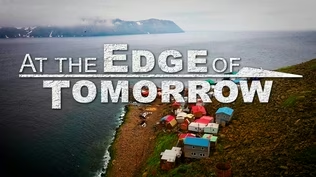
Resilience is the key to life in the Arctic as is launching a WWII barge to its villages.
Resilience is the key to indigenous life in the Arctic, and the thread holding together Cliff Johnson’s labors to launch his troubled WWII barge to improve lives in an isolated Bering Sea village two miles from Russia. He struggles to fix and keep his barge, wagering on a roulette wheel of logistics and setbacks. We visit the homes and lives of villagers. Resilience nurtures hope.
Problems playing video? | Closed Captioning Feedback
Problems playing video? | Closed Captioning Feedback
At the Edge of Tomorrow is a local public television program presented by AK
At the Edge of Tomorrow
Episode 1: Resilience
Episode 1 | 47m 59sVideo has Closed Captions
Resilience is the key to indigenous life in the Arctic, and the thread holding together Cliff Johnson’s labors to launch his troubled WWII barge to improve lives in an isolated Bering Sea village two miles from Russia. He struggles to fix and keep his barge, wagering on a roulette wheel of logistics and setbacks. We visit the homes and lives of villagers. Resilience nurtures hope.
Problems playing video? | Closed Captioning Feedback
How to Watch At the Edge of Tomorrow
At the Edge of Tomorrow is available to stream on pbs.org and the free PBS App, available on iPhone, Apple TV, Android TV, Android smartphones, Amazon Fire TV, Amazon Fire Tablet, Roku, Samsung Smart TV, and Vizio.
Keep Exploring
Related to This Episode
Providing Support for PBS.org
Learn Moreabout PBS online sponsorship(wind whooshing) - [Ryan] The day is coming to a close here on Little Diomede Island, Alaska, USA.
If you draw a line in the midpoint between these two land masses, that's where the international dateline is.
It's really interesting terrain.
It's very soft, mossy stuff.
I'm not sure what it's called but it grows in between all these big rocks.
This whole island is just tons and tons of massive rocks.
I don't know if you can see it on here, but there is a Russian boat right out on the water there, off their coast.
You can see most of the village down there, Little Diomede.
Helipad right here.
This is the school.
These are called salmonberries, pretty popular.
It's pretty amazing here.
This place has some very good energy.
- [Musician] One, two, play.
(upbeat jazzy music) - [Cliff] The story of the Arctic is that of its people.
It's about resilience.
It's about making things work and doing the best you can where you are, with what you have.
(upbeat music continues) To live here means adapting to continuous change, shortages; often harsh and rapidly shifting weather and seas; vast distances and barren landscapes.
It's a striking land but it's a dangerous beauty and one that does not forgive mistakes.
It is one of the most isolated, remote, and poverty-stricken regions in America.
But economic opportunity will come.
Climate change will open the Arctic to shipping.
Open waters will provide access to the vast resources of Western Alaska.
Some day in the future, the world will look at this time as the start of the next chapter in the history of the Arctic and its people.
(upbeat music continues) (waves lapping) (machine whirring) - [Marty] Some people are happy where they were born and raised.
Some, some are happy with where they were raised and how they were raised.
(Marty imitating seal bellowing) - Seal skin.
That's the seal skin my nephew caught.
(drums beating) (people chanting in foreign language) (car humming) - This is a pretty critical point to where we have a certain budget.
We've exceeded that budget multiple, multiple times.
If we don't get this on track today then we might as well not even proceed.
We might as well just, you know, make enemies now with everybody and skip the honeymoon and the divorce.
(upbeat music) My name's Cliff Johnson, the president, CEO of Northern Marine and Northern Contractors.
- And, my name's Micah Huss.
I'm vice-president of Northern Marine.
We are a barging company.
Right now we're also supporting the construction company that we have, Northern Contractors.
- [Cliff] We're heading down to Seward from Anchorage right now to go meet up with the guys at the shipyard, to go talk about the Kayak and check the status of it.
- It's important that we get to Seward and everyone's on the same page.
(man singing in foreign language) - [Christian] What the (beep) happened here, dude?
- [Jared] No bananas allowed on the (beep) boat.
- [Cliff] The start of what we're doing this year, we thought we could pull it out in Sitka.
That was our first plan.
- [Christian] Bro, the bananas go bad.
The (beep) apples go bad.
The carrots go bad, and we all get scurvy.
♪ Hey, hey, hey ♪ - [Cliff] It turns out, they were just too busy and the boat is a little big for what we're doing.
- Taking it from where we bought it, in Sitka, bringing it to Seward, we took about four days on the ocean.
That was probably one of the most amazing experiences of my life, just being able to see all the mountains and the northern lights, and the calm ocean.
It's just so surreal.
- [Speaker] Yeah, a beautiful morning.
- Today's a big milestone.
I mean, we've been working for weeks to get to this point.
It's due for inspection with the Coast Guard and until we get it pulled out of the water, we literally can't move forward.
(upbeat music continues) This is in really good shape.
Yeah.
We're happy with what this looks like.
I kind of envisioned it being a little worse.
But, there's some good steel.
It's a solid boat.
It's really in good shape.
Today's probably the biggest goal we had and the biggest hurdle that we had to accomplish.
I mean, we're there.
It's out of the water.
We're excited.
We're ready to go.
Now it's time to really start working.
♪ Hey, hey, hey ♪ (welder fizzing) (welder sparking) (grinder buzzing) - Just plugging along here.
(welders sparking) - We're gonna ramp up our crew to probably three times of what it is now, and probably be here for about a month.
(traffic rumbling) In our world we live in, you don't have a lot of opportunities to actually help contribute to making lives better and it's kind of a big deal.
(people singing gently) I remember when we got running water in the early '80s.
What a novel thing that was to have a sink and a flush toilet.
And that was in Nome.
(people humming gently) - We had a honey bucket, no running water.
It was always cold but, it was good.
- I remember like, I don't know if it was Wednesdays or, there was a day when the water guy was coming?
- Oh, yes.
- You'd open the front door and you'd drag the water hose in.
And mom used to make sure, got the washing machine ready so it could be filled at the same time.
- (laughs) Yeah.
- Remember?
- I loved that.
- Fill the washing machine too.
And then if you don't get the washing machine filled, you didn't wash clothes for another week.
And you filled up your drum and then you had water in the house.
Yeah.
The honey bucket guy, which was a different guy.
(laughing).
Thank goodness, a different guy.
Yeah.
He had a little trapdoor.
He pulled the honey bucket out, dumped it.
(people humming gently) Yeah, Diomede is still like that.
- I'm sure they don't have running water, do they?
- No, not a single house has running water there.
- Wow, that would be tough.
(gentle humming music) (machine whirring) - I love home.
It's pleasant.
Peaceful.
Quiet.
(water dripping) My name is Marty Ozenna.
I live in Little Diomede, Alaska.
Home is home.
Little Diomede is home.
(machine whirring) My parents were carvers.
(machine whirring) It's the way I was raised, the way I grew up.
And there's not too many of us left out here carving, it's good to have a little tradition going still.
(people chanting) (drums banging) - Time here is our own agenda, because it seems like it stands still a little longer for you to get something done or learn something better from it.
My name is Frances Ozenna, born and raised in Diomede.
Been here all my life and enjoyed every bit of it, even through the hardships.
- [Robert] Here, once you get to know the people out here, they help each other a lot.
- We are here in the Diomede washeteria.
It's good to have good clean clothes every now and then, take a shower, at least once a week.
(people chanting) (drums banging) - In order to sustain life, everybody adapts.
Everyone adapts to sustain life.
- Oh, my god, I always dreamt about running water.
That's all I ever dreamt about in the house.
Never had that, you know, ever, you know, in Diomede.
- Having running water inside the house would be a lot better.
- Running water.
- They said it's too rocky or something.
- Flushing toilet.
- [Marty] You wouldn't need to worry about having to fill up the water bucket or having to think about, you need to get a bucket of water or fresh water to drink.
- This place is very unique 'cause, it's very remote.
My name is Robert Soolook.
I've lived here all my life, just about.
We can never be bored here.
There's always something here to do, traditionally or whatever you can think of.
Let me tell you a little history first.
There was a person who was an explorer, Vitus Bering.
He come up here and saw these two islands, Big and Little Diomede, the two islands here in the Bering Strait.
He named this place after Saint Diomedes.
The little island, which we call Little Diomede, the native name is Inaliq.
And the big island is called Imaqliq in our language.
Not many people know about us here, our village out here in the middle of the Strait.
(drums banging) (people chanting in foreign language) (birds squawking) (people continue chanting) (people continue chanting) Here in a remote place, Little Diomede, you got to live traditionally.
You can see the hairs on there.
These cook about 30 minutes.
All these things that we're rich on is the resources, what nature provides.
Flipper, more flipper.
Here in Diomede, traditionally we live off the land, live off the sea.
We have eggs.
The birds are here, the avians.
(birds squawking) We have fruit, the berries.
We have salad, the seaweed we get from the sea.
We have fish, we have crab.
We have the mammals.
We have the bear.
(people shouting) - What I liked about growing up here in Diomede is, I was able to learn a lot of our cultural traditions.
I learned family values.
I learned happiness through struggle, how you pull through.
I learned how to survive Diomede.
- When this freezes up behind, at the edge of the ice.
A harpoon, that goes inside the animal and that breaks away.
- We're driven to choose how we wanna be, you know, what we wanna do.
(gentle vocalizing music) And I learned to love things that are in front of you, you know?
Things that you don't expect to be around as long as it should be, (gentle vocalizing music) and life comes with that.
- We live in a state of economic poverty but I believe that culturally and spiritually, we are one of the richest people in the world.
We've maintained this way of life that our ancestors before us carried forward for us, to be able to survive and sustain ourselves.
(woman yells) - Every season, the walrus and the whales come up to the Arctic.
- This is our home.
This is our culture.
I'm Akighqukaaghaq and my English name is Melanie Bahnke.
I'm the president of Kawerak, which is the regional tribal consortium in the Bering Strait region of Alaska, and we are 20 federally recognized tribes.
We operate out of the hub community of Nome.
There are three distinct cultures in our region.
We have Yupik, St. Lawrence Island Yupik and Inupiaq people living in our region.
Our people have lived here for thousands of years.
There's archeological evidence of that.
And we've sustained ourselves primarily by living a subsistence lifestyle.
There are few jobs in our region so we have high rates of unemployment.
And we have five communities that don't have pipe water and sewer.
- [Speaker] Rain water, we collect.
- We're resilient and we're strong.
But we've got some very real challenges that we're up against and facing on a daily basis to ensure the survival of our people, of our communities.
(dogs barking) (phone rings) - Hello, (indistinct) Village, with Agny.
- [Speaker] I'm trying to get your, the price for home heating oil here.
- [Frances] It's $5 a gallon.
- [Cliff] We're in a unique situation because of the work and the location we're working.
We're bringing sewer and water to a place that's never had sewer and water before.
We're building a new store.
We're actually making a difference and cleaning up things and removing garbage.
(person grunts) (hammer tapping) As far as our business is concerned, the Kayak could be our bread and butter.
Because most of the communities in Western Alaska are based around water.
And so when you get to Western Alaska, you get off the road system, literally there are no roads out there and everything's on the ocean or on the river.
We really need this boat to bring our supplies into Diomede.
There's only one way to get stuff there and that's with a vessel.
- From this community to other struggling communities, we know with the improvements made, people will be a little bit more happier.
That's the kind of community we always wished to see, that from the beginning this should be the example.
(whisk beating) - This morning it's pancakes, sausage, bacon and eggs.
- You don't do a lot of stuff during the winters in construction in Alaska.
But summertime, you only got five months.
(machine humming) - I'm filling up all these super sacks.
- You've got five or six months to do some work.
- On quite the crunch to get these done.
- [Micah] So you cram a year's worth of stuff in five months.
- Is this an all you can eat breakfast buffet?
- Working 12 hours a day, (machines whining) sometimes 16, sometimes longer, seven days a week.
- [Jack] This is the smoking-ist damn pot right here.
This little cast iron skillet.
- If we had smoke detectors, they'd be going off.
(beep) You know, we, we eat, we sleep.
- What's on fire?
- Jack's cooking.
- Micah!
- We play with the guys.
(people laughing) We're always together, all the time.
- Knucklehead.
- Are you in first gear or are you in third?
- [Ryan] I'm in first.
- The parking brake's on.
- [Ryan] Oh.
- Maybe if you took the parking brake off, you might be able to drive somewhere.
(Bart laughing) - Yay.
- You're the man, Ryan.
- You're with a group of guys that are smart.
You work with these guys every day.
- Like this, huh?
(Bart laughs) - [Cliff] And the work is rewarding.
- I'm gonna get that awkward look, the awkward look across the table.
(people laughing).
- [Cliff] And you feel like you've accomplished something and help better somebody's life.
- Yeah, that's a good bunch of guys.
Hard workers and we all get along.
We're kinda coming from all over.
Bart and I are from New Mexico.
Jared's from here and Ryan plays professional football in Spain.
And so he's here on for the summer, so he can go back to play football next fall.
All of us guys are living here.
We've got two more guys coming this next week, so we're gonna have to rearrange.
- NC, the NC stands for Northern Contractors and that's the company that's doing the work over on Diomede.
(pensive music) - We're one of the houses that got selected for improvement.
- I heard they're going to upgrade.
We're gonna have a new washeteria.
- Good to have a new store coming, a new building is going up.
(machinery whirring) - [Cliff] I love what I do.
I like helping people.
I do have a soft spot for Diomede.
- Everybody's house shifts during the winter and it causes gaps to open on the windows and the door.
(expectant music) - To improve your life out here, like the water and sewer, a new clinic, better housing.
(jazz music on radio) - I've been to every village in our region, almost all the villages in the Kuskokwim area.
I've been into all the villages on the North Slope.
And, you know, Diomede is a place to where I've never met harder working people.
(man imitating seal bellow) People that are happy to be there.
They love their life.
They love their lifestyle.
And it's like, how much better can you make it, if you just give them a flush toilet and running water?
- All right, watch yourself.
- Coming over.
All right.
- [Cliff] Who else is gonna do it?
I mean, they've been trying to get sewer and water in Diomede for 20 years, for 40 years.
I mean, if nobody can do it, well, then let's go do it.
It's just not that hard.
- Cliff and the tribes can come and fix, changing for the better.
- We can put foam board all the way across.
We can move that over another foot.
When you think long term, being in the business in Western Alaska there's never gonna be a time when there's not infrastructure work that needs to be done.
There's never gonna be a time when the need is not there.
So if you can create that niche of work where people see you as a good, honest, you know, hardworking group of guys that can come and get it done in a tough location, then that's your business model.
- Yeah, see, that plywood's trying to blow off of there, but that strap's holding it down.
Right now, we have some wells that we're gonna be putting in at a couple of houses a little ways out of town.
- We base our operations out of Nome.
If you look on a map, the furthest west part of the Seward Peninsula is Wales, which is about 24 miles from Diomede, Big and Little Diomede.
And Big Diomede is Russia and Little Diomede is United States.
- Running water is a blessing.
What's really cool too is, in Diomede, we're gonna supply them with their first little bit of running water out there.
And so it's gonna be a whole game changer.
- We won't have to haul water anymore.
Won't have to dump our honey bucket anymore.
- Excited to be putting it in for them.
(jazz music) - Okay.
Arctic pipe first.
Can you believe that there's no flush toilet in a village that has been there for 100 years, and there's no running water?
I can do something about that.
(jazz music) I have this ability to create work, you know, to make people feel good about the work we're doing and do a good job.
And, you know, I'm 53 years old and I don't have a lot of time left to get out and create a big business.
And, you know, I mean, I wanna retire too at some point.
So this is kinda the, probably the last shot I have to do that.
And so we're gonna do it, and we're gonna make it and we'll get there.
(jazz music continues) - One of our former governors, Governor Wally Hickel, he had a globe in his office.
And whenever I would go into his office before I was governor, he would take me over and say, "Look at Alaska from the top down."
He'd say, "What do you see?
You don't see San Diego.
You don't see Florida.
You see Asia."
- Alaska is unique for lots of reasons.
Certainly, its geography makes it unique and it's very unusual.
- We're not the end of the Earth.
We're not the end of the continent, which is the perspective that a lot of people think of us as.
We are at the center of the Pacific world.
- Our neighbors are different.
They're not, you know, bordering states.
they're bordering countries and they're sometimes countries that we've had conflict with.
(gentle music) (rocket blasting) - I'm Tom Barrett.
- My name is Katherine Ringsmuth, but you can call me Katie.
- I'm Bill Walker, former governor of the State of Alaska.
- [Tom] I was a Coast Guard flag officer, commanded Coast Guard operations in Alaska.
- [Katie] I am the Alaska state historian.
- I was a junior in high school in Valdez when they struck oil at Prudhoe Bay.
My world changed when that happened.
- [Tom] Eventually became the number two, the vice-commandant of the Coast Guard.
- Our resource development is almost unlimited.
- Deputy state historic preservation officer.
- Became the deputy secretary of the Department of Transportation, the US DoT.
- If Alaska was a country, we would be the 8th resource-richest country in the world as a state.
- [Tom] And ran the Trans-Alaska Pipeline, TAPS, for 10 years.
- And I also teach Alaskan history at the University of Alaska, Anchorage.
- Alaska is sort of on a cycle of development.
Certain things happen that cause certain other things to happen, and sometimes it's not in our control.
(gentle music continues) - [Tom] Alaska is the most strategic place on Earth, even if people don't acknowledge it.
It borders across the water, a strategic competitor, Russia.
Alaska will connect to Asia, Japan, Korea, across the Arctic, across Canada but into Europe fundamentally.
And obviously, you open up the largest economy in the world, which is China, growing, and that has huge implications for this country.
- You know, we have the Russian planes coming into our airspace and it's always over Alaska.
You never hear they're coming in the airspace of Michigan.
(laughs), you know, it's always Alaska.
- Last year we did 14 separate intercepts.
In doing those intercepts, we used over 60 of our aircraft to do those.
We've seen Russia resurrect up to 50 Soviet airbases in and around the Arctic, where they're putting aircraft.
They're putting ships.
(dramatic music) (explosions booming) - To think back to World War II, it was strategic for Japan.
They invaded the Aleutian Islands.
And, whether or not, you'll see that type of thing again, I would doubt, but these are the major players, Russia and certainly China.
China is building a nuclear icebreaker.
They see this as an economic leverage opportunity for them.
So they'll be a competitor for us, a global competitor and we will meet them up here eventually.
And we talk a lot about global warming and the Arctic Ocean is certainly experiencing that.
- One of the things that our region is experiencing with climate change is, there are longer periods of time where the Bering Sea is ice free.
- The Northwest Passage, right?
(gentle music with vocalizing) (grinder buzzing) - We thought about changing the name to Umiak, which is a bigger Eskimo, Alaska native boat for hauling things.
But Umiak would be, I thought, a little difficult for people to say, for the Coast Guard to deal with.
For talking over the radio and spelling.
So Kayak was the natural fit.
It used to be the USS Coh, which was a Navy net tender.
It was in World War II.
- It was in Vietnam War too.
- [Cliff] It was in the Vietnam.
- It was in the Vietnam War.
It got like 10 commendations.
And then it was brought back to the States where it survived a scrapyard.
- It got sold in, in the Philippines or someplace, and then it sank.
- [Micah] And then it came up to Alaska to work the Exxon Valdez oil spill.
After it was done, it was sold to Allen Marine, a very large company in Southeast Alaska that builds ferryboats.
- That's where it got named The Glacier.
- It was used at Allen Marine as a personal boat to go to do Costco runs for groceries.
So they kept it for 20 years and then, it came up for sale.
Eventually we bought it and brought it to Seward.
(grinder buzzing) - Now, there is significant superstition with people in changing the name.
We thought we alleviated that.
The superstition is, you have to remove everything that has the old name on it, down to the life jackets, to documentation, to everything that resembled the old name.
We did all of that, except for the original welded name that was on the stern of the boat.
We didn't cut that off with a torch and put "Kayak" on there.
And looking back at it, we probably should have done that.
(gentle music with vocalizing) - Oh, look at that salmon.
Ooh hoo.
That's a good salmon right there.
- We are definitely the canary in the mine when it comes to impacts of global warming and climate change.
- This is subsistence at its best right here, in the summer.
It's the last couple of weeks of catching salmon.
Later on we'll be getting caribou and moose up the river.
Then we switch back to, then we come back to seals in October, tomcod, smelts and then we'll get into trapping in the winter.
(people chanting) - [Melanie] People in our region rely heavily on a subsistence lifestyle, not just as a matter of food security but it's also the fabric of our culture.
It's a core part of our identity as Alaskan natives.
- Climate change.
Global warming.
We live it.
We experience it.
We see it.
- [Melanie] We're battling some of the effects of climate change.
We've got communities that are facing erosion, flooding, extreme weather events.
- Ocean don't freeze as much.
- [Speaker] The ice isn't as trustworthy.
We used to have an ice runway that we maintained.
- [Melanie] We haven't seen an ice runway out there in at least 10 years.
Birds that are native to our region have been dying by the thousands.
- [Speaker] Game passing by differently.
- [Melanie] Our fisheries are experiencing a collapse.
- I pick about four different types of green (indistinct).
And if it's a dry summer, it could burn the plants out, the sun, you know?
And that won't be edible.
- With the lack of sea ice, you're basically losing the start of your food chain.
Climate change is manmade.
If it was a cycle, it wouldn't be so drastic, you know?
Losing 40% of your sea ice, that's not a cycle.
I think we're probably past the point of no return.
- [Melanie] So we're very challenged right now.
We don't wanna become climate change refugees.
These villages are our homelands and our culture relies on maintaining our subsistence way of life.
- [Lance] So things are changing as a result of climate change.
It's gonna be a little unprecedented I think, as far as what it's gonna do for Alaska.
- I think what we're going to experience is a second wave of westward expansion attempts.
And there are some pros and cons we have to be mindful of.
- America is now starting to see itself more as an Arctic nation but it's only 'cause of Alaska.
- I think the opening of the shipping lanes, opening up of the Northwest Passage, is similar to the opening up of the ALCAN Highway or the building of the Trans-Alaska oil pipeline.
I think its access is gonna be another chapter in Alaska's future that's very similar to others.
(pensive music) - And the business will be transshipping.
It will be tourism on a large scale.
You're gonna bring more players into the Alaskan space.
They will all have their own interest.
- We're already seeing an increased shipping.
We're seeing a pattern of increased marine vessel traffic.
(pensive music continues) - When you look at this from a historical lens, this is just, you know, the final extension of what started in, you know, 1741 with Bering.
When you think of, you know, the opening up of the Arctic to shipping, this is why people have been coming to Alaska.
This is what has been motivating them.
You know, thinking of the explorers, Captain Cook.
What was Cook looking for?
The Northwest Passage.
Turnagain Arm, turn around again.
Looking for the Northwest Passage, Vancouver (laughs), you know?
And Spain, right?
The Spanish, the French, you know?
The great age of exploration.
Well, they weren't just looking for the sake of exploring.
They were looking for the Northwest Passage.
To where?
China.
It's always about China.
What's happening now is really just history taking its time.
(pensive music continues) - I see opportunities.
I call them pent-up opportunities.
And I say, we have pent-up opportunities because we have opportunities that we may not even realize.
- If there are economic opportunities that come as a result of global warming, which we haven't caused, our people should be the participants and drivers of economic opportunities that might be coming our way.
- We don't have any other boats that can do what the Kayak is doing.
There's not many vessels, especially in Western Alaska, that can do what the Kayak does.
You have to control your own logistics in the Arctic to be able to meet schedules and deadlines and do it efficiently.
So yeah, the Kayak is a pretty critical piece of equipment that we have to have.
- All Alaskans are entitled to basic rights of safe water, safe food and protection from contagious disease.
(audience applauding) That reminds me of a story from the campaign trail about a first grader I was told in Kotzebue.
In no uncertain terms he informed his parents that he was supporting my opponent in November's election.
When they inquired why, he said he had heard that Tony Knowles wanted to put the honey bucket in the museum.
The youngster was offended because the NANA Museum in Kotzebue already has a perfectly good bathroom.
(audience laughing).
Now, just as that first grader refused to take a step backward, we will not retreat from our commitment to Alaskans that no person should have to physically handle human waste.
(audience applauding) (upbeat music) (upbeat music continues) (upbeat music continues) (upbeat music continues) - It is intentional racial discrimination to deny indigenous communities access to basic things such as water and sewer.
- Here we are, 2022.
- There's my honey bucket.
You can take a pisser at that right there.
- It's mind-boggling that there's still communities out there that don't have running water and don't have a toilet.
- I feel like the region's been left out, like many other regions.
I mean, you know, there's other regions in Alaska that are in the same situation.
- You've got people living thousands of miles away, who maybe have never stepped foot on the Arctic, wanting to have policies established that threaten our way of life.
We're an endangered species.
- Contact since 1741 has been, very disruptive for the indigenous peoples of Alaska.
(pensive music) - [Maximus] Lucky (laughs).
- Maximus Toby, named after his grandma.
She passed away almost last year, about November.
She always said she was gonna come back and be a boy this time, and we sure think she did (laughs).
(birds squawking) - And the Russians came for the pelt and violently forced the Alaskan Native people to hunt the animals.
- We live in the richest country in the world basically and yet we've got ... - [Marty] Do any of you girls wanna have cereal?
- [Melanie] Primarily indigenous Native American communities are the ones that- - It will be a little while, eight o'clock.
- [Melanie] Are underserved when it comes to water and sewer, (water running) when it comes to economic development- - Dada.
- A lot of excitement.
I love my daughters.
- [Melanie] Broadband Internet.
- My boys are old enough to live on their own.
- There's also a housing crisis that's happening in our region.
- There's four of us in that real small red-roofed house right there.
- [Melanie] Key things that you need in order to have sustainable communities.
And this isn't unique to our region.
If you look at all Native communities, there is a stain when it comes to the government's treatment of indigenous people.
- Yes.
So Alaska has a long history of outsiders, if you will, exploiting Alaska's resources.
- Alaska was initially purchased for the resources.
That's why the US bought it from Russia.
They didn't really initially anticipate it would be inhabited by indigenous people.
They thought it would just be an extraction location, extracting resources.
(somber piano music) (somber music continues) - So there's all of these reasons why people are coming up and it wasn't to destroy the Native cultures.
But that's what they did.
- It's a continuation of the government's history of treatment of indigenous communities and it's shameful.
- [Katie] And then you're introducing diseases into these populations.
- I've always saw family as one of the most important of surviving Diomede.
- Our family's getting really big.
- [Marty] There's more need for housing out here- - I'm your mama.
- Due to the fact, families are growing.
Some of us grew up in crowded spaces.
That's normal.
- I come from a family of 12.
- Me, my honey.
- My dad, my mom.
- There's his daughter, Heather.
- My brother and me.
- Our daughter Agatha, Perseus, Maximus.
- I'm aware of 27 people living in one house.
- A lot of sharing.
- Who am I forgetting?
- Where else in the United States does that happen?
I don't know.
- Jeremy, Jeremy (laughs).
- A lot of respect.
- And then when the next waves come along, whether it's the whalers or the Gold Rush miners or the soldiers during World War II.
- [Frances] Family tend to nurture with each other.
- [Katie] People are less able to resist these type of changes.
- How many did I count at, six, seven?
- They're really just trying to save themselves, save their families.
- Pretty soon eight.
- [Katie] And save their kids.
- I'm gonna have my baby and then having- - And you see all the pictures here of our ancestors.
- Well, the dog counts as nine (laughs).
(gunshot bangs) (person chanting) Sometimes Agatha will sleep in here with us too.
Aggie always talk about a bigger home, you know?
She want a bigger home (laughs).
She wants her own bed.
(reflective music) - We've been exposed to an attempt to eradicate our culture, to eradicate our Native languages, to assimilate us, to talk and walk and be like the regular average Joe American with no regard to who we are as a people.
(seabirds squawking) (silence) - I was born here.
I was born and raised here.
Growing up in a village, you have this embedded sense of making life better, because you knew the things you didn't have growing up.
And when you go back to the region, there's definitely a bond of a nature that wants you to help people.
- It's so rewarding, you know, because you grew up with all these people.
You don't get a lot of opportunities to change the lives of people in this way.
So it's a project we're very much, committed to and very proud of.
- So that's why we're here in January.
The Kayak is absolutely critical to the area and to our clients and to the location we serve.
If we don't have this boat, we don't have a business.
- So this boat has been in two wars, has sank, survived a scrapyard.
Came to Alaska, worked an oil spill, spent 20 years in the Southeast.
Comes to us, you know, within a month we catch it on fire.
(somber music) - [Speaker] Man, it just don't quit, huh?
(fire truck rumbling) (somber music continues) (upbeat music) - I found my ammo.
I've got ammo.
My ammo sling.
It's made out of seal skin.
That cradles the rock inside.
(laughs) You release it early, hit down.
Hit the ground and ricochet somewhere.
You hit it too late, it's gonna go up somewhere.
And there's the overhead like that.
- I just hope you don't paint this as some desolate poor people.
We've been painted that way enough times.
We are very rich culturally and spiritually.
I think the whole world should take a look at indigenous peoples as a source of wisdom, basically to find our humanity and moral compass again.
- We had a little bit of a problem here couple days ago.
(dramatic music) - Once the fire happened it changed everything.
- Everything just up in smoke.
- [Cliff] Nothing slows us down.
We look at it as another obstacle.
- Get to Diomede and get the work done we gotta get done.
- Is there any water leaking in the house?
- Doing what we're doing may be small to this world but it's really big for Diomede.
- [Marty] There's no other place in the world like here, at the edge of tomorrow.
- [Cliff] This thing's gotta be resolved and we're either gonna have a boat or we won't.

- Science and Nature

Explore scientific discoveries on television's most acclaimed science documentary series.

- Science and Nature

Capturing the splendor of the natural world, from the African plains to the Antarctic ice.









Support for PBS provided by:
At the Edge of Tomorrow is a local public television program presented by AK