
The Charm & Chaos of SoCal's Botanical Landscape
Season 8 Episode 4 | 26m 29sVideo has Closed Captions
From wildflowers to jacarandas, explore the plants that paint California in vibrant hues.
Meet the personalities who bring year-round color to California’s landscape. Hunt for native wildflowers in the Santa Monica Mountains, visit San Diego to learn how horticulturalist Kate Sessions colorized the Golden State, stop by Whittier for a debate on the controversial jacaranda tree and see how Burbank’s annual Rose Parade float comes together.
Problems playing video? | Closed Captioning Feedback
Problems playing video? | Closed Captioning Feedback
Lost LA is a local public television program presented by PBS SoCal
The Charm & Chaos of SoCal's Botanical Landscape
Season 8 Episode 4 | 26m 29sVideo has Closed Captions
Meet the personalities who bring year-round color to California’s landscape. Hunt for native wildflowers in the Santa Monica Mountains, visit San Diego to learn how horticulturalist Kate Sessions colorized the Golden State, stop by Whittier for a debate on the controversial jacaranda tree and see how Burbank’s annual Rose Parade float comes together.
Problems playing video? | Closed Captioning Feedback
How to Watch Lost LA
Lost LA is available to stream on pbs.org and the free PBS App, available on iPhone, Apple TV, Android TV, Android smartphones, Amazon Fire TV, Amazon Fire Tablet, Roku, Samsung Smart TV, and Vizio.
Providing Support for PBS.org
Learn Moreabout PBS online sponsorshipNathan Masters: L.A.
's official city flower is as bold and vibrant as the place itself, the bird of paradise.
Transplanted from South Africa to Southern California in the 19th century, it quickly became a local favorite.
Its vivid orange and blue reflecting the city's colorful, sun-soaked identity.
But the bird of paradise is more than just a flower.
It's a clue to a bigger story, one of landscape transformation, thorny debate, and the perennial balancing act between the cultivated and the wild.
This program was made possible in part by a grant from Anne Ray Foundation, a Margaret A. Cargill Philanthropy.
♪ Color has always been woven into Southern California's landscape.
Each spring, we get a glimpse when Angelenos trek to desert hillsides and inland valleys to document super blooms on social media.
But these spectacles once dazzled across the entire region close to population centers.
One famous poppy field above Pasadena even had its own railway stop, where tourists could gather bouquets and soak in the view.
That poppy field, like so many others, didn't make it.
This springtime sea of poppies eventually became suburban Altadena.
That same story repeated itself across the region as urban growth overtook wild beauty and native plants were crowded out by houses, shopping malls, and invasive weeds.
Woman: There's a wide variety of aromatic plants native to California, such as this purple sage.
Masters: Mmm... To learn what we've lost and what still blooms in preserve wildlands, I joined Ella Andersson of the Theodore Payne Foundation in the Santa Monica Mountains.
♪ So horticulturalists for a long time have encouraged Southern Californians to grow these complex of plants that will produce color year-round.
But every year, the truth is, if you come out in places like this, the landscape will produce quite a spectacle all on its own.
Andersson: Yeah, absolutely.
California has over 7,000 native plants.
So, if you come to the Santa Monica Mountains, you'll see amazing swathes of color.
Masters: These are completely wild.
Andersson: Yes.
Masters: And what other sorts of colors can we see throughout the year?
Andersson: Earlier in Spring, you'll have a lot of bulbs coming up, tons of wildflowers with the bright yellow of tar weed, incredibly electric orange of poppies, a variety of reds from owl's clover, the orange and yellow from this deer weed.
This is actually really interesting.
After the flowers have been pollinated, the flowers turn from yellow to this red, indicating to the pollinators that that flower has been pollinated, but it gives us this wonderful confetti kind of color effect.
Masters: So, these colors actually perform a function then here.
Andersson: That's one of the big important factors of native plants.
They've ecologically adapted with our pollinators.
And so they perform a really complex dance.
Masters: Today, we're up above Westlake Village.
It's far away from the historical center of Los Angeles, but certainly before suburban development.
But before colonization, generally, you would have amazing wildflower shows all over the region.
Andersson: Yeah.
So, we have these remnant habitat patches, like the one we're in today, that kind of give us a glimpse into what it looked like at the time of settler contact and previously.
It only now really exists in these preserved spaces-- you know, so Antelope Valley, um, Carrizo Plains, uh, places that are protected.
Masters: I see yellow, which I guess is actually technically black mustard.
But I have to admit, if you're driving down the freeway certain times of the year, the hills are just carpeted in the mustard, and it can look, at least for distance, can look beautiful.
Andersson: Yeah, I mean, it has this really vivid yellow color.
It's absolutely part of the fabric of our landscape now.
Masters: But I gather that you're not the biggest fan of black mustard.
Andersson: Ha ha!
As an invasive plant, it just does a really good job of outcompeting the native wildflowers.
They make use of the nitrogen in the soil to just sort of explode above the native plants, outcompete them for space, light, pollination often.
Masters: How did it get here?
Andersson: A lot of these invasive flowering plants and invasive grasses, they were brought in with the first Europeans, both deliberately as livestock feed and in a myriad of unintentional ways-- seeds stuck in the hooves of creatures, of the livestock, just like us, in the folds of our clothes, in our shoes.
So, they were introduced to our spaces in a lot of ways.
Masters: And this over here is wild fennel, right?
And we could eat this?
Andersson: Yeah.
We could.
Masters: OK, I'm gonna grab-- Andersson: Should we?
Masters: Yes.
Andersson: Yeah, OK.
Masters: Let me grab some.
Andersson: Serve it up.
Masters: All right, I'm gonna break off a couple tiny pieces here, and, uh... Andersson: Bon appetit.
Masters: Yes.
Mmm!
Well, invasive, but delicious, actually.
Andersson: Yeah.
Ha ha!
♪ Masters: So much of Southern California's native color faded long ago... but it hasn't been forgotten.
In 1927, Susanna Bixby Bryant founded the Rancho Santa Ana Botanic Garden near Yorba Linda.
The daughter of a prominent real estate developer, she knew the toll urban growth took on the land.
Her garden aimed to preserve and catalogue the native flora of Southern California before it vanished completely.
Today, Bixby Bryant's work continues at what's now the California Botanic Garden in Claremont.
♪ I visited the garden's herbarium, a sort of time capsule of pressed plants showing how the region used to look.
We've visited a lot of archives in "Lost LA," but I think this is the first time we've visited an archive of plants.
Woman: It's a library of pressed plants, yes.
Masters: Library of pressed plants.
Let's take a look.
Botanist and curator Mare Nazaire showed me how she's working to save California's true colors.
Nazaire: This one is a very fragile specimen.
Masters: Oh, yeah.
Nazaire: You're gonna be mounting the next one.
Masters: Brush this on the foil?
Nazaire: Yep.
Now, just very gently dab glue on there.
Masters: OK.
How does that look?
Nazaire: That looks terrific.
Masters: So, after you've mounted the specimens and let the glue dry, this is where they wind up?
Nazaire: They wind up here in the main collection of the herbarium.
This is just one floor.
We actually have a whole other floor above us.
Masters: So, you have a lot of specimens here.
Nazaire: We have over 1.26 million specimens.
Masters: Wow!
Nazaire: And when we open up a cabinet, you can see the contents.
This is how we store the herbarium specimens.
So, what you mounted will get stored into a folder.
Masters: It smells good.
Nazaire: It's the mint family.
So we're looking at Monardella exilis, one of the mints.
One specimen that might be fun to show you is, this represents accession number 1-- Masters: Whoa!
Nazaire: in the Rancho Santa Ana Botanic Garden collection.
So now, you know, we changed our name to California Botanic Garden.
Masters: Right, but this is the very first from that subcollection?
Nazaire: Collected by John Thomas Howell, um-- Masters: And we have a date here "June 24, 1927."
Nazaire: Yes, from the original Rancho Santa Ana Botanic Garden.
Masters: In Orange County.
Nazaire: Yeah.
Masters: This isn't the oldest specimen by far, though.
You have--I see right over here "1891."
What is the oldest specimen you have?
Nazaire: This one right here is collected by botanists Banks and Solander on Captain Cook's first voyage.
Masters: Wow!
1700s!
Nazaire: 1768 to 1771.
Masters: So, this specimen has a story to tell.
I mean, it traveled-- Nazaire: It did.
Masters: around the world.
Wow!
Nazaire: And it's in remarkable condition, given how old it is.
Masters: Yeah, that is amazing.
Nazaire: I also wanted to mention where some other older specimens that represent extinct or extirpated.
It's only known from 2 locations in Colton, California.
And so, I know botanists have been actively trying to locate it.
So far, we don't--we haven't been able to find, you know-- Masters: Wow... So, right here might be one of the only places in the world you can see this plant.
Nazaire: Right now, probably.
I mean, we have a few representatives, but both lost due to urban development.
So, as we're losing diversity, these specimens are important to mark that we've had diversity at a particular time.
Masters: So, I see, yeah, this one was collected in 1891.
This one was collected in 1924.
The Southern California landscape was much different back then.
Nazaire: It was.
Masters: We're talking about, it's a much smaller urban footprint.
Nazaire: Right.
Masters: And as that urban footprint grew, we're talking about a lot of loss of-- Nazaire: Habitat.
♪ Masters: While Bixby Bryant was cataloguing native plants ahead of the bulldozers, others helped choose the plants that took their place.
As Southern California's "Apostle of Color," horticulturalist Kate Sessions promoted a dazzling palette for the region's streets, parks, and home gardens.
Championing the jacaranda, bird of paradise and my personal favorite, the bougainvillea, she added vibrant splashes of color to our urban spaces, an influence we see nearly everywhere we look.
In Glendora, I stop to admire what's billed as the nation's largest bougainvillea planting.
Since 1901, these vines have spanned some 1,200 feet, an entire city block, and their vibrant, cascading magenta is a living testament to Session's vision for a colorful California.
But to really appreciate her legacy, I had to make the 2-hour drive south to San Diego.
Here in 1892, Sessions leased 32 acres of city parkland, opened a garden and nursery, and made some of the first improvements in what would eventually become Balboa Park.
♪ She used this park as a living laboratory for experimenting with colorful plants from around the world, all on public display.
Recently, a corner of the park was finally named in her honor.
I met up with landscape architect Jacqueline Higgins, VP of the park's nonprofit partner organization, at the newly christened Kate O. Sessions Cactus Garden.
So, Kate Sessions is often called the "Mother of Balboa Park," but it wasn't until 2021 that there was a proper garden named after her.
Higgins: Kate Sessions was incredibly influential in introducing all types of plant species to San Diego in the early 1900s.
One of the things we learned is the saguaro cacti do not do that well here, although there's tons of other cacti and succulent species and native plants that do incredibly well here.
Masters: She was an experimenter.
Higgins: Correct.
One of the native California species that Kate Sessions domesticated is one of my favorites and actually one of Kate Session's favorites, the matilija poppy.
She said that this plant should be in every single garden in San Diego because it's such a unique species, and this time of year is where it really showcases its beauty.
♪ Masters: From Balboa Park, I made my way to the Mission Hills Nursery, founded by Sessions in 1910.
Here I met author Nancy Carol Carter to talk about Sessions' passion for colorful plants.
♪ This nursery wasn't just her business, it was her canvas and a place where she taught San Diegans to add year-round color to their own gardens.
So, here in San Diego, Kate Sessions is this towering figure in the city's history.
Now, up in L.A., I think we mainly associate her with some of these iconic plants that really make the urban landscape pop.
Carter: She, at a very early age, wanted to study plants.
She wanted to grow them.
She wanted to write about them, and she wanted to teach others how to successfully grow them.
After her graduation from high school, her parents allowed her to go on a trip to Hawaii, and she was completely captivated by the beauty of the plants in Hawaii.
And so that was really very influential in her life and her thinking about plants.
Kate Sessions came to San Diego when it was a very dry and dusty little town.
She spent a lot of time giving talks to city councils around our region about how improving the look of our gardens and planting more street trees would make the city more beautiful, would attract more population.
Kate Sessions was always looking for something that made sense in this climate.
Masters: Mmm...hmm.
Carter: And so in San Diego County, there is a lot of variation.
Masters: Sure.
Carter: And she really picked up on this idea of different plants for different areas of San Diego, depending on the microclimate.
Masters: How close you are to the coast, you're gonna get a lot more fog.
Carter: And there are mountains in San Diego County, you know, so you get totally different elevations.
So, she had an understanding that we shouldn't be planting grass lawns.
She had figured out the San Diego climate in a way that we seem to just now be figuring it out.
Masters: She was way ahead of her time with her sensitivity to the local climate, to water conservation.
Carter: Exactly.
Masters: So she was into sustainability long before that term was even invented.
Carter: She absolutely was.
And she was also into preservation.
Masters: And a big part of her legacy is her writing.
Carter: Absolutely.
And the "California Garden" magazine is still published today.
Masters: Yeah.
Carter: It's in its 115th year.
Her writings show she thought the ideal world was one where you had a garden, where something was colorful and blooming throughout the year.
And that's one of the things that she tells us how to do with the right plants.
♪ Newsreel announcer: Los Angeles is dramatically symbolical of the ancient prophecy that the desert shall bloom like a rose, for this city has become a modern Garden of Eden, a botanical wonderland with a never-ending panorama of bright and fascinating blooms, luxurious vegetation transformed into a vast empire of man-created beauty.
Masters: Sessions wasn't alone in her dream of Southern California as a floral paradise.
Around the same time she began improving Balboa Park, a group of Los Angeles society matrons staged an annual flower festival at Hazard's Pavilion downtown.
It was a spectacle, filling the pavilion with floral displays that drew huge crowds, and it laid the groundwork for what would become the Rose Parade, our now annual New Year's tradition.
Today, the Rose Parade still draws visitors and TV viewers from around the world to witness Southern California's winter bounty in full color.
To see how this tradition endures, I met up with Erik C. Andersen, who designs floats for the city of Burbank, to forage for flowers in his neighborhood.
Andersen: We try to source as much as we can because being a self-built float, we don't have the budget like the big float builders do.
When I pick these, I got to rush them into the silica gel that I use.
And that's the secret.
I found silica gel that's normally used for drying roses works really well on this stuff, and it keeps 80% of the color.
Masters: These little white things, these are the actual flowers.
There's a misconception that the colorful thing is the flower.
Those are called bracts.
Andersen: Are they?
I didn't even know that.
When I did a test on this, it actually preserves the petals.
The color gets a little bit darker, but it pretty much keeps the blue.
Masters: And what is this?
Andersen: I don't know.
Masters: Just something in your neighborhood.
We have yellow blooms right here.
Andersen: Oh, I didn't even see this!
[Both talking at once] Masters: I can help.
There we go.
[Snip] After gathering some bougainvillea from around Erik's neighborhood, we headed to a city-owned warehouse where work on Burbank's Rose Parade float was already underway.
[Sparking] ♪ Andersen: The float.
So, here it is in its current state.
Masters: It's quite a treat to see the innards of this thing.
This is all welded custom by hand-- Andersen: Yes.
Masters: Every year.
Andersen: Every year.
And welcome to our detailed deco area.
Masters: So, this is where the magic happens.
Andersen: Yeah.
This is where all the detail on the float start--happens.
Masters: And people will just bring in, donate things like this.
Andersen: Yeah.
I'm gonna have you help me prep this.
Masters: OK.
[Snip] So the trick with the silica gel is that it will dry it out, otherwise, it would lose most of its color.
Andersen: Right.
We're saving the color.
As the designer, I like the floats to feel very organic.
This year, the theme is "Best Day Ever."
Masters: Dinosaurs on a volcano.
Having a lot of fun, right?
I love it.
Andersen: We'll have waterfalls in the front.
There's gonna be real water.
There's gonna be lots of animation.
The volcano is gonna erupt fire and fireworks.
Masters: Nobody's ever seen this before.
You invented this.
Andersen: I mean-- Masters: But it's beautiful.
It's magical.
Andersen: And you say that, right?
Masters: Right.
And you can kind of imagine that this might have existed in prehistoric times, right?
Andersen: Probably not.
[Laughter] Masters: So, even if the bougainvillea is new-- that's an innovation-- there's nothing new about foraging in the local community for Rose Parade material.
Andersen: No.
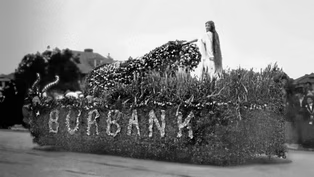
Our first float in 1914, called "Dragon Cornucopia," that's exactly what they did.
People had their gardens with their roses.
And also Burbank was agricultural.
So, they picked the watermelons and the melons and the-- and the pumpkins and stuff like that.
And that was the cornucopia.
So, they themed the float after what they brought in from the community.
Masters: So, when Burbank started participating in the Rose Parade, we're talking about a different era.
You still had probably wildflowers all around, but those bloomed in the spring.
And by the time winter rolled around, there probably wasn't a lot of color.
Roses, maybe?
Andersen: Roses was one because everybody had their rose gardens back then.
Masters: Yeah.
Andersen: And then the very rich had, of course, a whole bunch of stuff that they could snip.
We used on the first float, because there was a lot of green, there were a lot of tree leaves.
The back of it was, um, grasses that were grown locally, maybe even from the L.A.
River.
All the vegetables on the front of the float, all the fruits that were on the front of the float, you know, they were showing how much we were growing in the valley at the time.
Masters: Of course, the San Fernando Valley was one giant farm or ranch.
Andersen: Right, exactly.
So, they had a lot of stuff they could pull onto the floats.
Masters: So, 100 years ago, the San Fernando Valley was completely different.
Andersen: All agriculture.
Masters: It was all agriculture.
Yeah, either farming or ranching, maybe some scattered settlements.
Andersen: I think they wanted to show them off on their buggies.
You know, at the time-- Masters: The very first.
Andersen: Yeah, they were horse-drawn buggies.
And then they started having these covered cars, when cars started coming in the parades, and then it became floats.
Masters: And some of these people, because they were the sort of aristocratic elite, they were essentially just wintering in Pasadena, and they had their houses-- Andersen: The Wrigley Mansion, being donated to the Tournament of Roses.
That was the, I think, their winter home.
Masters: And that sort of goes back to the Rose Parade's origins.
For some of these people, it was a way to celebrate that, "Hey, we're in this amazing climate," and it's really one of the few places in the country like that all throughout the year, Andersen: I think so, yeah, definitely.
♪ Masters: Soon after the Rose Parade began flaunting the region's winter blooms, the All Year Club of Southern California perfected the pitch.
Founded by the Los Angeles Area Chamber of Commerce, the club invited tourists back east to experience California's endless season of bloom.
Newsreel announcer: Palatial estates are common here, since space is available to enjoy extensive grounds, for Los Angeles is largely a city of homes occupied by individual families, for there is not the congestion that's common to many other cities.
Homeowners take pride in keeping their gardens beautiful.
Blooming trees from other lands add their splendor to the landscape, like the jacaranda tree, which bursts forth with clusters of blossoms formed of many pastel- tinted bells.
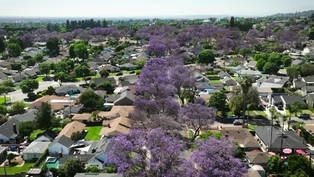
♪ Masters: Bragging about California's color is nothing new, and today we see it in the thousands of social media posts every spring, showcasing one of our most controversial trees--the jacaranda.
Brought here from South America and championed by Kate Sessions herself, the jacaranda adds undeniable beauty to our streets, but it's not without its detractors.
So, this is a real treat and a "Lost LA" first.
We have a bona fide bare knuckles debate about jacaranda trees.
Man: Jacarandas.
Masters: Jacarandas...L.A.
's most controversial tree.
I think we can probably all agree on that.
Woman: Definitely fair to say.
Masters: To hear both sides, I drove to an Insta-perfect street in Whittier, lined with blooming jacarandas, and met up with "L.A.
Times" journalist Gustavo Arellano and Julia Wick, who have very different takes on the tree.
Maybe somebody here would like to make an opening statement.
Arellano: Jacarandas suck.
Masters: Ha ha!
That's the opening statement.
How would you like to respond?
Wick: An elemental, beautiful piece of the Los Angeles landscape.
Also, beyond just how visually stunning they are, what other seasons do we have in L.A.?
We have fire season, pilot season, jacaranda season.
Arellano: We have tamales season.
We have Hollywood Bowl season.
We have Dodgers season.
Jacaranda trees.
Look at it.
Purple?
Yeah.
But look at the bark.
It's spindly, it's ugly.
The leaves look like ferns and ferns just suck as well.
Also, you obviously never lived under a jacaranda tree the way my family did.
Wick: I have 2 on my street, but yes, I very much avoid parking my car under it.
Arellano: Well, ours was right in front of our house.
We had to park there.
I had to clean everything up.
The smell of jacarandas-- I don't want to say it disgusts me, but it's absolutely terrible.
And also, more importantly, there's no use to jacarandas.
If you're gonna make an argument, use the cherry blossom argument.
Say jacaranda trees are ephemeral, just like I did.
Masters: They're ephemeral, and the point that you make in your article is that they remind us of the passage of time.
Wick: Yeah, it's the only passage of time we have here.
You blink, and you miss it.
They refuse to kind of be on any kind of clock.
Arellano: Yes, some trees bloom earlier than others.
So you have like a whole month and a half of jacarandas, which I call jacaranda hell.
Masters: I really don't want to take sides here, but... Wick: It does feel like you agree with me.
Arellano: Oh, geez... Masters: So, a big part of your critique against the jacarandas is that they're useless.
Arellano: They're the In-N-Out of trees.
Overrated.
Masters: In-N-Out.
Overrated.
Arellano: The best plants, there's a use for them.
You can make something out of palm fronds for Palm Sunday or get the dates.
Wick: What about beauty for beauty's sake?
Masters: Exactly.
What about arts?
Arellano: Libre arts, or whatever MGM said.
What's beautiful about them, though?
Purple.
Purple is a very beautiful color.
But get violets, get roses.
Roses are far more beautiful.
Bougainvillea.
We had a bougainvillea vine growing up right next to the jacaranda.
Lightning struck the jacaranda tree.
The bougainvillea still lives.
I write a lot of columns for the "Los Angeles Times," and I get a lot of hate and a lot of love.
This is one of the few columns, everyone hated me.
Everyone.
So few people actually agreed with me.
Wick: Well, I will say they've been polarizing pretty much forever.
One thing that was fun, I wrote the story about them years ago, where I went back through the archives and read basically every time the word jacaranda had ever come up in a Southern California paper.
And there was a great column from like the early 1960s about how people love or hate them.
And the main thing was because it can ruin your wall-to-wall carpeting when you track them in.
Masters: So you two really are here, standing here representing very old and competing traditions.
Wick: Yes.
Masters: OK.
Arellano: It's one of those questions that are quintessentially Southern California.
Wick: And I think there's something so kind of quintessentially L.A.
about a tree that is this beautiful but also this ephemeral, that it's such a short period of time where you actually get the beautiful thing-- Arellano: And so destructive, too.
Wick: And so destructive, too.
Exactly.
What could be more L.A.?
Masters: Southern California's colors are as bold and complex as the place itself.
The jacaranda, as Julia and Gustavo noted, is both beautiful and frustrating, a mix of charm and chaos that mirrors L.A.
's personality.
Our landscape is a mosaic of contrasts, from cultivated gardens to untamed wildflowers, telling a story of constant transformation.
Maybe by embracing these contradictions, we can fully appreciate the unique tapestry of colors and history that make this place feel like home.
♪ This program was made possible in part by a grant from Anne Ray Foundation, a Margaret A. Cargill Philanthropy.
Video has Closed Captions
Clip: S8 Ep4 | 3m 50s | LA Times’ Gustavo Arellano and Julia Wick debate the controversial Jacaranda tree. (3m 50s)
Rose Parade Floats and the History and Craft Behind Them
Video has Closed Captions
Clip: S8 Ep4 | 3m 38s | Erik C. Andersen gives a behind the scenes look at Burbank’s 2026 Rose Parade float. (3m 38s)
Providing Support for PBS.org
Learn Moreabout PBS online sponsorship














Support for PBS provided by:
Lost LA is a local public television program presented by PBS SoCal