
Appraisal: Washington's Inaugural Ball Sash, ca. 1789
Clip: Season 30 Episode 22 | 3m 33sVideo has Closed Captions
Appraisal: Washington's Inaugural Ball Sash, ca. 1789
See Leigh Keno appraise George Washington's Inaugural Ball sash, ca. 1789, in 250 Years of Americana.
Problems playing video? | Closed Captioning Feedback
Problems playing video? | Closed Captioning Feedback
Funding for ANTIQUES ROADSHOW is provided by American Cruise Lines and Ancestry. Additional funding is provided by public television viewers.
Support provided by:


Appraisal: Washington's Inaugural Ball Sash, ca. 1789
Clip: Season 30 Episode 22 | 3m 33sVideo has Closed Captions
See Leigh Keno appraise George Washington's Inaugural Ball sash, ca. 1789, in 250 Years of Americana.
Problems playing video? | Closed Captioning Feedback
Where to Watch Antiques Roadshow
Antiques Roadshow is available to stream on pbs.org and the PBS app.
Buy Now

ANTIQUES ROADSHOW's 2026 Production Tour
Enter now for a chance to win a pair of free tickets to one of the three stops on ANTIQUES ROADSHOW's 2026 Tour. Sweepstakes entry deadline is April 6.Providing Support for PBS.org
Learn Moreabout PBS online sponsorshipGUEST: My mother said this was a scarf worn at George Washington's inauguration.
He did not wear it.
The men got these, and the women got the earrings.
APPRAISER: You have some distinguished ancestry, I should put it, right?
GUEST: I do.
APPRAISER: Entirely possible that you would have, uh, some family member that went to that ball, right?
GUEST: Yes.
APPRAISER: But you don't know whi-- exactly which one, right?
GUES: No.
APPRAISER: Okay, we are looking at this now framed and-and folded, a silk banner that probably was seven feet long if you extend it.
And it's all folded under itself right here, it's really long.
GUEST: I did not realize that.
APPRAISER: When this showed up, I was so excited, because, first of all, I love American folk art.
GUEST: Uh-huh.
APPRAISER: I also love American history.
GUEST: Right.
APPRAISER: This piece combines a great folk design... GUEST: Right.
APPRAISER: ...with great history.
So, as you know, President Washington was inaugurated on April 30, 1789.
A week later, they held a big ball down near Wall Street in New York, for the president-- we have this American eagle, painted eagle on the silk.
And it's a classic stance with the laurel branch in one claw symbolizing the peace, and the other claw, the arrows symbolizing strength.
And the eagle's banner here says "E Pluribus" written out in gold.
There are 13 stars above that in yellow with blue outline.
And up here, it looks like an abstract design.
Somebody else actually pointed out, I can't take credit, this is "G," and this is a "W."
GUEST: Oh, my heart.
APPRAISER: For George Washington.
GUEST: That's fabulous.
APPRAISER: Isn't that great?
You never, you never... GUEST: No, it's better than fabulous.
APPRAISER: And it's better than fabulous because the "G."
If you look sideways.
GUEST: I see the "G."
APPRAISER: And then the-the "W" for George Washington.
They're probably silver little spangles with glass beads.
GUEST: Right.
APPRAISER: Each one is carefully sewn over the star... GUEST: Oh APPRAISER: ...for "G.W."
and the 13.
GUEST: That's... that is so exciting.
APPRAISER: Isn't that neat?
And above it, GUEST: Oh, yeah.
APPRAISER: the French, like, like a fleur-de-lis.
GUEST: A fleur-de-lis!
APPRAISER: Now, a week after the major ball... GUEST: Yeah.
APPRAISER: ...Count de Moustier had another ball, the French count... GUEST: De Moustier!
APPRAISER: ...for Washington-- De Moustier!
Now, we don't know, we certainly can't prove it because these relics are so rare.
And to my knowledge, no other of these banners exist.
But it's very possible that a banner like this would have been at that ball a week later.
And I've checked with several experts here, The silk, the fine silk is of the period.
The spangles.
It's all right.
I've got good news and bad news-- which one?
Which one do you want first?
GUEST (chuckling): I, I think I'll take the good news today.
APPRAISER: You want the good news first?
Okay, I think that's a good way to do it.
The value, on a, on a bad day, would be $3,000 to $6,000, and this is the kind of object that, in the right situation... GUEST: Right.
APPRAISER: ...could bring $10,000, $15,000 at an auction setting.
Now, I'm going to give you the bad news.
These are costume jewelry from after 1900.
GUEST: So they aren't...?
APPRAISER: They, they didn't... GUEST: Mother lied to me.
APPRAISER: They didn't make clips like this... GUEST: Okay.
APPRAISER: ...uh, th-this ear clip until after 1900.
So, you know, and al-- GUEST: Okay, oh, that's interesting.
APPRAISER: Yeah, and also, the metal's not gold, and it's not even enamel, so they're nice decorative ear clips.
But, so these weren't made for... GUEST: So I can wear them without feeling like I'm......all right.
APPRAISER: You can wear them without worrying about losing them as much, you know, but this, you want to... GUEST: Yeah.
Yeah, yeah, yeah.
Yeah.
APPRAISER: ...you want to really preserve as you've always done.
GUEST: I'm excited, really.
I just love it.
Preview: 250 Years of Americana
Video has Closed Captions
Preview: S30 Ep22 | 30s | Preview: 250 Years of Americana (30s)
Appraisal: Paul Revere Jr. Silver Pitcher with Diary, ca. 1775
Video has Closed Captions
Clip: S30 Ep22 | 2m 46s | Appraisal: Paul Revere Jr. Silver Pitcher with Diary, ca. 1775 (2m 46s)
Appraisal: F. Douglass Letter & Free Will Baptist Archive
Video has Closed Captions
Clip: S30 Ep22 | 4m 49s | Appraisal: F. Douglass Letter & Free Will Baptist Church Archive (4m 49s)
Appraisal: Flag Quilt, ca. 1880
Video has Closed Captions
Clip: S30 Ep22 | 2m 43s | Appraisal: Flag Quilt, ca. 1880 (2m 43s)
Appraisal: Tiffany Studios Turtle Back Glass Shade
Video has Closed Captions
Clip: S30 Ep22 | 2m 22s | Appraisal: Tiffany Studios Turtle Back Glass Shade, ca. 1915 (2m 22s)
Appraisal: WWII Propaganda Posters
Video has Closed Captions
Clip: S30 Ep22 | 3m 50s | Appraisal: WWII Propaganda Posters (3m 50s)
Appraisal: 1775 Abilmeleck Uncus-carved Powder Horn
Video has Closed Captions
Clip: S30 Ep22 | 3m 10s | Appraisal: 1775 Abilmeleck Uncus-carved Powder Horn (3m 10s)
Appraisal: 1954 Fender Stratocaster
Video has Closed Captions
Clip: S30 Ep22 | 51s | Appraisal: 1954 Fender Stratocaster (51s)
Appraisal: George Nakashima Grass Seat Chair, ca. 1965
Video has Closed Captions
Clip: S30 Ep22 | 4m 2s | Appraisal: George Nakashima Grass Seat Chair, ca. 1965 (4m 2s)
Appraisal: 1968 Warhol Campbell's Soup Can Screenprint
Video has Closed Captions
Clip: S30 Ep22 | 3m 18s | Appraisal: 1968 Warhol Campbell's Soup Can Screenprint (3m 18s)
Appraisal: Colt Single-action Army Revolver, ca. 1880
Video has Closed Captions
Clip: S30 Ep22 | 21s | Appraisal: Colt Single-action Army Revolver, ca. 1880 (21s)
Appraisal: Women's Carved Surfboard, ca. 1925
Video has Closed Captions
Clip: S30 Ep22 | 1m 4s | Appraisal: Women's Carved Surfboard, ca. 1925 (1m 4s)
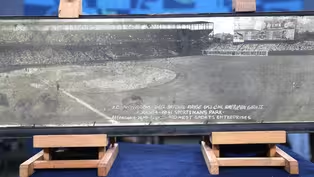
Appraisal: 1941 Sportsman's Park Panorama
Video has Closed Captions
Clip: S30 Ep22 | 3m 11s | Appraisal: 1941 Sportsman's Park Panorama (3m 11s)
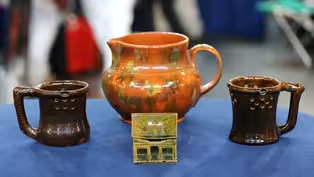
Appraisal: George Ohr Pottery, ca. 1900
Video has Closed Captions
Clip: S30 Ep22 | 4m 37s | Appraisal: George Ohr Pottery, ca. 1900, in New Orleans Hour 2. (4m 37s)
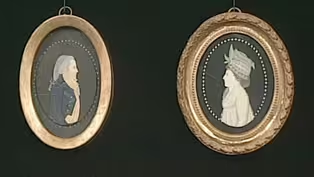
Appraisal: 1796 & 1799 Mary Way Dressed Miniatures
Video has Closed Captions
Clip: S30 Ep22 | 3m 11s | Appraisal: 1796 & 1799 Mary Way Dressed Miniatures (3m 11s)
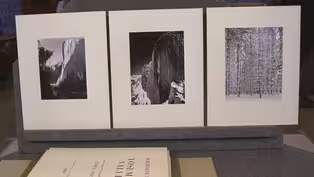
Appraisal: 1960 Ansel Adams Portfolio III
Video has Closed Captions
Clip: S30 Ep22 | 2m 16s | Appraisal: 1960 Ansel Adams Portfolio III (2m 16s)
Appraisal: Gustav Stickley Armchair, ca. 1905
Video has Closed Captions
Clip: S30 Ep22 | 34s | Appraisal: Gustav Stickley Armchair, ca. 1905 (34s)
Appraisal: 1884 Edison Light Bulb & Plaque
Video has Closed Captions
Clip: S30 Ep22 | 2m 36s | Appraisal: 1884 Edison Light Bulb & Plaque (2m 36s)
Appraisal: Claymore Beaded Bag, ca. 1895
Video has Closed Captions
Clip: S30 Ep22 | 1m 55s | Appraisal: Claymore Beaded Bag, ca. 1895 (1m 55s)
Providing Support for PBS.org
Learn Moreabout PBS online sponsorship New Episode
- Home and How To

Hit the road in a classic car for a tour through Great Britain with two antiques experts.
 New Episode
 New Episode










Support for PBS provided by:
Funding for ANTIQUES ROADSHOW is provided by American Cruise Lines and Ancestry. Additional funding is provided by public television viewers.